






Ask 10 people on your team to use generative AI to come up with a new product idea and each might bring back a proposal worth considering. Now put all ten proposals on the table. How many genuinely different ideas do you have?
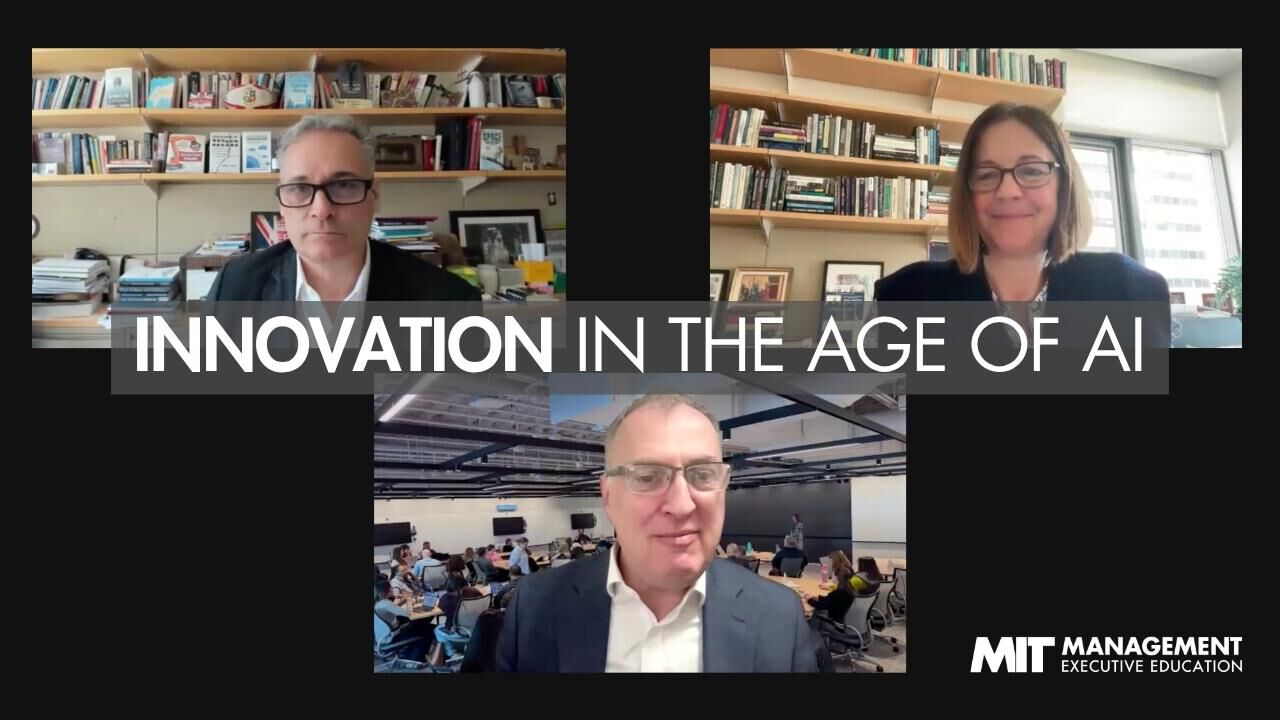
In a recent MIT Industrial Liaison Program webinar, Jackson G. Lu, General Motors Professor of Management at MIT Sloan, explored a paradox of AI-assisted creativity. The same tools that help individuals think beyond their own expertise can steer a group toward remarkably similar ideas. For leaders deciding where to invest, that similarity can be easy to miss. As Lu put it, “10 polished versions of the same idea leave a company with fewer strategic options than they would appear to.”
Lu and fellow MIT Sloan faculty member Phil Budden looked at the challenge from two vantage points. Lu examined what happens when people turn to AI for inspiration. Budden picked up the story where the brainstorming ends and someone must decide which ideas deserve a chance to prove themselves.
“Ten polished versions of the same idea leave a company with fewer strategic options than they would appear to.”
Give people the first word
Consider an experiment Lu discussed during the webinar. Researchers asked participants to write a short story. Some could request an idea from generative AI to get started. Others worked on their own. Readers rated the AI-assisted stories as more creative and better written, with the greatest gains among writers who scored lower on a baseline creativity measure. Yet when the researchers compared the stories with one another, the AI-assisted entries were more alike. A reader judging any one story would have missed what happened across the collection. (You can read more about the experiment here.)
A product team can run into much the same problem. Ask a model for five promising product ideas, Lu suggested, and you’ve given it little reason to offer anything a competitor couldn’t get from the same prompt. Your team, however, may know something the model doesn’t. A customer may have shown an employee a workaround no one at headquarters has seen. A failed experiment may have ruled out the solution that looks most promising on paper. Either observation gives the team a more distinctive place to begin.
Lu recommended letting people develop an initial idea of their own before consulting AI. Once they have a point of view, they can ask the model what they’ve overlooked or how else they might solve the problem. That small change in sequence gives employees a chance to compare two lines of reasoning. It also helps them practice what Lu calls metacognition: paying attention to their own thinking and recognizing when a different approach might serve them better.
Decide what earns a second experiment
During the Q&A, the moderator described a chemical company whose chemists had gained access to an AI coding tool. Employees who once would have asked a developer to build software for them had created hundreds of applications themselves. Now the company faced a decision few people would have anticipated when software was harder to build. Which of those applications was it prepared to support?
For Budden, that’s precisely where the work of managing innovation comes in. He described innovation as “the process of taking ideas from inception to impact.” In his work with large organizations, that process has four stages: exploring, validating, accelerating, and scaling. At each stage, teams run a larger experiment and use what they learn to decide whether the idea merits further investment.
For the chemical company, that might mean asking a chemist to show a colleague how an application solves a recurring problem. Can the colleague reproduce the benefit? Is it valuable enough to justify maintaining the tool? Those questions give a promising application a way forward and give leaders a reason to stop funding one that has outlived its usefulness.
Budden also sees a role for AI in those decisions. When a committee is enthusiastic about a proposal, he suggested using an internal AI tool as “a critical internal friend.” A team could provide it with the proposal and the evidence gathered so far, then ask which assumption is least supported and what experiment would put it to the test.
That leaves leaders with a practical question for their next innovation review. Before asking everyone to vote for the best proposal, try asking: Which of these ideas would teach us something the others wouldn’t? The answer can reveal both where a team is thinking independently and where its next experiment is worth the investment.
Learn from these speakers firsthand in their related Executive Education courses. Jackson Lu teaches in the AI Adoption: Driving Business Value and Impact and Leading the AI-Driven Organization. Phil Budden teaches in Innovation in the Age of AI.