



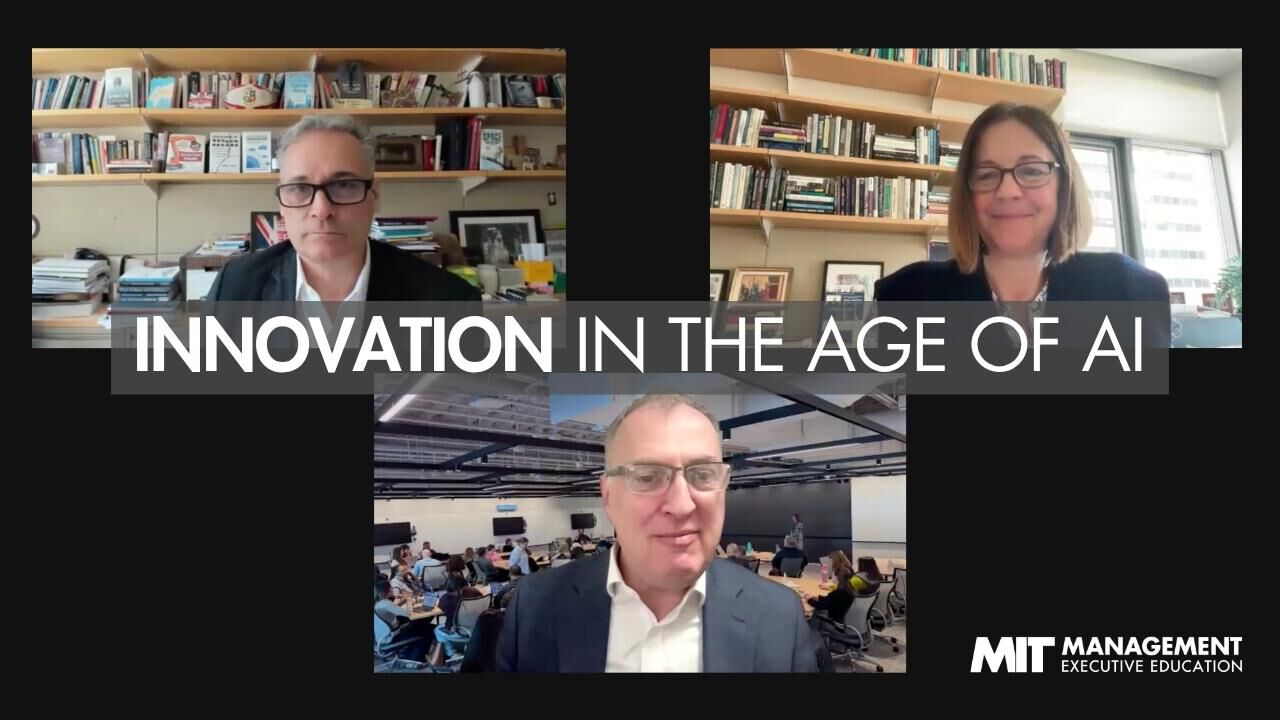


In a recent MIT Sloan Executive Education LinkedIn Live conversation, “Risk and Resilience at the Speed of AI,” my MIT Sloan colleagues John Carrier, Senior Lecturer on System Dynamics, and Retsef Levi, Professor of Operations Management, explored how organizations can build resilience as AI introduces new capabilities as well as new uncertainties. Drawing on their experience across industries, they examined how leaders can recognize operational risks before they become serious problems, and why AI is raising the stakes by increasing the speed and scale at which those problems can develop.
Faster processes can bring faster failures
AI promises enormous gains in efficiency, but as Retsef pointed out, accelerating a poorly designed process simply produces bad outcomes faster. Leaders who automate work without examining how it gets done risk making existing problems more costly and harder to correct. The decision to introduce AI should therefore begin with an assessment of the work itself.
AI can help with that assessment. By monitoring operations and detecting patterns or anomalies, it can reveal weaknesses that might otherwise go unnoticed. Retsef sees an opportunity to use these insights to improve how work is designed. This means critically evaluating which processes are ready for automation and which need redesign first.
John made a related point from his experience with industrial operations. Recurring inefficiencies often reveal where a process needs attention. Addressing them improves productivity and creates a stronger foundation for adopting new technology.
The warning signs are flashing
A second challenge is knowing how to read the numbers. Retsef pointed out that an organization reporting more problems may actually be managing risk better than one reporting fewer. Near misses and operational irregularities reveal weaknesses that conventional performance measures may overlook. Leaders who rely on favorable results alone may have an incomplete picture of their organization's exposure to risk.
John described how this can play out when operations approach their limits. Schedules begin to slip, employees constantly switch between tasks, and managers intervene more frequently to keep work moving. Those interventions can compound the disruption. What looks like a problem with individual performance may actually reflect a process that can no longer handle the demands placed on it. In other words, before you rush to find fault with your people, take another look at the system they are working in.
Retsef offered another caution: Sometimes the worst outcome is luck! When a process fails without serious consequences, the favorable result can create false confidence. Leaders need to examine how outcomes were achieved, including what nearly went wrong. Otherwise, they risk making decisions based on apparent success while underlying vulnerabilities continue to grow.
AI introduces a new risk to human expertise
AI also creates a longer-term challenge that may be harder to measure: the erosion of professional expertise. Retsef pointed out that experienced professionals can draw on their knowledge to question AI recommendations and recognize mistakes, but employees who have never performed the underlying work may lack that judgment. As automation takes over routine tasks, it also removes opportunities for people to learn from mistakes. Organizations could eventually become dependent on systems that fewer people know how to troubleshoot when something goes wrong. Being cognizant of a tradeoff between immediate efficiency and future capability, leaders must find ways for employees to gain practical experience, exercise judgment, and develop expertise even as AI takes over more of the work.
Resilience begins with leadership
These challenges ultimately come down to leadership decisions. Retsef argued that organizational behavior is more consequential than the formal structure of risk management. Centralized and decentralized approaches can both work, he noted, but their effectiveness depends on the incentives leaders establish and the actions they reward.
Consider what happens when an employee identifies a problem that could delay a project or affect quarterly results. Does the manager welcome the information or pressure the team to stay on schedule? And if someone takes an excessive risk that happens to generate a profit, is the decision questioned or rewarded? These responses influence what employees report, which risks they take, and how problems develop across the organization.
John emphasized that ethical considerations and safeguards need to be built into operational processes from the outset. As AI makes decisions and takes action at increasing speed and scale, leaders must establish where human review is needed and how exceptions will be handled. Leaving these questions until after deployment can make failures harder to contain and accountability more difficult to establish.
AI gives organizations powerful new ways to accelerate their work. But speed and efficiency might be poor measures of progress if they come with greater exposure to failures and fewer people equipped to address them. Greater machine intelligence should not diminish human accountability. Leaders should remain responsible for the decisions their organizations make, even when those decisions are carried out by AI.
Retsef and John explore these ideas further in MIT Sloan Executive Education's two-day program, “Building Organizational Resilience,” where participants examine risk management frameworks, learn from examples across industries, and develop practical approaches to strengthening resilience in their own organizations.