



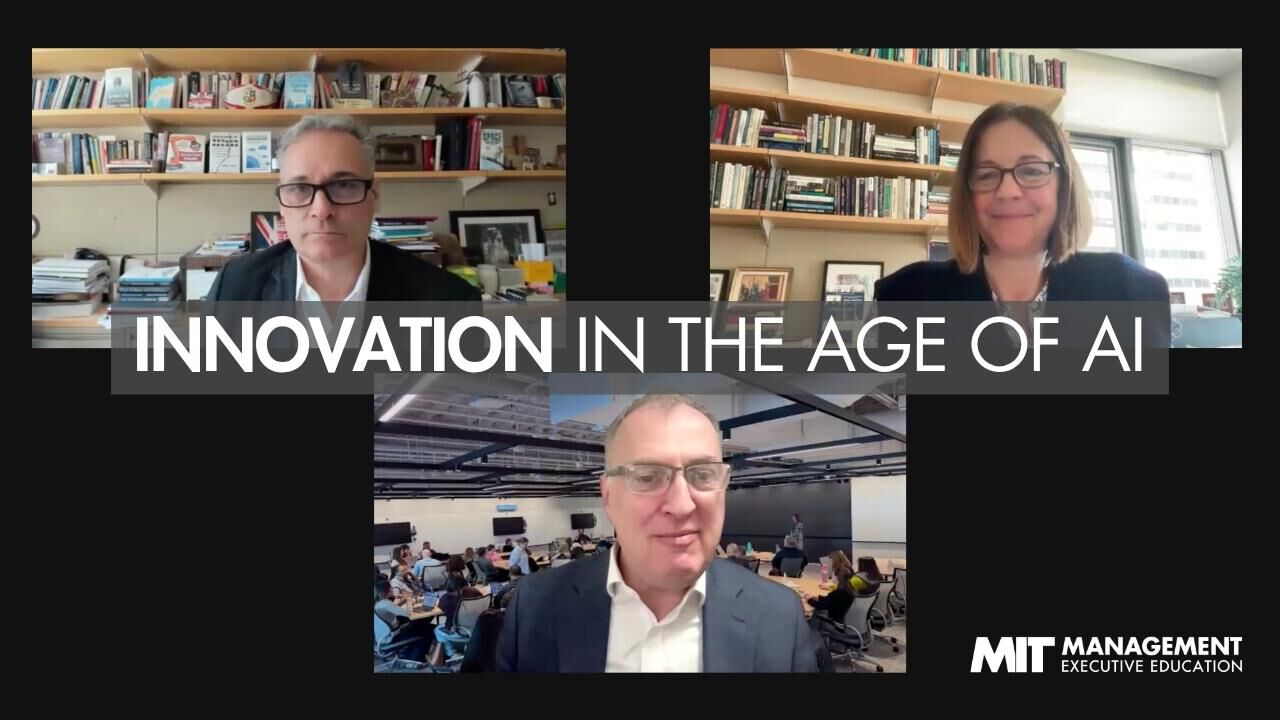




That was a central theme of a recent MIT Sloan Executive Education webinar featuring my colleagues Fiona Murray, Professor of Entrepreneurship, and Phil Budden, Senior Lecturer in Technological Innovation, Entrepreneurship, and Strategic Management. Drawing on their book, Accelerating Innovation, they explored how organizations can turn technological advances into meaningful results. Their discussion raised an important question for leaders: As AI expands what organizations can attempt, how can they become better at deciding what to pursue and bringing those ideas to fruition?
Starting with the problem
A very MIT definition of innovation is that it is the process of taking ideas from inception to impact. AI makes it easy to create solutions, so deciding which opportunities are worth pursuing becomes essential.
“It’s not enough just to have ideas; you need to bring them through to impact.”
Fiona explained that an idea begins with a match between a problem and a potential solution. She used the example of a pharmaceutical company seeking to improve drug discovery. It might introduce AI into established laboratory processes or pursue an entirely new approach to identifying drug targets. Both are forms of innovation, but they involve different levels of uncertainty.
Fiona then encouraged leaders to assess opportunities along two dimensions: how well they understand the problem and how familiar they are with the proposed solution. This can help organizations decide where to invest, what requires experimentation, and how to manage risk.
Small improvements can deliver significant results
Phil distinguished between small-i and big-I innovation. Big-I involves potentially transformative advances, often associated with startups working at the technological frontier. Small-i focuses on incremental improvements to existing products and processes. For established organizations, incremental innovation can deliver substantial value.
At the same time, businesses need to remain alert to advances that could fundamentally change their industries. Fiona described how pharmaceutical companies work with startups developing advanced technologies, combining their innovations with established capabilities in production and commercialization. Leaders should balance improvements to today's business with investments in opportunities that could shape its future.
Innovation is a process
Fiona and Phil described how successful startups typically manage uncertainty through experiments, testing assumptions, and using evidence to determine whether to proceed. These organizations manage innovation in four stages: exploring, validating, accelerating, and scaling. They also focus on pull-through, the ability to move promising ideas through these stages to impact. Established companies can sometimes struggle with this progression. Initiatives can stall because they lack effective validation or encounter organizational barriers. Others continue receiving resources despite weak evidence of their potential; for example, due to internal politics winning out over market discipline.
“Decision-making is where we often see organizations going wrong. They just don't make the hard decisions.”
Fiona suggested using AI to evaluate ideas and learn from previous projects, while Phil described its potential to act as a devil's advocate during go/no-go decisions, challenging assumptions, and identifying weaknesses. These capabilities could help organizations direct resources toward more promising opportunities.
Looking beyond your organization
Fiona emphasized the role of innovation ecosystems in developing new technologies and encouraged leaders to consider where external capabilities could complement their own. Universities and startups are often at the forefront of emerging AI applications, providing established businesses with opportunities to access expertise and innovations developed elsewhere. The pace of AI development makes these relationships increasingly valuable.
There are competitive implications, too. New entrants can use emerging technologies to challenge established business models, while incumbents bring market knowledge and resources that can help innovations scale. How organizations combine these advantages will influence their competitive position.
Creating the conditions for AI innovation
Phil raised an important point about how leaders introduce AI. Employees may be reluctant to embrace a technology they believe threatens their jobs. Using AI to reduce burdensome tasks and improve how people work can create better conditions for experimentation and innovation.
Fiona also encouraged leaders to learn from colleagues who may already have considerable experience with emerging AI tools. Giving employees opportunities to share that knowledge can strengthen organizational capabilities.
These observations bring us back to the central challenge. AI is creating new possibilities at a remarkable pace, but organizations still need to identify important problems, make informed investment decisions, and carry ideas through to implementation. As AI changes what organizations can accomplish, improving the innovation process itself may be one of the most valuable investments leaders can make.
Our four-day MIT Sloan Executive Education course, Innovation in the Age of AI, led by Phil Budden, offers practical frameworks for improving the innovation process and turning promising ideas into measurable results. It next runs December 1–4, 2026, on the MIT campus in Cambridge.