




The Client: Canadian Tire
Canadian Tire Corporation is one of Canada's most recognized and trusted companies, a retailer serving customers through a portfolio of brands. With a nationwide network of stores, deep customer relationships, and decades of retail data, the company is focused on creating personalized experiences that strengthen its connection with Canadians.
As artificial intelligence became increasingly central to its long-term strategy, Canadian Tire came to MIT Sloan Executive Education to find an education partner to help its senior leadership team build a shared understanding of AI, align around a common vision, and accelerate enterprise-wide transformation.
Creating alignment around AI transformation
“AI isn’t changing retail, it’s becoming retail,” said Greg Hicks, President and CEO of Canadian Tire Corporation. “For over a century, we’ve built a relationship with Canadians that competitors simply can’t match. To extend that position and our prosperity in a new era of retail requires our people to pick up new tools and practices, combining our legacy customer insights with the transformative power of AI.”
The company was already investing in artificial intelligence across the business; what it needed next was leadership alignment. "We knew we needed to get two things right: data readiness and people readiness,” said Bob Hakeem, Executive Vice President and Chief Human Resources Officer at Canadian Tire. “The people readiness piece was really about leadership mindset, which is why we gravitated toward MIT.”
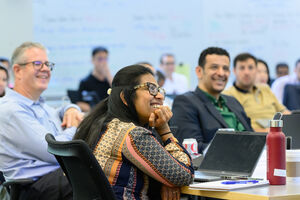
MIT Sloan Executive Education designed a fully customized, five-day learning experience to enable Canadian Tire's senior leadership team to develop a shared understanding of AI and its implications for the business. The immersive program brought together 47 participants—including the company's CEO, senior executives, functional leaders, and various Canadian Tire Dealers who own stores—for a week of collaborative learning on MIT's campus.
“We felt that the combination of the engineering and business schools was unique to MIT. We needed both the science behind AI and the leadership capabilities to lead through it.”
Connecting AI to business strategy
“We didn’t want a program to be about technical skills or how to create agents, but more about the thinking and frameworks behind AI – what that means for business in general, but more specifically our own,” said Christopher Gray, Vice President, Talent, Performance & Culture. “A big part of it was having our core leaders hear from the best and brightest in this space, creating a common framework, then applying it to real challenges our business is facing. That was a key component of the program to accelerate our thinking in terms of real-world AI strategy.”
“The value wasn't just learning about AI,” said Anthony Wolf, Vice President, AI Activation and Engineering. “It was getting everyone in the room working from the same understanding and thinking about the opportunities together.”
Rather than delivering a standard AI curriculum, the program was built around Canadian Tire's strategic priorities and its detailed AI ambition—part of a broader transformation strategy. Before participants arrived on campus, MIT Sloan Executive Education faculty and program leaders worked closely with Canadian Tire to understand the company's business model, customer relationships, organizational goals, and leadership challenges. That preparation ensured discussions, exercises, and examples reflected Canadian Tire's context rather than generic AI use cases.
“We spent a great deal of time with Canadian Tire before the program, understanding their strategy, their business, and what success would look like, so the experience reflected their reality,” said Levent Yarar, Senior Director, Executive Programs at MIT Sloan Executive Education. Renée Richardson Gosline, Faculty Director for the program, elaborated further: “We did everything from ethnography to interviewing folks at the firm to going to stores to conducting competitive analysis. The program wasn’t canned; it was very collaborative.”
The program combined discussions of AI strategy with practical frameworks for leading organizational transformation. Sessions explored topics including responsible AI, customer trust, data readiness, experimentation, organizational change, governance, and leadership, while giving participants opportunities to apply those ideas directly to Canadian Tire's own business challenges.
From shared experience to shared purpose
The experience extended beyond the classroom. Participants engaged with faculty, explored the MIT innovation ecosystem, and spent significant time working together as a leadership team, connecting the week's learning directly to Canadian Tire's strategy and future direction.
“Coming in, we had varying levels of understanding of AI in our organization,” said Ilana Santone, Senior Vice President, Business and AI Transformation. “The program certainly raised our floor to a much more common level. It gave us a shared language, a shared ambition, and an applicability of concepts into practices.”
The impact of the program was evident almost immediately. Once back in the office, executives applied a questioning framework they had learned at MIT Sloan Executive Education to tackle a longstanding business challenge. “We just got down to work,” said Kevin Groh, Senior Vice President, Corporate Affairs and Communications. “It was a very practical application and an approach we would not have had at our fingertips without MIT.”
Just as important, the immersive experience strengthened relationships across Canadian Tire's senior leadership team. Spending five days learning together created opportunities for conversations that rarely happen in the course of day-to-day business.
“What we took away, almost as much as the content, was being in a room with our colleagues for several days,” said Karen Keyes, Head of Investor Relations. “It helped us cement our relationships, drive an agreed sense of urgency, and focus together on managing the change of AI, not just the pure technology.”
That shared experience translated into stronger collaboration across functions.
“It certainly brought the team closer together,” said Eva Salem, Senior Vice President, Marketing and Brand. “There was a collaboration mindset across the senior leadership team that we haven't had in the past.”
New conversations, new ways of working
For Micheline Davies, Chief Merchant, one of the program's most important takeaways was that AI reinforced, not replaced, the fundamentals of leadership. “The fundamentals around who you are as a leader, who you need to be, and how you need to show up are the same, regardless of AI,” she said. “The two biggest things that stood out for me were the need to shift to a culture of experimentation and to think about AI and agents as members of the team.”
Technology leaders built stronger connections with business partners during the program. “There is no world in which we achieve this AI agenda through one team,” said Keran McGuire, Senior Vice President, AI and Technology Platforms. “It has to be cross-functional. The program really facilitated the opportunity for everyone to start rowing in the same direction.”
Participants also described a noticeable shift in the quality of conversations after returning to work. “The conversations I'm having since MIT are simply better, because people are further along in their understanding,” said Graham Jeffery, Senior Vice President, Customer Strategy, Analytics and Merchandise Planning. “There is a better base of knowledge across the organization that we are tapping into. It will be a great accelerator for progress.”
Beyond building AI literacy, the program helped leaders think differently about leading change. Rather than focusing primarily on technology, many participants came away with new frameworks for experimentation, organizational learning, and responsible adoption. “We took away a better appreciation of the guardrails, how to think about responsible use of AI, how to think about the challenges it might pose for our teams,” Keyes said. “As technology continues to change, this helps us think about the frameworks we need to manage that change.”
For Canadian Tire, the result was more than increased knowledge of AI. It was greater organizational alignment, stronger cross-functional relationships, and a leadership team better equipped to guide the AI transformation together.
Read more about Canadian Tire’s approach to adapting AI across the organization.