




Over the years, we have developed a portfolio of long-standing collaborations with other leading business schools that are built on shared goals, mutual learning, and trust. In fact, my role in the organization includes exploring, developing, and sustaining these types of relationships.
These programs take many forms. Some bring senior executives to the MIT campus to explore innovation, leadership, and emerging technologies. Others combine faculty expertise from multiple institutions to create unique learning experiences for global audiences. In every case, the most successful collaborations are characterized by close relationships, a commitment to co-design, and a willingness to learn from one another.
Expanding innovation and transformation for Mexico’s business leaders with IPADE
MIT Sloan Executive Education's collaboration with IPADE, the business school of Universidad Panamericana and one of Mexico's leading business schools, began with a shared goal: creating an executive education experience that would complement what participants were already learning at home.
For IPADE, that meant finding a partner that understood both its curriculum and its audience. According to Bea Guzmán, who works together with IPADE's Academic Director for Executive Education to design the school's international learning experiences for IPADE's senior management programs, MIT Sloan Executive Education stood out because we were willing to build on the foundation IPADE had already established rather than simply export a preexisting program. Over time, the relationship evolved into a highly customized experience for senior executives, many of them CEOs and business owners from across Mexico.
Aithan Shapira, who serves as faculty director for the program, credits the partnership's success to a commitment to learning from one another. Before assuming his leadership role, Shapira attended IPADE's Jornadas Internacionales in Mexico, a global immersion initiative that gave him firsthand exposure to participants' interests, learning styles, and business challenges. That experience helped shape a program that is continually refined to meet participants' needs.
For the participants, the program is much more than an international study experience. They are exposed to MIT Sloan's hands-on, experiential approach to learning, engage with faculty across disciplines and the MIT innovation ecosystem, and connect with peers from across Mexico. Along the way, they gain new perspectives and build relationships that often continue long after the program ends. The collaboration is a testament to how executive education partnerships can create value when institutions invest in understanding one another and designing experiences together.
Exploring Strategy and Innovation for Businesses in Asia with Mahidol University
For more than a decade, MIT Sloan Executive Education has collaborated with Mahidol University College of Management (CMMU), a graduate business school in Bangkok that develops management and leadership talent across Thailand and the region. Through the annual Strategy and Innovation for Businesses in Asia (SIBA) program, executives from a wide range of industries—including banking, manufacturing, utilities, academia, and retail—come together for a week-long learning experience on the MIT campus in Cambridge, MA.
Participants engage with MIT faculty on topics such as leadership, design thinking, and innovation while working in teams on real business challenges. “The collaboration extends beyond the classroom, with project work continuing in Thailand and creating opportunities for ongoing networking, learning, and impact across the Thai business community,” notes Michael Kavanagh, Director, Executive Programs.
Connecting the world with the Global CEO Program (GCP)
Now in its fourth year, the Global CEO Program (GCP) is a seven-month-long learning journey co-created with the IESE Business School, a globally recognized graduate business school headquartered in Barcelona, Spain. True to its name, the program is highly international in content, delivery, and audience. “The program is designed to reflect its global audience. The three modules are delivered in Cambridge, Singapore, and Barcelona, representing the North American, Asian and European perspectives,” says Laura Ziukaite, Managing Director at MIT Sloan Executive Education.
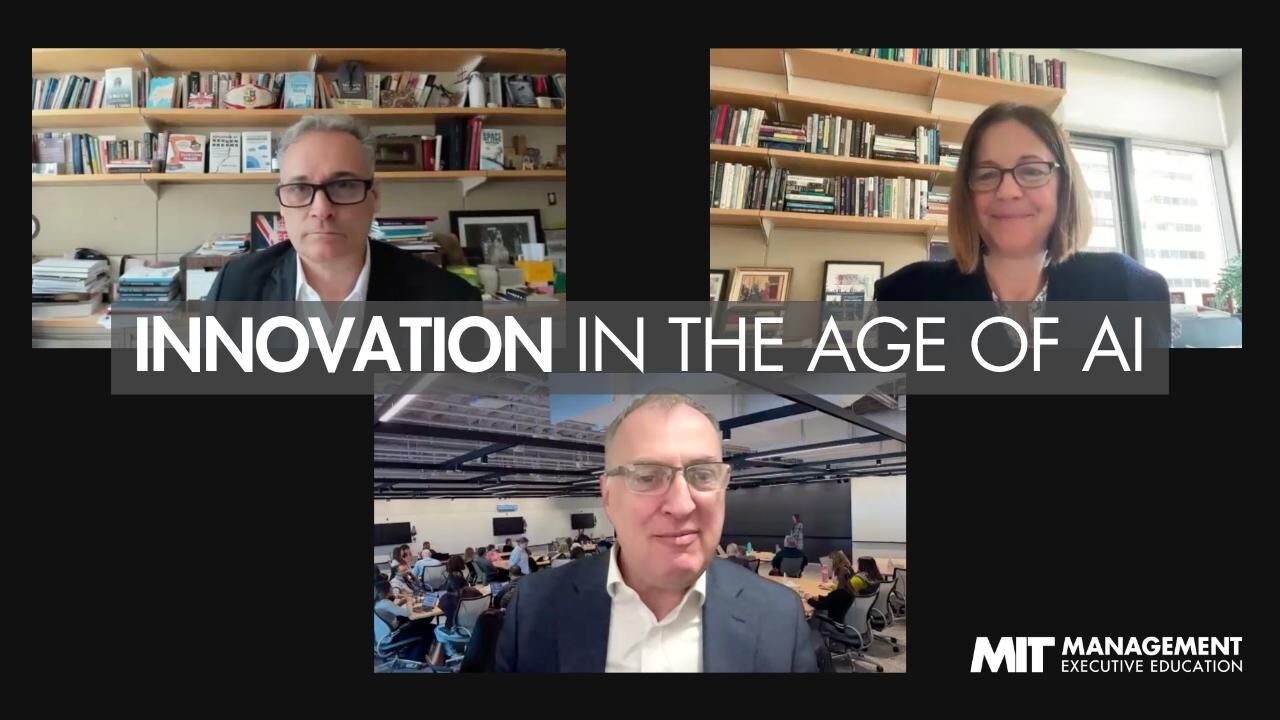
Each module examines business challenges through a distinct regional lens, combining MIT's expertise in innovation, AI, and technology management with IESE's leadership-focused approach. Faculty and program teams from both institutions work closely throughout the year to align content, select participants, and ensure continuity across the experience. “One of the things we need to do to prepare leaders for this uncertain future is to expose them to a range of perspectives,” says Phil Budden, the Global CEO program faculty director at MIT Sloan.
Each year brings together a globally diverse group of CEOs who, through the shared experience of the program, become a tightly connected cohort, leaving with new insights, broadened perspectives, and lifelong friendships and professional relationships that span industries, countries, and continents.
Building bridges with Tsinghua PBC School of Finance Scienvest Program
Our collaboration with Tsinghua PBC School of Finance is rooted in the idea that some of the most valuable learning opportunities come from engaging with leaders whose business environment is different from yours. Through the relationship, MIT Sloan Executive Education contributes a module to a broader executive program for senior entrepreneurs and executives in China, creating an opportunity to exchange perspectives on innovation, technology, and global business.
For MIT Sloan Executive Education, the collaboration opens doors to a leadership audience and market that would be difficult to reach independently. For participants, it offers exposure to management approaches and business practices shaped by a global perspective. The relationship reflects a broader belief that executive education is most powerful when institutions learn from one another while helping leaders navigate increasingly interconnected economies.
Driving Strategic Innovation with IMD
When MIT Sloan Executive Education and IMD, the independent business school in Lausanne, Switzerland, known for executive education and leadership development, launched a portfolio of joint executive education programs in the early 2000s, there was no guarantee the collaboration would last. In fact, of the six programs created between the two institutions at the time, only one remains today: Driving Strategic Innovation (DSI).
Its longevity can be traced to an unlikely beginning. Charles Fine of MIT Sloan and Bill Fischer of IMD had never met when they were asked to co-lead the program. What Fine jokingly describes as a “shotgun wedding” quickly evolved into a close professional partnership and lasting friendship between the two faculty directors. Rather than combining existing courses, they set out to create something neither institution could deliver alone, blending MIT Sloan's strengths in innovation and technology with IMD's expertise in executive leadership and global business.
Over the past two decades, that spirit of co-creation has shaped every aspect of our longest-lasting program. Fine, Fischer, and other long-term faculty contributors continually redesign the curriculum to reflect emerging challenges, from shifts in global markets to the rise of artificial intelligence, remarking that they have “never taught the same course twice.”
Last year, we added another exciting collaboration called “Future-Ready Enterprise Academy,” which is offered at MIT Sloan Executive Education and IMD in Singapore and combines the expertise of our two institutions to help senior executives develop the strategies and leadership capabilities needed to navigate uncertainty and drive transformation.
Staying true to the MIT Sloan mission
At MIT Sloan Executive Education, we believe these relationships are more than a way to expand reach. They create opportunities to exchange ideas, access new learner audiences, and combine expertise in ways that benefit participants around the world. No matter which way markets shift or what new technologies emerge, the need for principled, innovative leaders who improve the world is always relevant.
Fostering a partnership culture
The term “partnership” carries very specific legal connotations in business, but in this context, we use it more broadly to describe the spirit of our organization. At MIT Sloan Executive Education, we approach all our engagements with a partnership mindset. In addition to co-delivering a program with another university, we often work with other knowledge providers, such as professional associations and consulting firms, who value an opportunity to offer MIT Sloan learning as a benefit to their members or customers.
“These relationships are a model for what makes executive education partnerships successful,” says Peter Hirst, Senior Associate Dean, MIT Sloan Executive Education. “As faculty directors Budden, Fine, and Shapira pointed out, the synergy, mutual respect, and collaborative spirit of their colleagues in the partner institutions make the experiences that much more valuable for the participants.”
We bring the same attitude to our custom executive education programs, as well, working closely with client organizations to design and deliver a learning experience that has a tangible impact on their business. If this is something that may be relevant to your organization, we would welcome a conversation!