



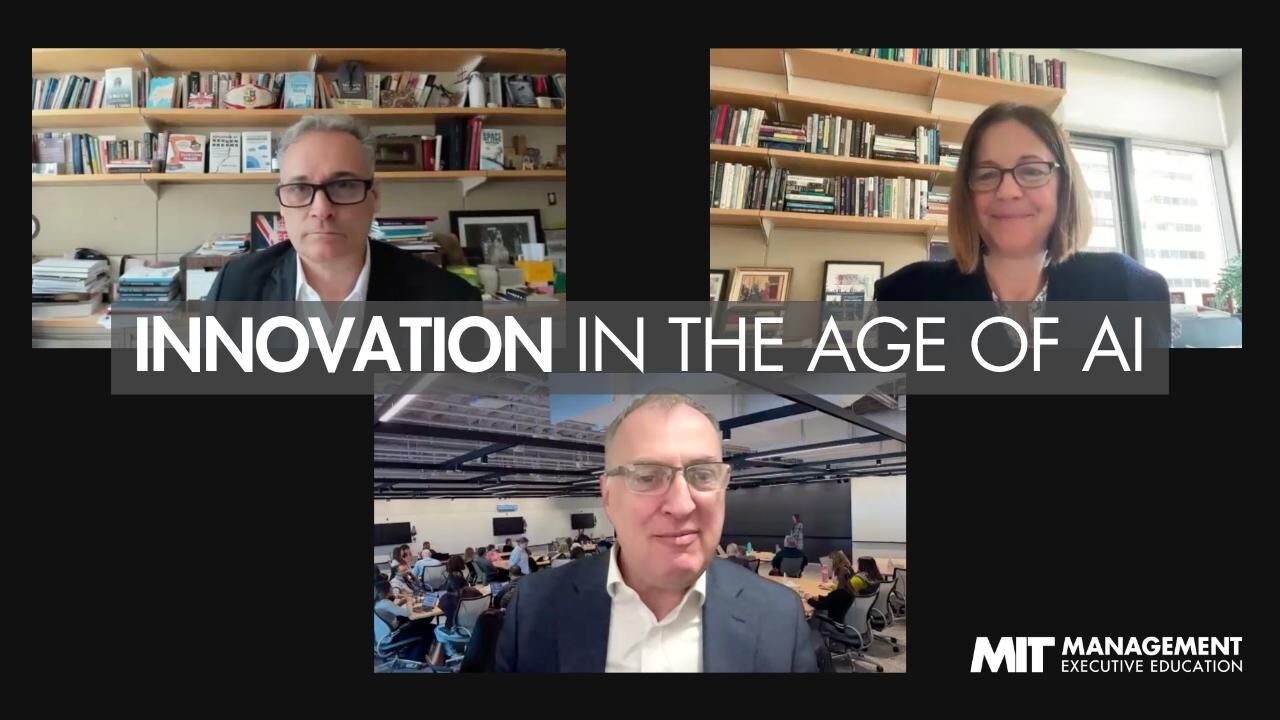




In a recent MIT Sloan Executive Education webinar, two of my brilliant colleagues, Paul Cheek and Paul McDonagh-Smith, explored what agentic AI means for leaders, organizations, and the future of work.
Beyond the demo
For the past few years, much of the business conversation around AI has focused on what the technology can do. Leaders have seen impressive demonstrations, tested generative AI tools, launched pilots, and encouraged teams to experiment. That work has certainly been valuable, as it has built familiarity and helped organizations begin to imagine new possibilities.
But as Cheek and McDonagh-Smith discussed, agentic AI raises a more consequential question: What happens when AI systems do not merely respond to prompts but begin to pursue goals, use tools, make decisions, and act on behalf of the organization? That is the frontier now coming into view. And it requires executives to shift their attention from isolated experimentation to comprehensive enterprise design.
Autonomy is a dial
McDonagh-Smith shared an apt metaphor: When leaders talk about agency in AI, they should not think of autonomy as a switch to flip, but more as a dial to adjust according to the organization’s evolving needs. Organizations have long been designed around people, roles, reporting lines, workflows, and decision rights. Increasingly, however, work will be carried out by networks of humans and AI agents operating together. The organization of the future may be less a hierarchy of people and more a dynamic system of human and machine capabilities.
The human becomes more important
Cheek was careful to distinguish between using AI to supercharge human capability vs. replacing people. The real question is whether leaders can redesign work in ways that amplify human judgment, creativity, responsibility, and purpose. This is also why the move from sandbox to production is so difficult. As Cheek noted, many organizations have no shortage of pilots that remain experiments because the surrounding organization is not ready for them.
AI literacy as a leadership capability
Both presenters returned repeatedly to the importance of AI literacy. Cheek argued that organizations need to build comfort, confidence, and conviction around AI across the workforce. It is not enough for executives to delegate understanding of AI to technical teams. Nor is it enough to ask whether a tool can generate a return on investment in the short term. Leaders need to understand how AI changes the clock speed of the organization. When AI-enabled organizations learn faster and compound improvements over time, delay itself becomes a competitive risk.
McDonagh-Smith pointed out that literacy is built through doing. Organizations cannot become AI-fluent by observing from a distance. They need to become builders. It is through redesigning workflows, experimenting with new systems, and connecting AI to real organizational problems that leaders and teams develop the fluency required to use the technology well.
Adoption vs. adaptation
McDonagh-Smith drew an important distinction between adopting AI and adapting to AI. Adoption asks: How can we use AI within the organization we already have? Adaptation asks: How must the organization change because AI now exists?
The first question is important. The second is transformative. Adapting to agentic AI may involve rethinking workflows, decision rights, governance models, talent strategies, and even the organizational chart. Cheek challenged leaders to consider whether AI agents belong in the formal map of the organization. If agents are taking on work, coordinating activity, and contributing to outcomes, leaders need some way to understand where they sit in the system and how they relate to human colleagues.
Cheek also warned against simply re-engineering existing processes with AI agents inserted into old workflows. Leaders should instead ask what the process should look like now that new capabilities are available. The goal is not merely to automate the old way of working. It is to redesign work for a new reality.
Governance as an enabler
Governance was another recurring theme. Cheek noted that data is one of the most important assets in any agentic system and also one of the most sensitive. Organizations need to protect it. That creates understandable caution around moving agentic AI from sandbox to production.
McDonagh-Smith offered another useful metaphor: Governance can be thought of as the brakes that allow an organization to take a corner more effectively. In other words, governance should not be seen only as a constraint. Done well, it allows organizations to move with greater confidence, safety, and speed.
The organizations that succeed will not be those that chase every new tool or automate indiscriminately. They will be those that cultivate the conditions for responsible experimentation, thoughtful deployment, and continuous learning. They will build cultures where curiosity is encouraged, skepticism is respected, and governance is treated as a catalyst for better outcomes.
Designing the autonomous enterprise
Agentic AI invites leaders to ask bigger questions. What work should humans uniquely do? What decisions should AI support but not own? Where can agents help us move faster? Where must we slow down to ensure trust, accountability, and alignment with our values?
The opportunity is not merely to make existing organizations more efficient. It is to reimagine what organizations can become. As Cheek and McDonagh-Smith made clear, moving from demos to deployment is not a technology challenge alone. It is a leadership challenge. And it begins with the willingness to understand the organization deeply, question inherited assumptions, and design for a future in which human and artificial intelligence work together with purpose.
For those interested in exploring how organizations can move beyond agentic AI demos and pilots toward responsible deployment, organizational redesign, and measurable enterprise value, the upcoming “Agentic AI: Business Implications and Applications” course offers plenty of opportunities to delve deeper into the topic.