



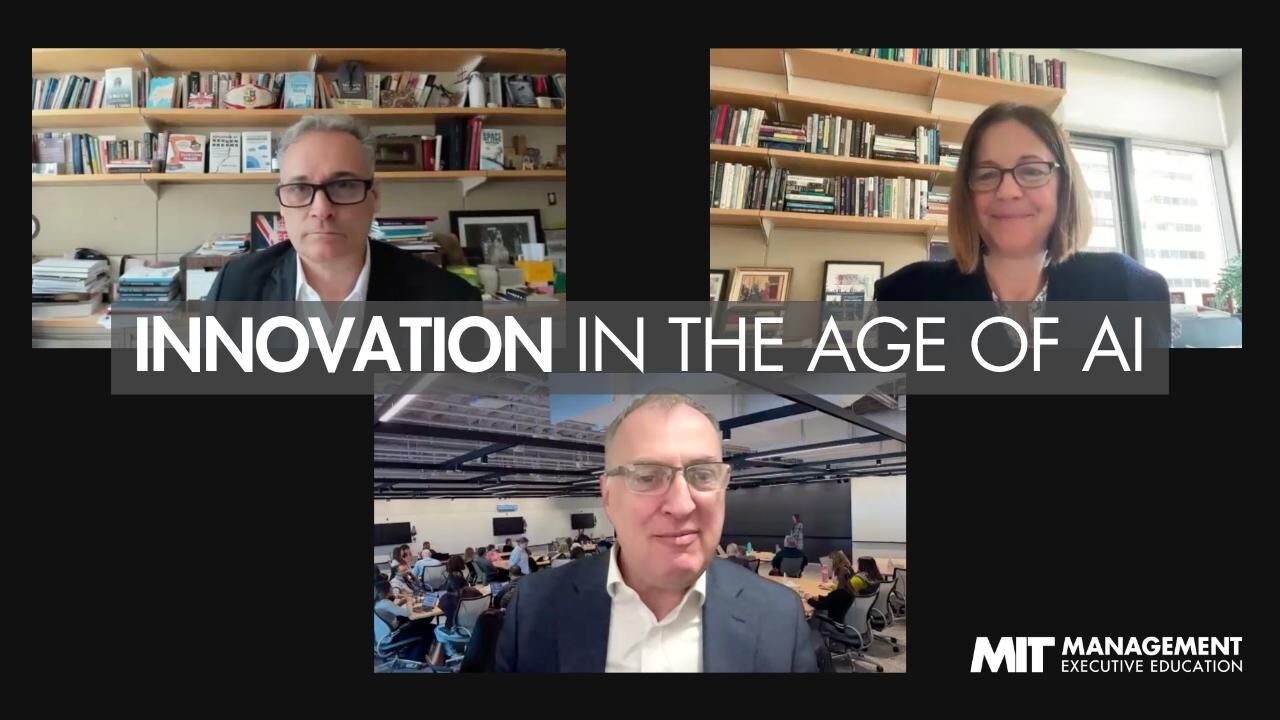


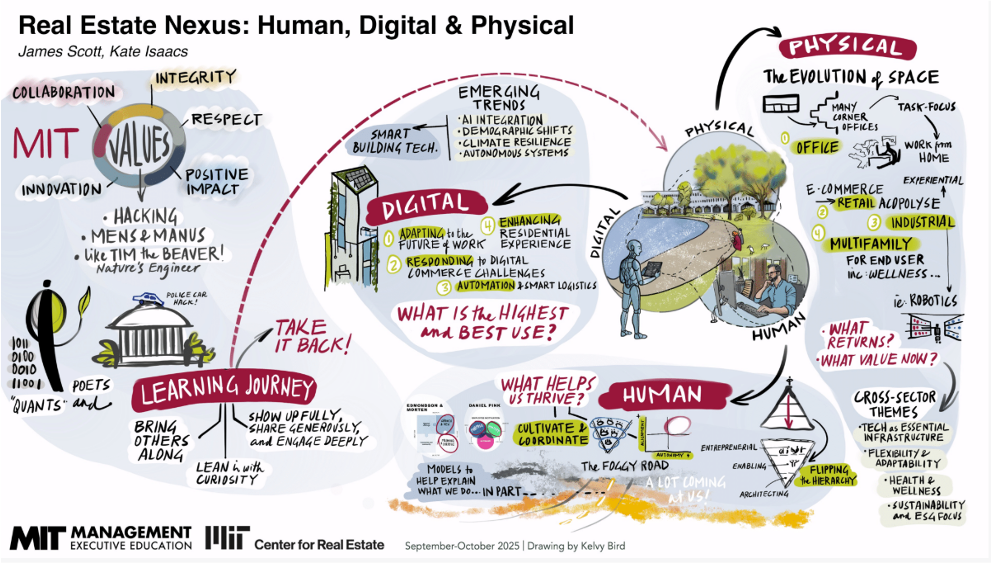
In a recent MIT Sloan Executive Education webinar on the future of real estate, Christopher Palmer, Kate Isaacs, and James Scott brought together three distinct but complementary perspectives: finance, leadership, and technology. Palmer, a finance professor at MIT Sloan, framed the conversation through the lens of markets and capital. Isaacs, a specialist in leadership and organizational change, focused on how people adapt and collaborate. Scott, working at the intersection of real estate and technology, explored the implications of AI and digital transformation for the built environment.
Where real estate decisions are actually made
Christopher Palmer began with a simple observation: The people shaping real estate decisions today are often not real estate professionals. They hold HR, operations, or transformation roles. They are deciding how teams are structured, how technology is used, and how work is organized. Space follows from those decisions.
For some time, it was possible to treat real estate as something separate, a portfolio to be optimized once more important questions had been answered. That separation is becoming harder to maintain. When space reflects how work is organized and how value is created, it begins to reveal the assumptions an organization is operating under. Those assumptions are rarely stated directly. But they become visible in the environments organizations create.
The human dimension is key
Kate Isaacs emphasized that the built environment is not simply a backdrop for people doing work. It shapes how people interact, how decisions are made, and how organizations respond to change.
As digital tools become more capable, the question is no longer simply how they improve efficiency. It is how they alter the role of the people using them. Isaacs described one aspect of this as “cognitive surrender”—a gradual tendency to defer judgment to systems that appear more capable or more certain.
It is not a dramatic shift, but over time, it can change how decisions are made and where responsibility sits. Real estate enters here in an often-overlooked way. Space shapes interaction. It shapes attention. It shapes the conditions under which judgment is exercised. Treating it as neutral infrastructure misses its influence entirely.
Why does change feel slower than it should?
James Scott brought a different take grounded in the realities of the industry. It is common to describe real estate as slow to change, but that description is incomplete. The constraints are structural.
Real estate operates across multiple stakeholders with different incentives. Decisions are long-term and capital-intensive. The cost of getting it wrong is high, and the reward for getting it right early is uncertain. In that context, waiting is often the rational choice. What complicates this is that the environment around that system is moving at a different pace.
Scott pointed to the way employees and customers are beginning to use AI, sometimes navigating complex processes before organizations have fully engaged. Whether this becomes widespread immediately is less important than what it signals. Expectations are shifting, and not evenly.
Rethinking productivity
The conversation returned, more than once, to productivity, though not in the way it is often framed. Palmer noted that much of the current debate, particularly around where work should happen, rests on assumptions that are rarely examined. Presence is often taken as a proxy for performance. Visibility becomes a measure of contribution.
These ideas endure, even when the conditions that supported them have changed. Isaacs added an important distinction. Where organizations responded to uncertainty with simple directives—bringing people back, standardizing patterns—the results were often mixed. Where they allowed more room for teams to determine how work should be organized, within clear priorities, the outcomes tended to be stronger.
This is not a question of office versus remote work. It is a question of how work is designed. Productivity emerges from the interaction between people, the tools they use, and the environments in which they operate. Change any one of those elements without considering the others, and the system becomes less effective.
A need for a different kind of leadership
What sits beneath all of this is a shift in what leadership requires today. Isaacs described it as a move toward sense-making, staying close to how work is actually done. It requires understanding how customers behave, how employees experience their work, and how those experiences are changing.
It also requires a willingness to question assumptions that have, for some time, gone largely unchallenged. She offered a practical suggestion to use “pre-mortems”: assuming a strategy has failed and working backward to understand why. It’s a simple exercise, but one that creates space for alternative perspectives in environments that can otherwise become too certain.
What conversations about real estate reveal
What makes real estate a useful lens is not that it offers all the answers, but that it exposes the questions organizations need to address. It reflects how organizations think about talent, how they use technology, and how they translate both into performance. When those elements are aligned, the effect is often subtle but meaningful. When they are not, the consequences tend to be more visible.
For those who want to spend time working through these questions more deliberately, MIT Sloan Executive Education’s “Shaping the Future of Real Estate: Human, Digital, and Physical Innovation Strategy” program brings together Palmer, Isaacs, Scott, and a group of peers to explore how human, digital, and physical systems come together in practice.
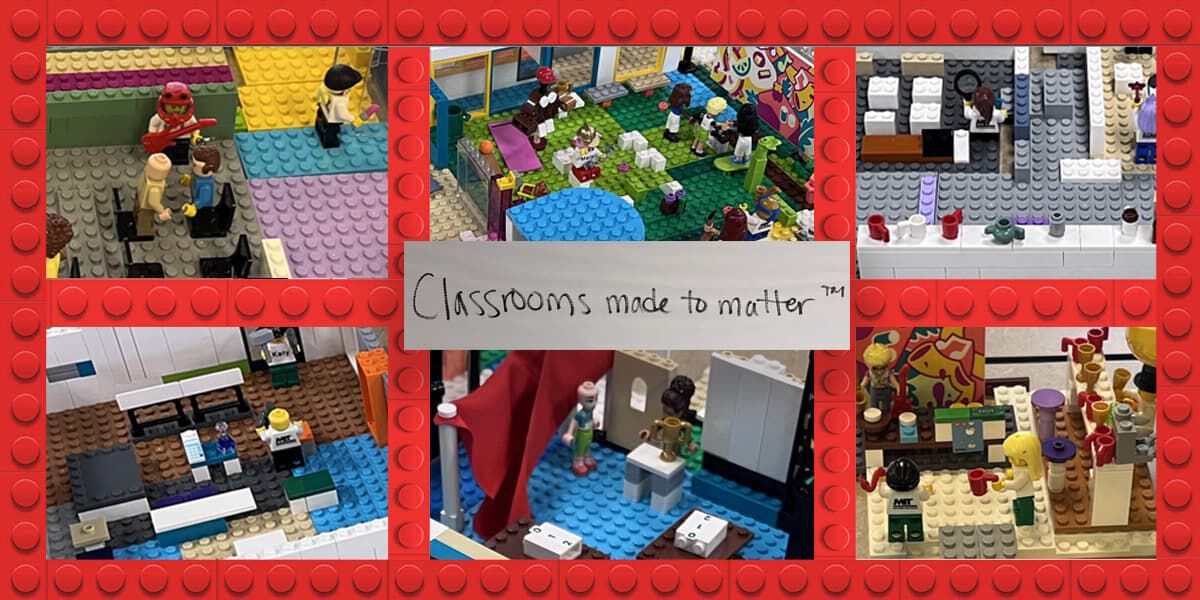
And if you’d like to experience firsthand the results of a real estate project that very much embraced the principles espoused in this webinar, come and take a course in our new MIT Sloan Executive Education space in Cambridge, Massachusetts!