





Ravi Singh is no stranger to adaptability and ambiguity. As Leonardo’s current head of Business Development and Sales (Automation) for the North American market, he’s used to juggling a variety of competing interests (across government entities and corporations), cultural differences, and constantly changing technologies.
Leonardo is the largest multinational Italian high-tech industrial group, specializing in aerospace, defense, security and automation sectors. Although it’s controlled by the Italian government (with 30% ownership), they are a publicly listed company with over sixty thousand employees around the world, out of which around seven thousand five hundred based in US.
Ravi has been with the company since 2007, when he got his start in the Aerospace and Defense Sales sector. In 2015 though, he made his move into the Aviation sector focused on airport systems and baggage handling systems (BHS). He was initially tasked with launching Leonardo’s foray into the Asian market – specifically Hong Kong’s airport. After proven success, he was asked to take on a more challenging role (personally and professionally): the US market.
While many sectors in the US surrounding general aviation, innovation, and intelligence are strong, Ravi reveals “You’d be surprised to know that in the specific aviation baggage handling system, the US systems are really old using conventional BHS technologies.” (Though truthfully, anyone who’s had a checked bag go MIA knows this pain all too well).
While airports have invested a lot in the security aspect of the baggage system, they have not prioritized much else in the process for decades. Adding to the complexity are the various stakeholders one needs to go through. When he launched in the Asian market, it was a direct pitch to the airport. Per Ravi, in the US, there’s a complicated stakeholders map and you’re lucky if you only have eight stakeholders to appease. The BHS technology based on Cross-Belt sorters had already been proven in top airports like Paris, Rome, Zurich, Frankfurt and Hong Kong, but it was new to the US. There was hesitation for a while. “It’s tricky because in our industry, no one wants to be first, everyone wants to be second.”
Now, Leonardo has been able to introduce new systems to Denver, Houston, and Melbourne (FL). With that success (and hopefully more converts to come), Ravi could step back a bit to consider his next steps as he continues journey within the US market. He had been with Leonardo for 20 years at this point, but now it was time to modernize his own management and leadership systems.
Why Global Executive Academy?
“I am a sort of a technocrat. When I was in India, I had a bachelor's and master’s in computer science from a very reputed university - Indian Institute of Information Technology and Management… I’ve always had an interest in how technology can help in business to improve a lot of things. MIT reflects that in their motto – which I really love – Mens et Manus (Mind and Hand). So, it was just a perfect fit. It can’t just be about theory – I have to be able to implement it.”
“Change is not easy. To change your personality, at this age, it’s not easy. But they are seeing the difference in my leadership and that gives me the satisfaction that I definitely invested ten days of my life at the right place at the right time.”
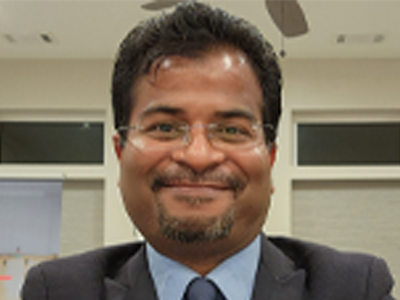
Ten days away from one’s team (and family) can be quite the sacrifice. Ravi initially considered finding something online (or a shorter course) but the more he read about the Global Executive Academy (GEA), the more he realized this was going to have the most ROI for him and his company. Thanks to his many prior positive contributions, his manager was very supportive and understood the positive outcome this could have.
“We are working in a very complex world, with very complicated challenges, within a very dynamic industry. The practical knowledge one gets from MIT was one of the main reasons I wanted to enroll.”
Connecting across industries and borders
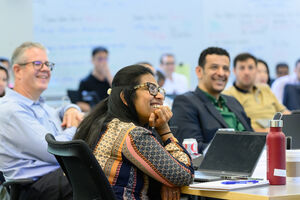
Ravi is a people person, so another alluring aspect of the program was the diversity within the classroom. His cohort had 45 participants representing 22 different countries and a varied mix of industries. The relationships he fostered were just as important as the technical frameworks.
It may be tempting, especially as a busy executive, to retreat back to your hotel room at the end of the day, but Ravi advises against that. “I always believe that the bond of beer is one of the strongest bonds on planet Earth!” Each night he made a point to go out with different members of his cohort. “I got to hear the story of each person one-on-one… I learned a lot from their own success stories.”
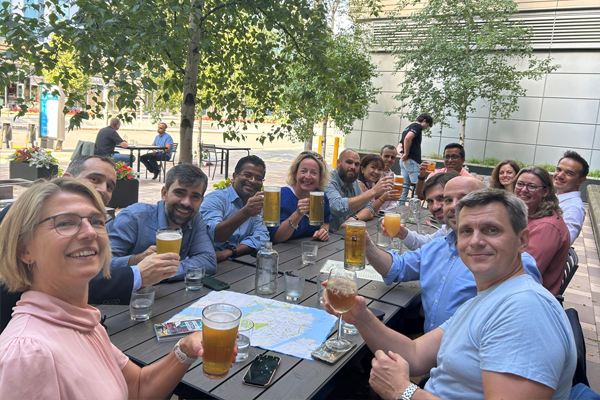
GEA participants socializing
They have created a Whatsapp group where they consistently stay in touch with pictures, updates, and continue discussions that started in the classroom. “We have created a network which will remain with us for our lives.”
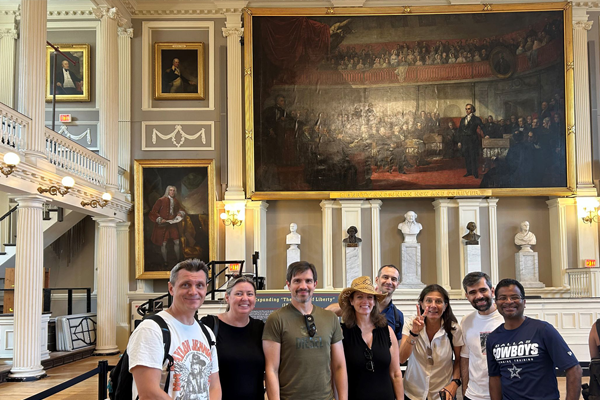
Ravi with fellow GEA participants at a museum
While Ravi is firm in his belief the connecting and building these relationships when you attend MIT is very important. “There’s always talk of AI replacing jobs and I always joke that luckily AI cannot drink beer – so I will always have a job in Sales. It’s never companies selling to companies. It’s the executive of one company selling to the executive of another company. You will always need to have that person-to-person interaction.”
Lessons learned
Throughout the ten days of the program, various MIT faculty thought leaders led sessions on topics such as management, leadership presence, negotiations, systems thinking, and innovation. “Each faculty member created a spark of curiosity, which allowed my learning to be continuous.”
Ravi learned important lessons on how to be a better leader thanks to discussions with Professors Elsbeth Johnson and Kate Isaacs. He valued the session on “incomplete leadership” where he realized he doesn’t have to be everything to everyone. It’s impossible to expect someone to have all the capabilities, instead it’s important to build a team that have complementary skills. Find those knowledge gaps and nurture them for a cohesive success story.
The sessions on negotiation with Jared Curhan were also highly valuable. The experience involved a detailed case study, one-on-one negotiation sessions, evaluations from the professor and peers, and an AI model simulator to refine skills and strategy. Prior to GEA, Ravi always thought negotiation meant someone wins and someone loses, but Professor Curhan helped him realize that doesn’t have to be the case. “In the longer term, the pie you’re fighting over initially can grow. So maybe instead of fighting for one slice, you can expand the scope of the negotiation, so the pie is large enough for both sides to win. That felt counterintuitive at first.”
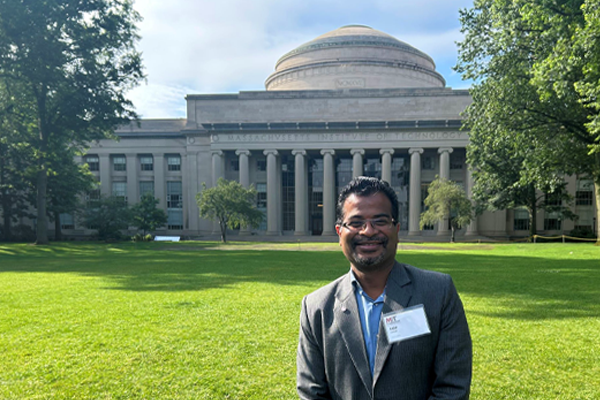
Ravi in front of MIT's Great Dome
He learned to prioritize the subjective value of negotiation as well. It’s not always a straightforward exchange of numbers and contracts. “If you develop a good relationship with someone, you can negotiate with them long-term. It’s not just about one deal but 10 or 20 deals more down the line. If you’re only looking at the one deal you could be missing out on 10 more opportunities down the road.” These are lessons he’s brought back to his team to help them bid more successfully on projects.
The Visual Management framework, taught by Sheila Dodge, was another lesson he was able to bring back to his team. “It’s a great way to figure out how can win together. It keeps us on track and accountable. We meet, we discuss, we meet again and determine what we’re missing.” During all this he makes it a priority to focus on his presence as a leader. He makes certain his team feel that they have his undivided attention. “Those meeting are the most important part of the day.”
Next steps
Ravi is already eyeing the AI Executive Academy when time allows. In the meantime, he continues to keep himself informed with the activities and research of his professors and GEA cohort. On top of being able to bring some valuable frameworks back to his team, he’s also received feedback from them that his time at MIT has produced positive leadership changes. “They have seen a difference. Change is not easy. To change your personality, at this age, it’s not easy. But they are seeing the difference in my leadership and that gives me the satisfaction that I definitely invested ten days of my life at the right place at the right time.”
Learn more about the Global Executive Academy and save your seat for the next session.