





The answer relates to the importance of being human. People are telling us—and voting with their feet!—that they want to come together and have an MIT experience. Even though we continue to be agile and digital in our program delivery formats, there is still enormous interest and demand for the in-person experience.
We began this effort during the COVID lockdown, when people were understandably asking why we were focusing on the physical. More recently, there have been broader questions about commercial real estate and shifting work patterns. But for us, securing a space at One Memorial Drive, literally next door to the MIT Sloan building, was significant because it let us expand our in-person classroom capabilities in the perfect location.
Building the best of both worlds
Many business schools have been scaling down their online executive education offerings recently. Just as many organizations have been rolling back remote work opportunities for employees. For us, flexibility is still key.
In the last several years, we have proven that we can teach online very well. In fact, MIT Sloan Executive Education had been designing and delivering online programs (both live and asynchronous) for quite some time before the pandemic. Hence, we were perhaps better equipped than other schools when in-person learning suddenly became impossible.
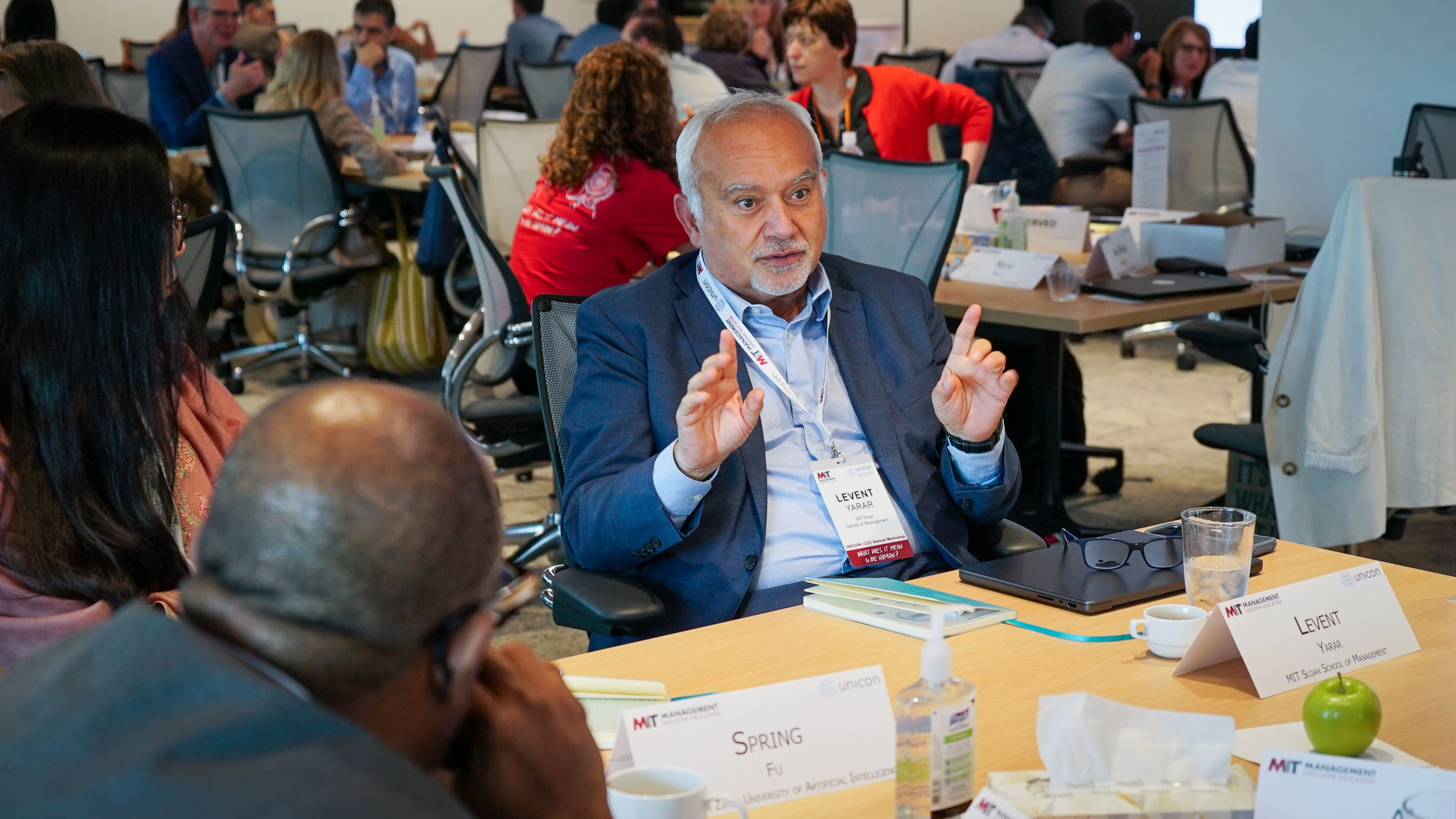
Levent Yarar, Senior Director, Executive Programs; Photo Credit: Jess Luma
And yet, we continue to hear very clearly from executives, faculty, and organizations: People still want to come together! They want to learn with and from one another. They want the experience of being at MIT. Which is why we design our learning experiences to meet people where they are, in person and online.
Constraints as a source of creativity
The new space is physically close to the main MIT Sloan buildings, which matters. Proximity is not just a logistical convenience. It is part of the experience. It helps participants feel connected to the school, the campus, and the energy of Kendall Square, which is always inspiring, regardless of how far you’ve travelled to get here. Whether you work half the world away or just around the block, coming to this environment is still highly enriching.
But proximity also came with constraints. We were not starting with a blank sheet of paper. We were adapting space in an existing office building. That meant working with the realities of the structure: the square footage, the shape of the rooms, the windows, the ceiling heights, and the many tradeoffs that come with creating classrooms in a building not originally designed for that purpose. In some ways, that is where the design challenge became most interesting.
We had to think carefully about how people learn, how faculty teach, how executives interact, and how a space can support the moments that happen before, during, and after the formal classroom experience.
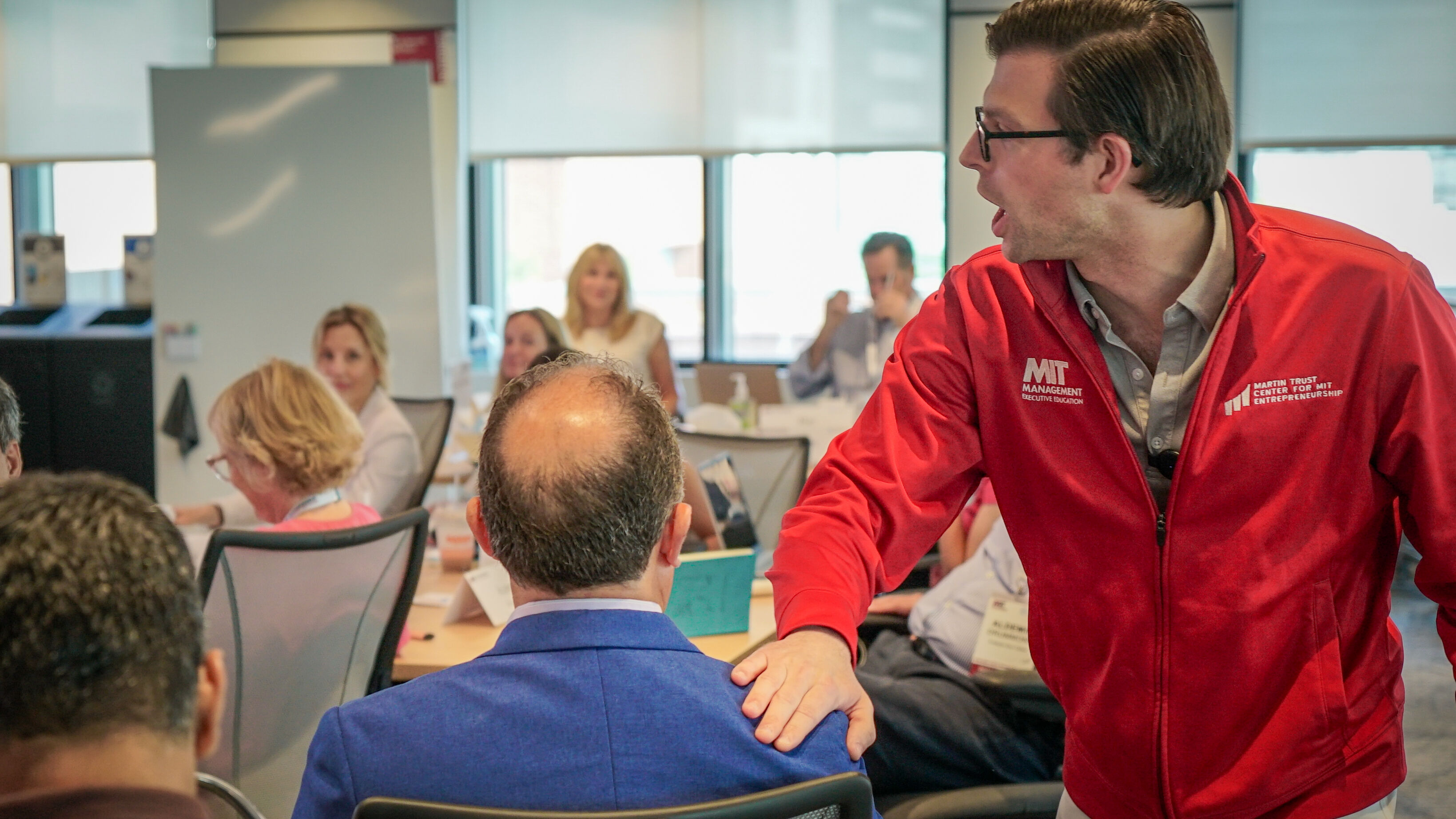
Paul Cheek, Senior Lecturer; Photo Credit: Jess Luma
One example is acoustics. At MIT Sloan Executive Education, we have long favored flat classrooms over traditional amphitheatre-style classrooms. That choice is intentional. Flat rooms make it easier for participants to work in groups, turn to one another, collaborate, and engage in discussion. They support a more active, participatory learning style.
Technology in the service of the human experience
Flat rooms also pose acoustic challenges. People may be seated with their backs to one another. Discussion may come from anywhere in the room. Faculty need to be heard, but so do participants. The usual solution is to rely on microphones and amplification, which we have been using for years in our existing learning spaces. We saw an opportunity to try something new and worked with our Sloan Technology colleagues to identify an acoustics system that could address the usual constraints more elegantly. The result: In relatively large classrooms, faculty and participants can be heard without needing to use tabletop, handheld or lapel microphones. Moreover, the classrooms electronically adapt the acoustic environment to create a very natural experience that can be tuned at the touch of a button to simulate different kinds of venues, from small-group discussions to theatre or concert halls.
This system creates many new possibilities. A classroom can function like a classroom, but it can also be adjusted to support performance, role play, music, or more theatrical forms of teaching. That opens up opportunities for faculty who do not teach in conventional ways, and for participants who learn through doing, experimenting, reflecting, and interacting. In other words, technology helped us solve a constraint. But it also expanded what we could imagine.
Space as a reflection of work
The idea that space reflects work feels relevant far beyond the physical space. Many organizations are wrestling with a similar issue. They are not building themselves from scratch. They are working with existing people, structures, cultures, and systems.
That is especially true as leaders think about the future of work. The return-to-office conversation is often framed as a policy debate: how many days, which days, who decides, and what rules should apply.
“I would argue the deeper issue is not simply where people work. It is what happens when they are together.”
If the office is merely a place people are required to be, it will disappoint. If it is designed as a place where people can do work that is difficult to do alone—build trust, solve problems, develop shared language, learn from one another, and create a sense of belonging—then it has a much stronger claim on people’s time and attention.
The same is true of learning spaces. A classroom is not valuable simply because it is physical. It is valuable when the physical environment makes certain kinds of learning more possible: the exchange after a faculty session, the side conversation over coffee, the moment when a group wrestles with a problem together, the chance to test an idea out loud and have it sharpened by others in the room.
That is why the spaces outside the classroom also mattered in this project. Circulation space, shared space, informal gathering space, and quieter areas for reflection are not secondary to the learning experience. They are part of it. We wanted to create different kinds of spaces for different kinds of human activity: conversation, study, reflection, networking, collaboration, and pause.
Human-centered design is practical
Universal design was instrumental in our thinking from the beginning. Accessibility should not be treated as an afterthought or compliance exercise. A more useful frame is to ask how the design can benefit everyone. A space that is easier to navigate, easier to hear in, easier to gather in, and easier to adapt is better for all participants.
This is one of the lessons I keep returning to: Human-centered design is not soft. It requires discipline. It requires choices. It asks us to be precise about what we are trying to enable. And it requires the human-centered leadership that I have long advocated for.
At MIT Sloan Executive Education, we were fortunate to have excellent existing facilities, and this new space is no substitute for them. It is another version of first class. It gives us more capacity, more flexibility, and new ways to support the kinds of learning experiences that executives and organizations are seeking. That is what we were designing for. Not a shiny new facility for its own sake. But a place where technology, architecture, teaching, and human interaction work together.
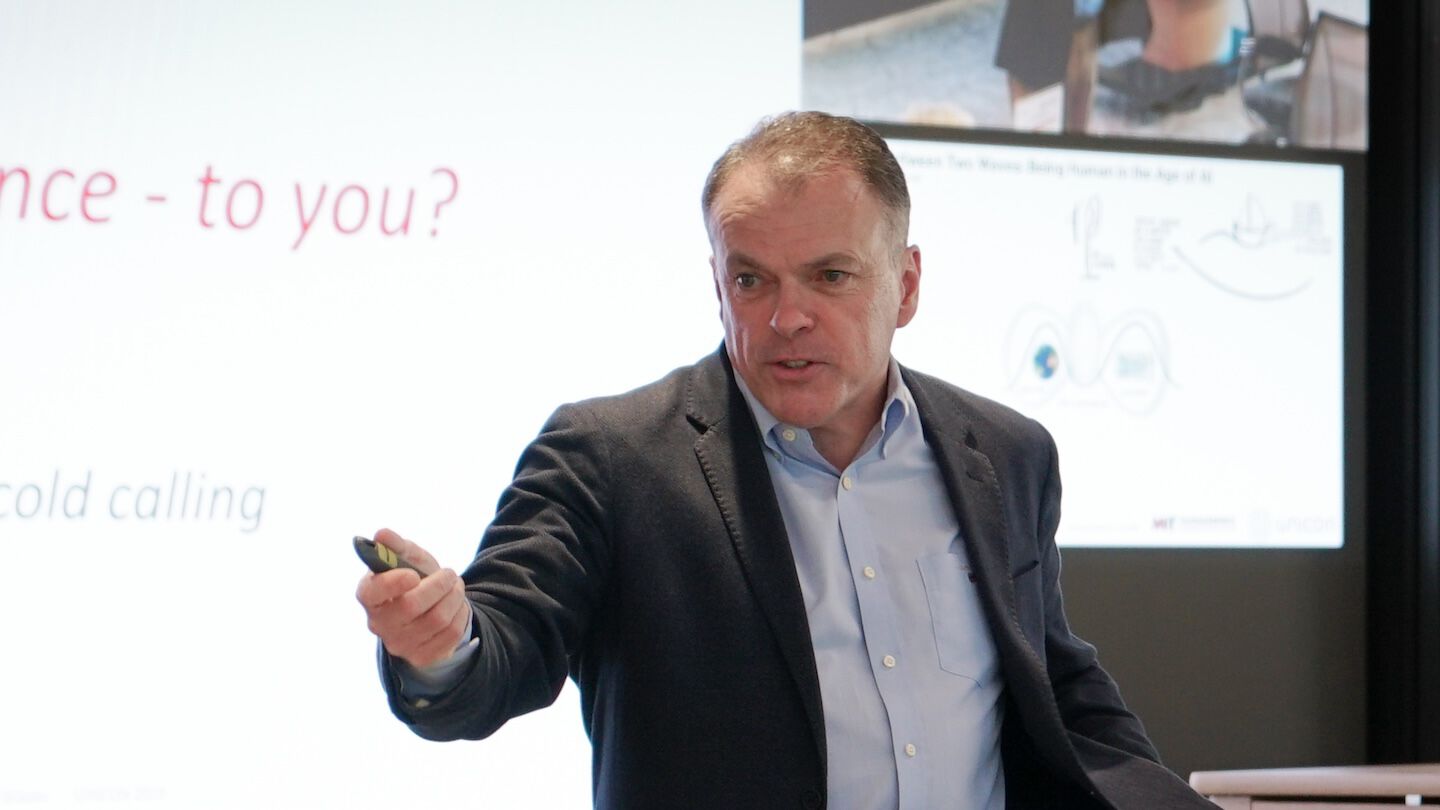
*Header image: Paul McDonagh-Smith, Senior Lecturer, Photo Credit: Jess Luma