




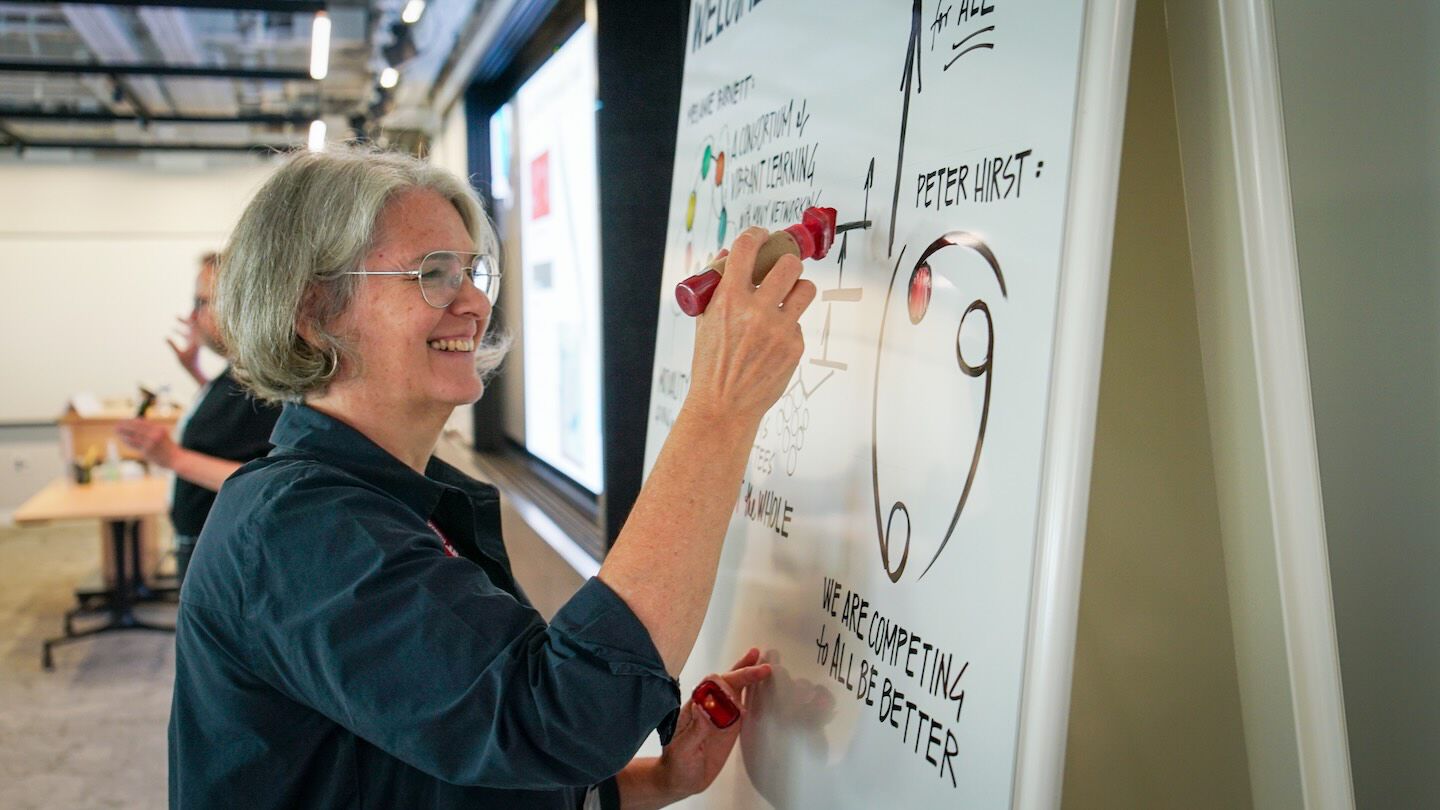
While faculty teach and participants listen, artist and MIT Sloan lecturer Kelvy Bird begins to draw. The images that emerge across whiteboards or glass walls are striking, but their purpose goes well beyond just illustration. They are part of an evolving practice at MIT Sloan Executive Education called Visual Sensemaking: a visual practice influenced by systems thinking that helps people understand complexity. Or as Kelvy puts it, “finding the signal in the noise.”
More than a record
Kelvy has spent over three decades working in visual practice, including pioneering Generative Scribing, an approach to drawing out emerging ideas in real time. At MIT Sloan, she has been exploring how that practice can expand to become a methodology for executive learning. “The way that I’ve been framing it and guiding my own inquiry is to see it as a practice and a methodology for orienting in complexity,” she says.
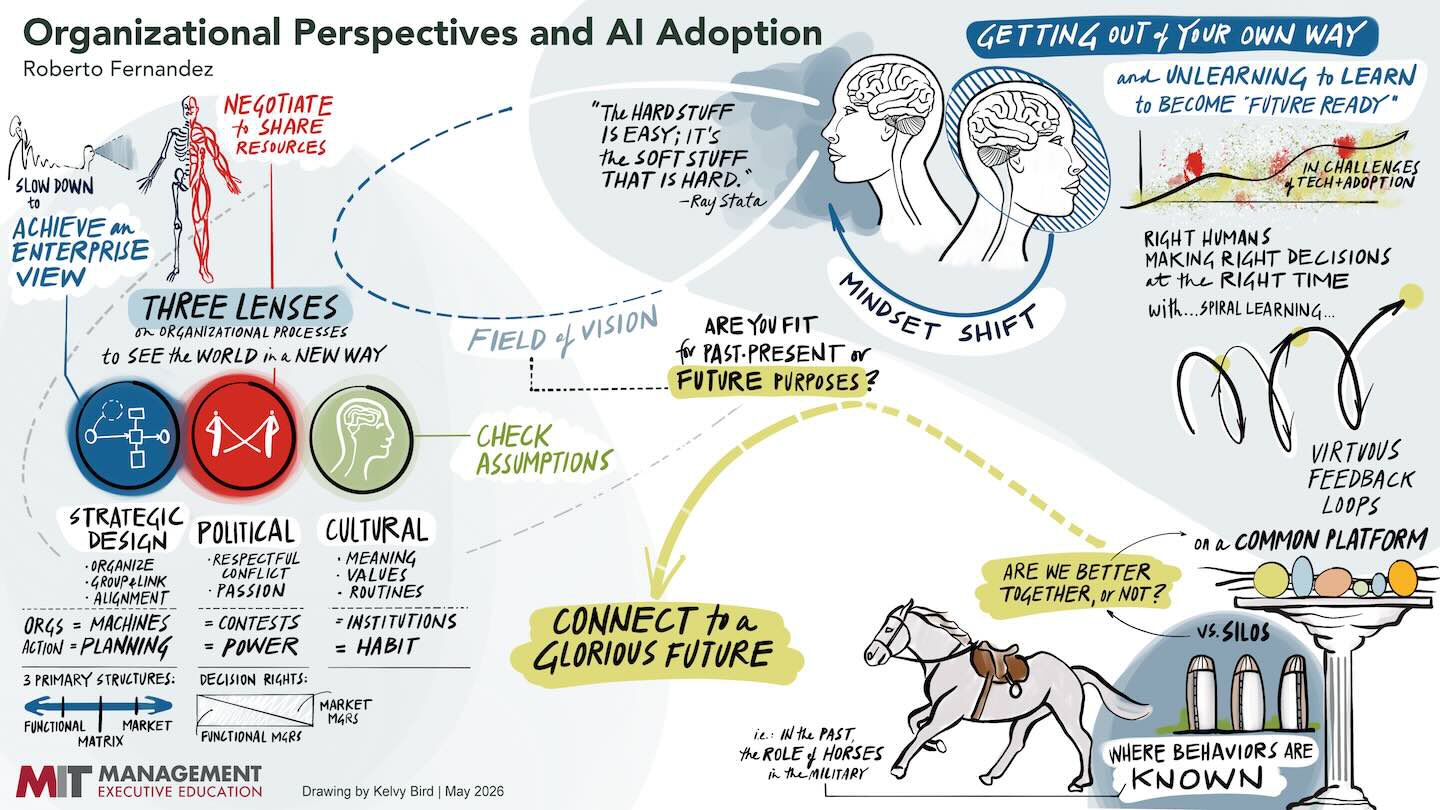
Image from a custom executive education program, scribed digitally then distributed as a handout to participants in the room.
Traditional graphic facilitation often records or tracks what is being said to document the spoken word. Visual Sensemaking builds on this by identifying connections that may not be immediately visible to navigate complexity. Kelvy actively applies systems thinking as she listens. She may look beneath actions to the structures producing them, consider patterns and mental models, or listen for reinforcing and balancing feedback loops. Those judgments influence what she includes, what she emphasizes, and how ideas relate to one another on the board. “It’s not even about the importance of something,” Bird says. “It’s about the relevance of it.”
Layers of meaning
For longtime MIT Sloan Senior Lecturer Court Chilton, the deeper value lies there. Visuals can summarize and reinforce learning and make intangible concepts concrete, he says, but those are only the “surface reasons” in which they are useful. At another level, they can help executives clarify ideas they already carry, challenge assumptions, and see why a practice that works in one context may not work in another. “It’s beautiful,” Chilton says, “but she’s also capturing the multiple layers of learning that we’re trying to deliver.”

A program director reviews key learnings on AI Taxonomy from a multi-day, custom executive education program.
Those multiple layers matter because participants do not all absorb information uniformly. “We can’t just expect everybody to be learning in the same way,” Kelvy says. She explains that bringing in a more sensory mode of learning provides another avenue into the material.
That can be particularly valuable in a long, content-rich program. In the five-week Advanced Management Program, for example, participants encounter dozens of frameworks. Program Director Molly Schneider says participants often report experiencing tremendous clarity while they are at MIT, away from their day-to-day responsibilities and surrounded by faculty and peers. The challenge is helping that clarity survive when they return to work. “What we wanted to provide folks with was something tangible that would remind them of the aha moments that they had with us in the classroom,” Schneider says. Kelvy’s visual work became one way to create those anchors.
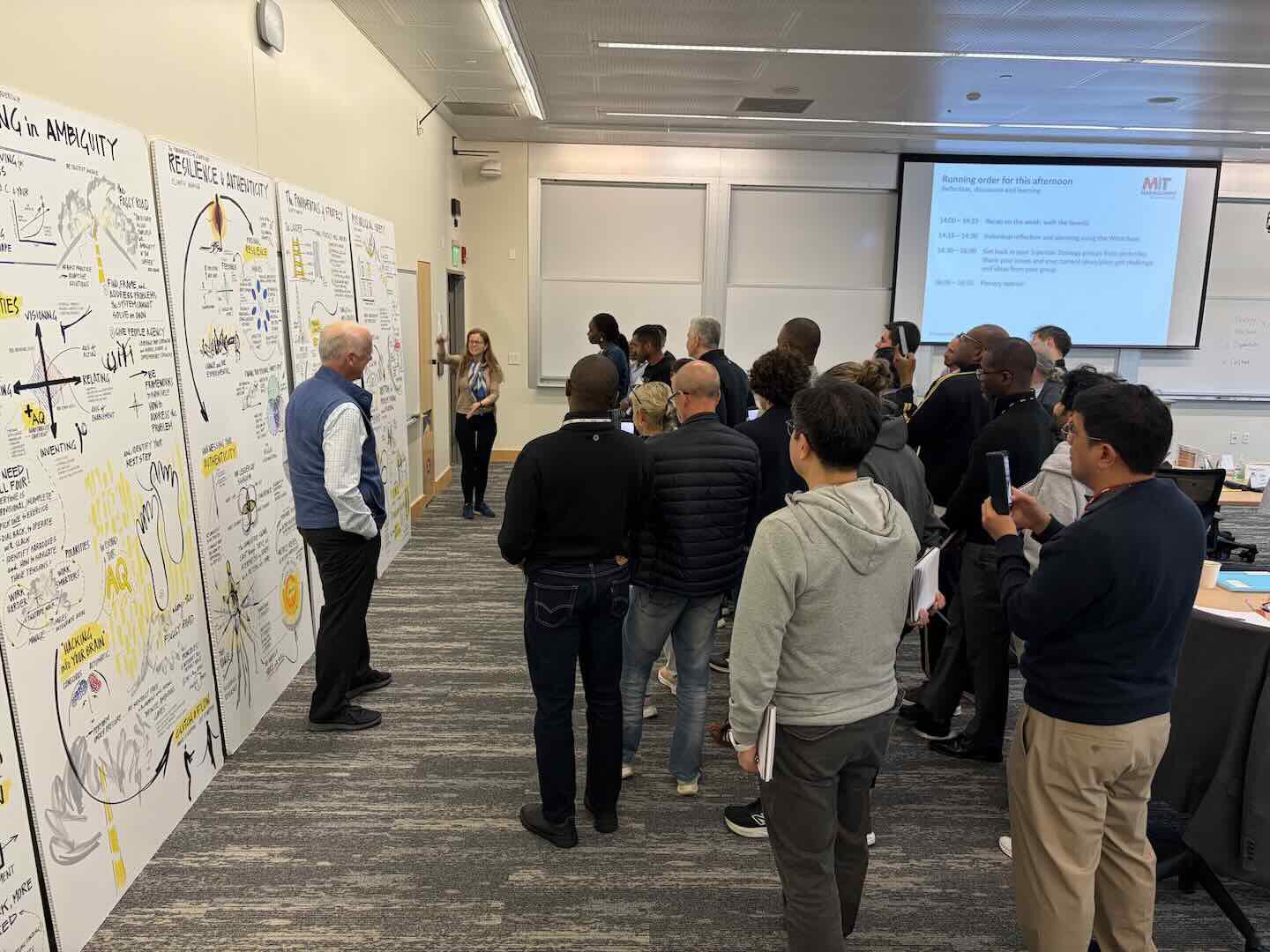
Faculty “walk the boards” with participants to review week one of the Advanced Management Program (AMP) 2026, to encourage pattern-recognition and reflection.
Deborah Ancona, Professor of Organization Studies and Founder of the MIT Leadership Center at MIT Sloan, calls Visual Sensemaking “a fabulous add” to any program or class she is teaching. “Visual sensemaking is helpful to the students in myriad ways,” she says. “It helps students to remember the material and to see it from a different point of view, sparking new insights and connections. Also, the visual sensemaking enables students to see both the separate parts of the class as well as how they all fit together—something that is not always possible to teach in the moment." She also points out that the drawings help her see what resonates most with students.
Hal Gregersen, Digital Fellow at the MIT Initiative on the Digital Economy at MIT Sloan, describes another dimension of that process. “The best notes taken are not what the teacher says, but what the student thinks,” he says. At their best, he explains, the visual representations become part of a “visual notebook,” provoking participants to rethink both the content and their own experience.
Value beyond the classroom
Participants have echoed the value. In program feedback, learners described the drawings as helping them “create visual memories,” understand the material, and take the learning home with them. One participant wrote that Kelvy had inspired them to begin scribing their own learning and meeting notes.
The visual layer may also help make learning more accessible across a highly international classroom. For the participants for whom English is not a first language, a visual vocabulary can slow down and clarify a rapid flow of information and, Kelvy argues, can cross languages and cultures in ways that words sometimes cannot.

Digital scribing at a 2026 UNICON workshop.
Building continuity
Visual Sensemaking weaves a thread that connects the entire learning experience during an executive program. Chilton describes participants coming to class the next morning, seeing the drawings from the previous day, and immediately reconnecting with what they discussed. “You don’t have to work hard to get back on to the beam and do the next thing,” he says. The images can also become a shared reference point for faculty. A participant who did not fully understand a concept can return to a drawing with an instructor or program director and examine it again. That creates what Chilton describes as “a second chance to get after it.” The visual record can help more of the room move forward together rather than leaving those who missed a connection behind.
Gregersen sees another benefit in returning to an image after the initial learning moment has passed. “What didn’t I see the first time, and what insight did I miss? What question was I not asking?” he says. “It provokes new things.”
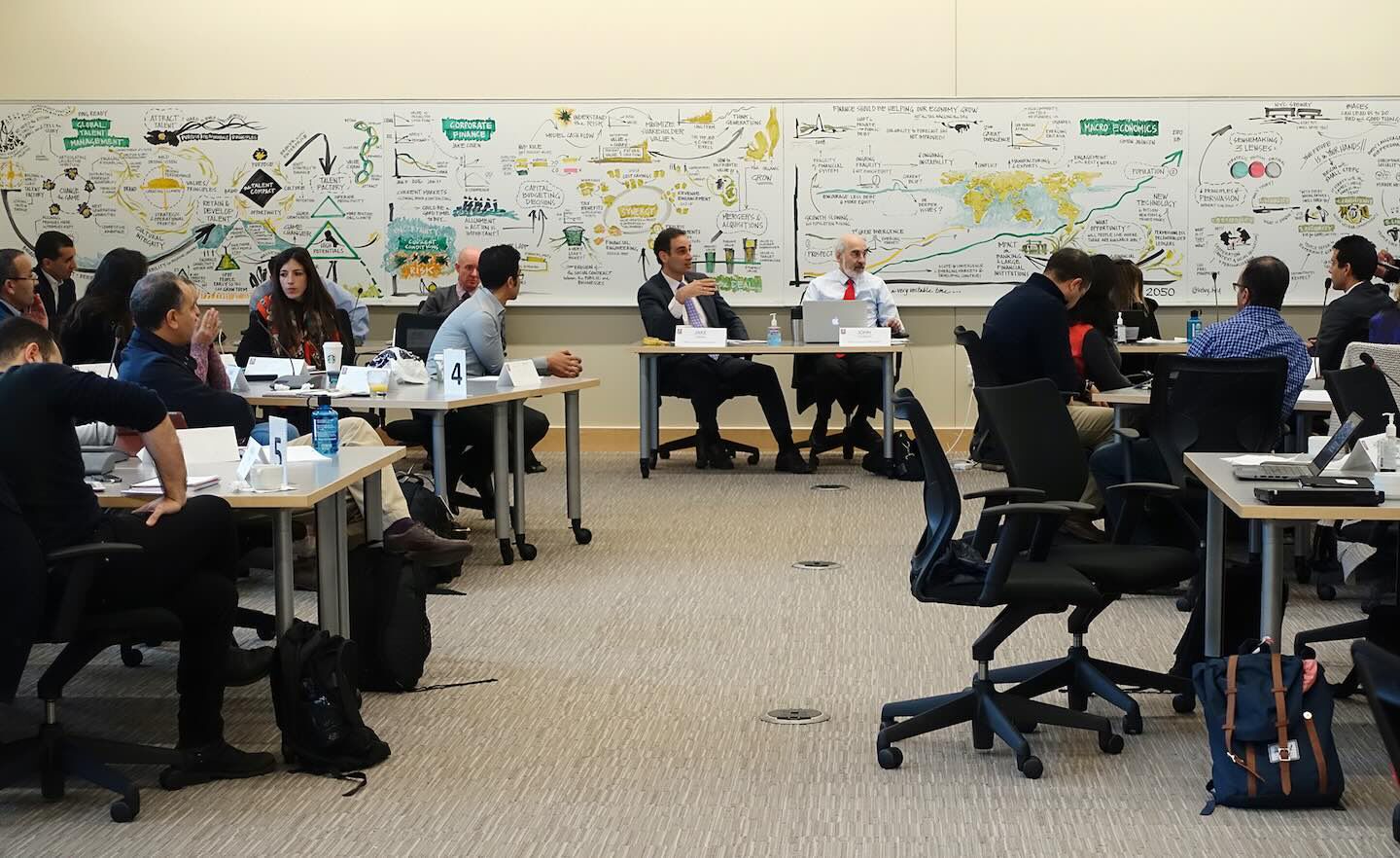
An example of how multiple images combine to wrap around a classroom during a week-long program on Systems Thinking, Macroeconomics, and Market Dynamics, among other topics
Kelvy sees that connective role as fundamental. A conversation about operations may connect visually to leadership; leadership may connect to AI; AI matters more as leaders confront problems that refuse to stay within traditional disciplinary boundaries.
Bringing the learning home
The work does not necessarily end when a program does. For the Advanced Management Program, Kelvy helped transform key frameworks into a series of visual cards that participants can use to revisit important concepts and consider how to apply a framework when they encounter a new challenge. For Schneider, that portability is central to the value. “The power of this is capturing what’s happening in the classroom, and then making it accessible beyond the classroom in a really digestible, condensed way,” she says. “It’s not just an experience,” she adds. “It’s a takeaway.”
“Participants are impressed with the images and enjoy looking at them with colleagues, and people are always snapping pictures to refer to later,” says Meg Regan, Lecturer, Work & Organizational Studies, and Managing Director at MIT Sloan Executive Education. “We always provide cleaned-up images in a compendium, and many learners say they refer back to it regularly to remind them of key concepts. We also encourage participants to share them with their teams and teach back.”
That idea is central to Kelvy’s longer-term vision. She imagines visuals becoming “a parallel element” of the entire executive education learning journey: appearing before a program, supporting the classroom experience, and continuing afterward through visual artifacts and reflection. To her, the classroom is like a garden, a place where participants spend time surrounded by ideas that grow and connect. When they leave with the images, it is almost as though they are taking a bag of seeds with them—something they can use to recall the experience, share it with other people, and perhaps influence future decisions.
Making new connections
Executives increasingly operate amid enormous volumes of information and rapid technological change. Visualizing those systems can make the relationships among ideas easier to see and make room for something else.
“When you can clearly see the dots that you’re trying to connect, you can play more. You can have wilder ideas.”
That possibility feels particularly relevant in an age of AI. As machines become increasingly capable of summarizing and generating information, human judgment remains essential. Bird sees visual practice as one way to exercise that capacity, to connect thinking and sensing with the physical act of making an idea visible.
And despite the sophistication of her own work, Kelvy is emphatic that visual practice is not reserved for artists. “Anybody can do it,” she says. “It really is a visual language for everybody.” That may be the larger promise of Visual Sensemaking: to strengthen the executives’ ability to see relationships, find meaning amid complexity, and carry that understanding into what they do next.
*Header image: Kelvy Bird at work. Photo credit: Jess Luma