







Oscar Wilde’s The Importance of Being Earnest is remembered as a comedy, but it is also a study in identity. Beneath the wit and wordplay lies a commentary on what happens when the structures that define who we are begin to shift.
Today, it is not aristocratic lineage that is destabilized, but professional identity. The digital revolution has already transformed the way we work. Artificial intelligence is now reshaping how we think, create, make decisions, and assess value. Roles that once felt secure, such as accounting or paralegal, now feel provisional. Skills that once guaranteed relevance feel transient: writing, research, coding, communication, the list goes on. In fact, the World Economic Forum estimates that 22% of jobs globally will be disrupted by 2030, with 92 million roles displaced and 170 million new ones created, while about 40% of employers expect to reduce their workforce where AI can automate tasks.
For learning and development (L&D) leaders, this is not abstract. They are being asked to prepare organizations for work that is still being invented! In such periods of acceleration, identity, both individual and organizational, becomes unsettled. Which is why the importance of being human feels less like a philosophical sentiment and more like a strategic imperative.
An exponential shift
In May 2022, just months before ChatGPT burst on the scene, I co-authored a report for UNICON’s fiftieth anniversary titled “The Future of UNICON – The Next Fifty Years”. UNICON is a global consortium of leading university-based executive education providers. For five decades, it has brought together institutions responsible for developing leaders at scale and shaping leadership capability across industries and geographies.
In that report, we examined three time horizons (3–5 years, 10–15 years, and 30–50 years) and pondered how technological acceleration, geopolitical shifts, new market entrants, and evolving learner expectations might reshape executive education and lifelong learning. We framed change as exponential rather than incremental. We suggested that falling behind the curve might not simply require catching up, but could threaten structural relevance. What we did not anticipate was how abruptly the curve would soar!
What held and what accelerated
Nearly four years later, I can confirm that we were quite on the mark in many cases, as several observations from that report remain sound.
- We anticipated the rise of lifelong learning and the relative decline in the importance of a formal degree. That shift has accelerated as skills cycles shorten and career paths become more fluid. For L&D leaders, this has meant moving from episodic interventions to sustained, modular, and stackable learning pathways tied directly to workforce strategy.
- We predicted that competition would increasingly come from outside academia — from EdTech firms, professional services organizations, and potentially Big Tech platforms. That competitive landscape has clearly intensified. The vendor ecosystem facing L&D today is broader and more technology-enabled than at any point in the past decade.
- We emphasized experimentation: building portfolios of small bets as a hedge against disruption. Many L&D teams are now piloting AI-assisted coaching, adaptive learning pathways, and skills inference tools.
What we woefully underestimated is compression. Generative AI did not merely accelerate existing trends; it reset expectations. It collapsed the cost and time required to produce content. It made personalization scalable at levels previously unattainable. It embedded itself into workflows with extraordinary speed. For example, as far back as 2023, software developers using generative AI tools could complete coding tasks up to twice as fast as those without AI assistance, a McKinsey study found.
This changed the basis of differentiation. When knowledge becomes abundant, what remains sought after?
The real strategic risk
For the L&D professionals, this question shapes strategy. If AI can generate content instantly, what justifies premium investment in structured learning? If coaching can be automated at scale, what becomes the distinctive value of human facilitation? If skills can be inferred algorithmically, what remains uniquely developmental rather than transactional?
In such an environment, it is tempting to compete on efficiency alone, to focus on faster content production, broader reach, and deeper automation. Yet if everyone can generate content, content ceases to differentiate.
AI can draft a syllabus, summarize research, simulate dialogue, analyze skill gaps, and recommend personalized learning pathways. It can scale access and responsiveness in ways never before imagined. But it does not create trust among leaders confronting consequential decisions. It does not hold moral ambiguity. It does not replicate the friction of disagreement in a room of peers wrestling with strategic tradeoffs. It does not cultivate judgment through shared experience.
The bigger risk is not that AI will replace executive education and leadership development, but that L&D strategies might narrow their definition of value to what AI can most easily optimize.
Designing for what machines cannot do
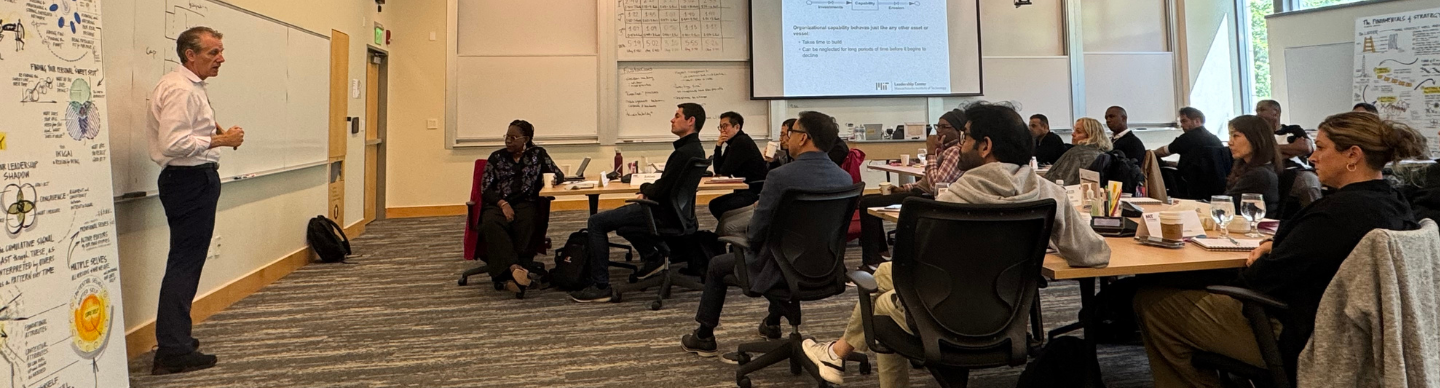
At MIT Sloan Executive Education, when learners complete a certain number of courses along a chosen path, they earn an Executive Certificate, which is presented in a small but heartfelt ceremony at the end of their last course. I have the distinct honor of awarding these certificates, which is always a deeply rewarding experience for me. Whether learners completed programs online, in hybrid formats, or fully in person, when they offer advice to classmates still progressing, they almost invariably say: “Come in person if you can. The other experiences are great, but this is something beyond.”
That “something beyond” reflects a profound truth about leadership development. It is not merely information transfer. It is a perspective shift. It is confidence built through dialogue and experience. During COVID, many of us discovered how much could be accomplished remotely. I travel far less than I once did. And yet, when I participate in an in-person executive program—especially one centered on AI, digital transformation, or business model disruption—I am reminded how deeply leaders value the opportunity to think together in real time about questions that do not have algorithmic answers.
Humanity as strategy
I’d like to emphasize that, for L&D leaders, the main takeaway here is not to resist technology. It is to be precise about where human-centered investment matters most. If your strategy centers solely on scaling content, you are competing on terrain that machines will increasingly dominate. If, however, your strategy centers on cultivating judgment, trust, ethical discernment, and collective sense-making, you are investing in capabilities that technology can augment but not replace.
The importance of being human is not a retreat from innovation. It is a recognition that innovation does not replace meaning. Invest in AI. Experiment boldly. Expand access.
But design deliberately for the spaces where leaders gather to reflect, challenge one another, and confront complexity together.
Wilde exposed the fragility of identity in his time with humor. Our moment calls for clarity. If professional identity is once again being thrown into the air, the organizations that endure will not be those that automate most efficiently, but those that cultivate leaders who remain unmistakably, deliberately human.
MIT Sloan Executive Education offers many AI-focused programs for individuals and for organizations. Check out the full catalog of courses to see how we can support your learning journey.