




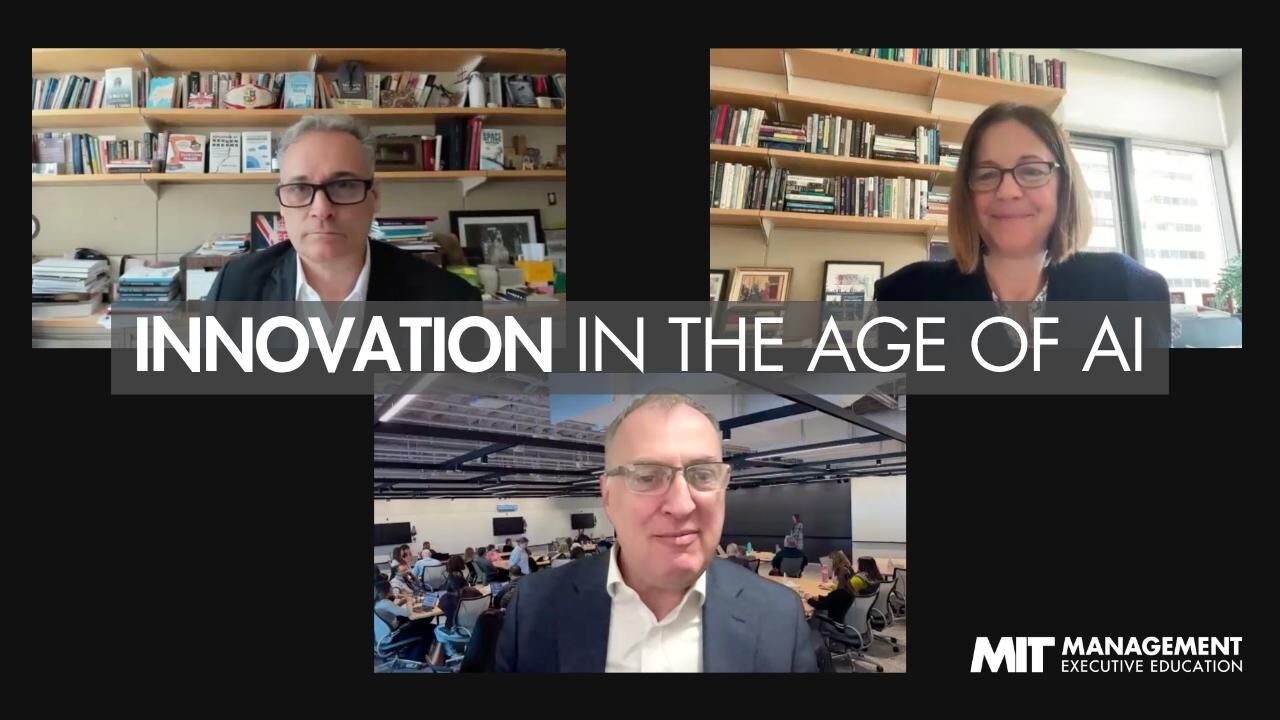




In a recent MIT Sloan Executive Education LinkedIn Live, my colleagues Bill Aulet and Jenny Larios Berlin explored what it means to create and scale a venture today. Bill is the Ethernet Inventors Professor of the Practice at MIT Sloan and Managing Director of the Martin Trust Center for MIT Entrepreneurship. Jenny is a senior lecturer at MIT Sloan and an entrepreneur-in-residence.
Their discussion reinforced an important point: AI changes the tools and the pace of entrepreneurship, but it does not eliminate the need for entrepreneurial discipline. In many ways, that discipline is becoming more important, because it’s become that much easier to move very quickly in the wrong direction!
Speed is a basic entrepreneurial capability
Entrepreneurs have always moved in changing environments. They look for shifts in technology, customer behavior, markets, and society, and then ask what new opportunities those shifts create. AI has dramatically accelerated that process. Entrepreneurs can now generate hypotheses, build prototypes, conduct research, and test possible solutions at remarkable speed and relatively low cost. That creates an unusually promising moment for entrepreneurship! Barriers that once prevented people from exploring an idea are falling. Small teams can access capabilities that previously required significant capital, specialist expertise, or large organizations.
But speed is not simply about producing more. It is about learning faster. The entrepreneur’s advantage comes from forming an intelligent hypothesis, testing it against reality, absorbing what the market reveals, and adapting before others do. AI can shorten that cycle enormously, but it cannot decide which questions are worth asking.
Understanding customers is even more important now
Jenny raised one of the central risks of this new environment: When producing something becomes inexpensive and easy, activity can be mistaken for progress. AI can help entrepreneurs quickly create a website, campaign, product concept, prototype, or business plan. But the ability to produce an artifact does not prove that anyone needs it. Nor does it mean customers will pay for it.
The underlying questions remain remarkably familiar. Does the venture solve a meaningful customer problem? Is the value proposition clear? Is there a paying customer? Can the business acquire and retain more of them?
As Bill put it during the conversation, product-market fit does not end with the product. A product must also have a market. This distinction becomes more consequential as the volume of AI-generated products and ideas increases. Entrepreneurs may be able to reach an initial product much faster, but product-market fit is now closer to the beginning of the journey than the end. They must also understand how the venture will reach customers, which channels will work, how customer acquisition will be managed, and whether the underlying economics support growth. Technology may have changed, but the customer remains the source of truth.
AI rewards rigor, rather than replacing it
It may be tempting to see AI’s vast capabilities as an alternative to following a diligent process. The assumption is that because an entrepreneur can experiment quickly, a structured methodology is no longer necessary. In fact, the opposite may be true. When the cost of generating options falls, entrepreneurs need a stronger framework for deciding which options deserve attention. They need to distinguish meaningful learning from AI slop.
This is where practicing Disciplined Entrepreneurship becomes particularly valuable. Developed by Bill Aulet, it is a rigorous 24-step process that helps founders define their target customer, understand an unmet need, quantify a value proposition, examine the competition, develop a business model, and determine how the venture can scale.
And AI can support every step! It can synthesize existing information, identify patterns, challenge assumptions, generate alternatives, and accelerate secondary research. But entrepreneurs must still conduct primary market research, speak directly with customers, interpret incomplete information, and make judgments about an uncertain future.
Large language models are particularly effective at processing what is already known. Entrepreneurship, however, is fundamentally concerned with what does not yet exist. That requires human curiosity, imagination, judgment, and conviction.
The most capable entrepreneur will combine human and artificial intelligence
Seeing the human-AI relationship only as a competition is not the most useful way to envision the future. Entrepreneurs will not succeed by ignoring AI. Nor will they succeed by delegating the work of entrepreneurship entirely to a machine. The advantage will belong to people who learn how to combine the reach and speed of AI with distinctly human capabilities.
AI can remove a lot of repetitive work. It can help founders research markets, examine competitors, model scenarios, prepare customer conversations, and iterate on possible strategies. This gives entrepreneurs more time to focus on the work that matters most: developing insight, building relationships, assembling teams, making difficult choices, and earning customer trust.
Jenny also emphasized the importance of teams. AI may allow teams to become smaller and more capable, but it does not make collaboration less important. Building a venture still requires people who bring different perspectives, challenge one another’s assumptions, and commit to a common purpose.
Entrepreneurship remains a human undertaking
AI is a technology. Like any powerful technology, it can be used to create real value or simply to create more noise. The responsibility rests with entrepreneurs and leaders to decide which problems are worth solving, whose interests a venture will serve, and what principles will guide its growth. Bill made a compelling case for entrepreneurship grounded in a clear reason for being, not simply the pursuit of short-term profit.
This matters because many of the challenges facing society will require entrepreneurial responses. Established organizations often lack the speed or the incentives to pursue uncertain opportunities. Entrepreneurs can bring urgency, focus, and imagination to problems in areas such as energy, climate, health, education, and economic development. AI gives them a new set of capabilities.
For entrepreneurs, aspiring founders, corporate innovators, and leaders responsible for building new ventures, the central challenge is therefore not simply to learn how to use AI tools. It is to develop the mindset, skills, processes, and judgment required to use those tools purposefully.
MIT Sloan’s Entrepreneurship Development Program is designed around that challenge. Drawing on MIT’s culture of entrepreneurship and innovation, the six-day program covers the venture creation process from identifying an opportunity and understanding customer needs to developing a business model, navigating financing, and scaling globally. Participants also work in teams to develop a venture using the 24-step Disciplined Entrepreneurship framework and a custom generative AI tool built to support that process.
The next Entrepreneurship Development Program will take place in Cambridge, Massachusetts, January 17–22, 2027. I encourage those ready to turn ideas into viable, scalable ventures to learn more and reserve their place.