



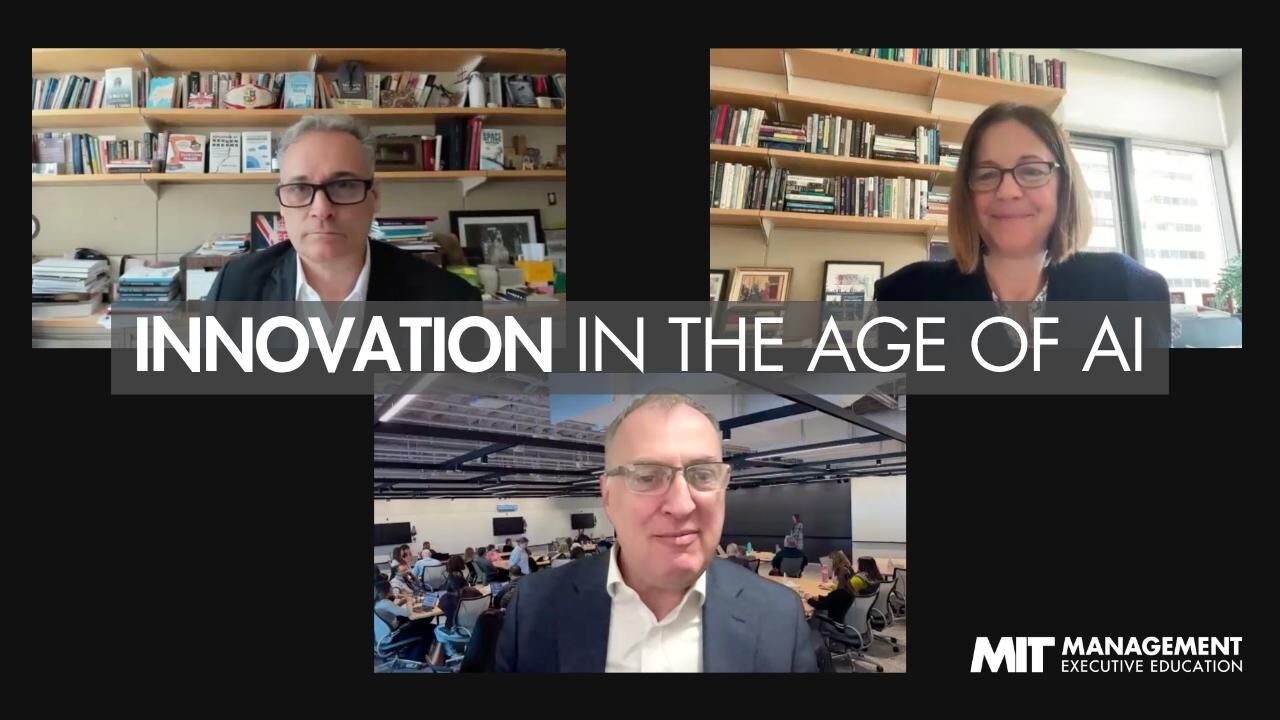




That was the question MIT Sloan Senior Lecturer Paul Cheek posed during a recent LinkedIn Live conversation about his new book, “No One Works Here: How AI-Driven Enterprises Are Raising the Bar for Business, Leadership, and Competition.” The title is deliberately provocative, but Paul’s argument is really about how the work is organized when people are not the only ones carrying it out.
An existential change
Paul opened with a bold proposition: If an entrepreneur rebuilt your business from the ground up today, it would not take nearly as long as it once did. AI-native companies can launch, test their ideas, and scale at a speed that established organizations are not designed to match. Traditionally, an organization’s operating rhythm has been constrained by human time. AI agents operate on what Paul calls “system time”—always on, always at peak performance.
This fundamentally changes what an organization is. Paul suggests that we think of it as a collection of interconnected nodes, some human and some AI, working toward a shared purpose. The concept may sound impersonal, but it highlights something our familiar organizational structures do not yet adequately represent as we try to incorporate AI into our operations. Paul emphasizes that leaders need to start acting as architects of a system where authority, information, and accountability move between human and machine actors, with clear credit and accountability.
Is faster really better?
The ability to build quickly is usually considered an advantage. And it is, but Paul also identified a less obvious consequence. Budget approvals, requests for additional headcount, and formal project reviews can be frustratingly slow. Yet these processes have historically done more than allocate money or people. They have allowed leaders to determine whether an initiative supports the organization’s broader strategy.
AI lowers the cost of creation significantly. An individual may now develop a new product or service without requesting a large budget or assembling a team. As some traditional approval points disappear, the strategic review embedded within them can disappear as well.
At the same time, risk, compliance, and governance teams may find themselves reviewing far more initiatives than they were designed to handle. They must assess rapidly changing technologies while also finding time to build their own expertise. The answer isn’t to add more approvals and recreate the same bottlenecks at greater scale. Organizations need governance that can operate at the speed of technology. That means clearer boundaries, visible accountability, and agreed points where an AI-enabled process must be reviewed or escalated. Speed without alignment can otherwise help an organization move more quickly in several directions at once—including the wrong ones!
AI fluency must come before AI strategy
One of Paul’s key points was the importance of AI literacy (and eventual fluency) as the necessary foundation for any AI-related activities on an organizational scale.
“AI tools + AI training ≠ AI transformation.”
Pithy enough for a T-shirt! Providing access to new technology and teaching people how to use it are necessary steps, but transformation also requires new ways of working and a culture that supports continuous learning. It begins with leaders who understand enough about AI to recognize both its possibilities and its limitations.
Paul points out that executive teams often want to begin with strategy, but getting it right fully depends on the AI fluency of the people making the decisions. Leaders cannot set an informed strategy if they do not understand what the technology makes possible. They cannot establish appropriate safeguards if they have never seen where an AI system can fail. This is why Paul asks executives to work directly with the technology, to experience the speed of AI-enabled creation and encounter its imperfections firsthand. It changes the leadership conversation. AI becomes less abstract, and decisions about investment, risk, and organizational design become more grounded.
Common work, shared agency
Perhaps the most poignant distinction Paul made was between replacing an existing job and reimagining a process. Giving an AI agent a human job description may preserve assumptions that no longer make sense, he cautions. Process reimagination starts with a different set of questions: Which parts of this work can AI perform effectively? Where would its use exceed our risk tolerance? Where does human judgment create the greatest value?
Paul describes the result as “shared agency.” AI can take on more of the repetitive analysis, coordination, and execution, while people focus on work that requires judgment, creativity, relationships, and an understanding of context. The objective is not to keep a human involved in every decision simply because that is how the process worked before. It is to design human involvement deliberately.
For leaders, this represents a significant shift, Paul stresses. They are designing a system beyond human effort, one of human and machine agency, determining its purpose, permissions, accountability, and capacity to learn.
Paul concludes by describing an exercise he calls “Dear C-Suite.” At the end of an executive education program, leaders write a postcard identifying what they have learned, the strategic decisions their organization now faces, and the next actions their teams should take. Some return to work and read it at an all-hands meeting. This simple gesture is quite telling. AI transformation may involve sophisticated technology, Paul says, but it still begins with leaders clearly communicating what is changing, why it matters, and how the organization will learn together.
The organization is changing, but the responsibility of leadership is not. Leaders must ensure that greater speed serves a shared strategy, accountability remains visible–and exclusively human—and technology expands rather than diminishes the value people can create.
To learn more from Paul Cheek and other MIT Sloan faculty about these important and timely topics, see our portfolio of MIT Sloan Executive Education AI-focused courses.