


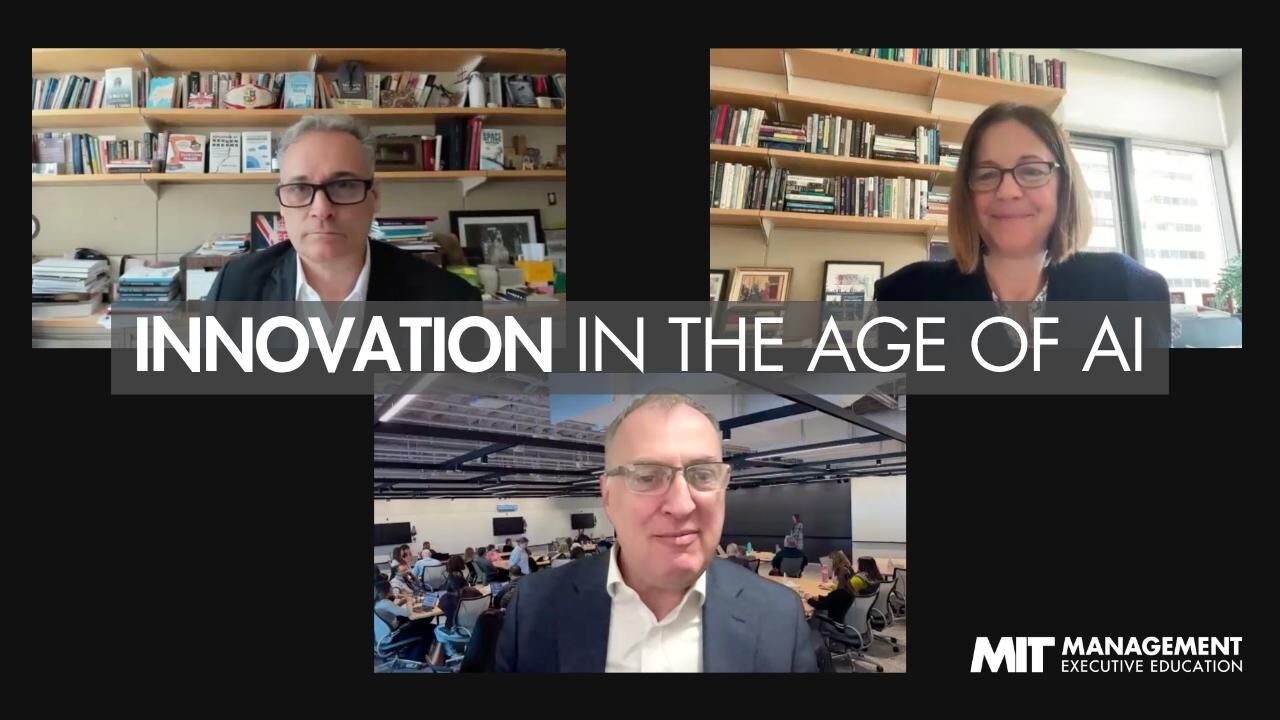




In a recent MIT Sloan Executive Education webinar, my colleagues Bill Fischer and Charlie Fine reflected on more than two decades of teaching “Driving Strategic Innovation: Achieving High Performance Throughout the Value Chain,” a six-day course offered jointly with IMD. As you can imagine, the course content has changed as much as the innovation conversation itself has changed during that time.
Innovation today reaches almost every part of an organization. It involves products and technology, certainly, but also business models, supply chains, organizational design, marketing, culture, talent, ecosystems, and increasingly AI. As a result, strategic innovation is becoming less about managing a defined innovation process and more about building an organization capable of making better choices amid continuous change.
Strategy must match the speed of change
Charlie uses the idea of “clockspeed” to describe the different rates at which technologies, markets, and organizations change. That distinction feels particularly important right now, as AI capabilities seem to change in a matter of months or even weeks. Markets shift. Geopolitical conditions change. Tariffs, competitors, customer expectations, and technologies can all alter assumptions on which previous investments were based.
Organizations need enough stability to invest, build, and capture value, but they also need to respond when the assumptions behind those investments change. That creates a difficult leadership challenge. How do you continue to benefit from what you have already built while preparing for a future that may arrive faster than expected?
Bill described this as the persistent tension between harvesting past investments and investing in what comes next. It is one of the central questions of innovation because both matter. An organization cannot continually abandon the present in pursuit of the future. But neither can it assume that yesterday’s sources of success will remain relevant.
In fact, Bill made an observation I found particularly provocative. As the time horizon contracts, familiar distinctions between long-term and short-term—or even between strategy and tactics—can become less useful. Paradoxically, that makes strategic judgment even more important.
AI changes more than the technology
Much of the current AI conversation understandably focuses on capabilities: what the models can do, how quickly they are improving, and which activities might be automated or augmented. Bill and Charlie pushed the discussion further, emphasizing that AI is also changing how organizations think about products, services, value propositions, business models, teams, and customer relationships. Bill described the opportunity to use AI to reconsider established business models and identify entirely new sources of value creation. That is a much broader question than, “Where can we use AI?”
The more interesting questions may be: What could we make now that was previously difficult or impossible? How might our customers’ expectations change? What should our teams look like? Where should ideas come from? And what parts of the organization may need to change and how?
Agentic AI makes these questions more pressing. Charlie was appropriately cautious here. We remain early in developing AI agents. Their potential productivity benefits are significant, but so are the uncertainties. Organizations are therefore going to be making consequential decisions before all the answers are available. Making choices under uncertainty is hardly new to leaders. What is new is the speed and scale at which some of those choices are arriving.
The hardest innovation problems are often organizational
Organizational structure and culture tend to attract less attention than technology, since they are harder to see. They are also much harder to change. Bill pointed out that while it may be relatively straightforward to design a new business model or articulate a new value proposition, creating an organization that can consistently support that value proposition is a much longer proposition.
Where does innovation come from today? Increasingly, organizations cannot assume that their best ideas will originate within their own walls. Bill described the evolution from a more “inside-out” view of innovation toward one that is increasingly outside-in, involving partnerships, ecosystems, and ideas flowing across organizational boundaries.
Charlie similarly emphasized looking beyond the individual company to understand the entire value chain or ecosystem. Technology, geopolitics, managerial choices, suppliers, customers, and competitors form interconnected systems. Change in one part can reshape opportunities elsewhere. For leaders, this requires the ability to look beyond the organizational chart.
Innovation requires experimentation and judgment
One of the final audience questions in the webinar captured another tension leaders face: engineering cultures often emphasize safety and risk reduction, while innovation is associated with experimentation and “failing fast.” Bill challenged the assumption that those activities necessarily belong in the same team. Charlie challenged the broader premise that engineering should be conservative while strategy should be experimental.
Even though experimentation without regard for consequences would be irresponsible, eliminating risk creates a different danger: an organization that becomes exceptionally good at protecting what it already has while the world changes around it. Strategic innovation therefore requires leaders to think explicitly about both risk and potential reward and to design organizations in which different types of experimentation can happen appropriately. No universal formula exists for that balance.
Perhaps that is one of the key insights from a program that has been evolving for more than twenty years. Bill described the course itself as an experiment in continuous learning. The faculty change the material as the world changes, learn from participants, test new ideas, discard what no longer works, and try again.
Learning to make better choices
Charlie used the MIT motto Mens et Manus (Mind and Hand) as an analogy for implementing strategic innovation. You learn an idea intellectually, and then you learn it again by putting it into action. Frameworks matter. Technology matters. Strategy matters. But ultimately, leaders have to make smart choices about where to invest, what to change, which assumptions to challenge, what risks to take, which capabilities to build, and what value they want their organizations to create.
The environment will keep changing. The goal cannot be to predict every change correctly. It is to build the capacity—in ourselves and in our organizations—to recognize change, learn from it, and make better choices as it happens. If you would like to explore these ideas further, join Bill, Charlie, and other faculty for the upcoming “Driving Strategic Innovation: Achieving High Performance Throughout the Value Chain” program at MIT Sloan Executive Education in the fall, or at IMD in Lausanne, Switzerland, in the spring, and dig deeper into the frameworks, choices, and organizational capabilities required to innovate in a rapidly changing world.