




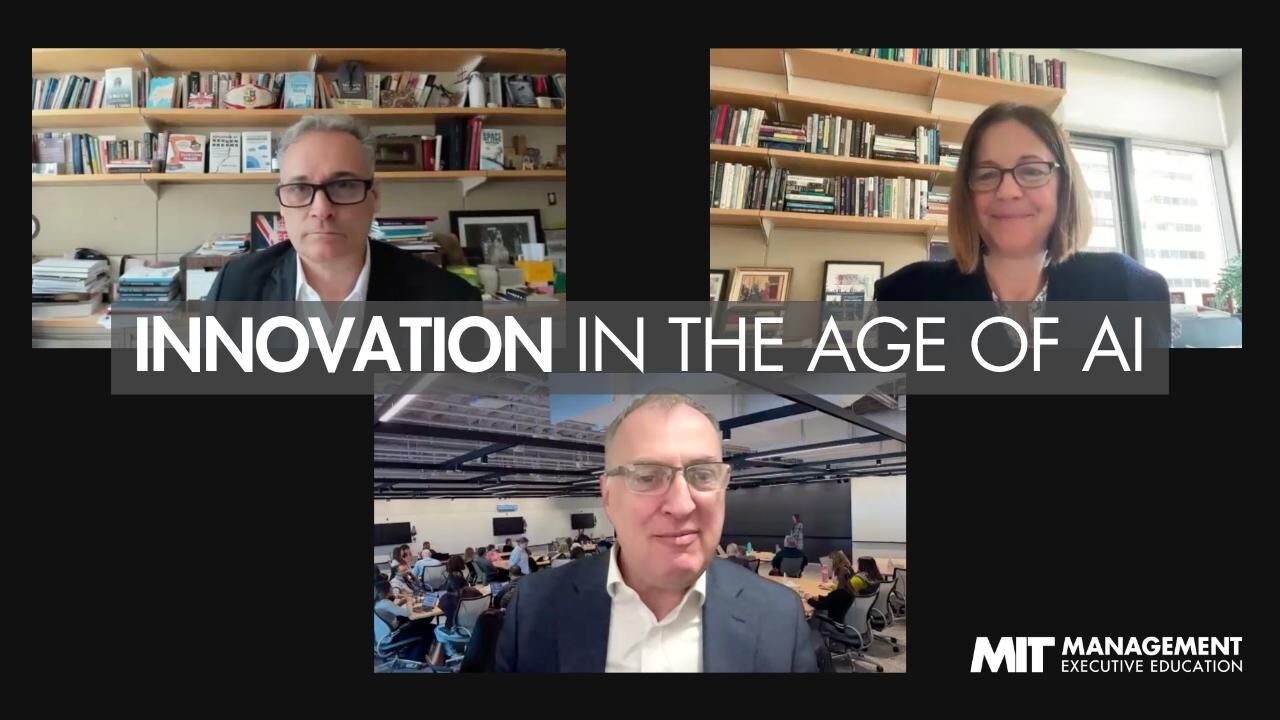



A few weeks ago, my MIT Sloan colleague Ben Shields, Senior Lecturer in Managerial Communication, made a compelling addition to the list—social connection. Ben was giving a talk to an audience of UNICON members, the international association of university-based executive education providers, in a two-day workshop titled “What Does It Mean to Be Human?” Hosted at our new learning space at One Memorial Drive, the discussions centered on the evolving role of executive education in supporting leaders, but the question is much bigger than that, and so was Ben’s point.
As AI changes how easily people can access knowledge and apply it, where will the distinctive value of human learning come from? Ben argued that it has always been an important part of the executive education experience, alongside knowledge transfer and knowledge application. But as AI makes some aspects of knowledge increasingly accessible and less differentiated, the ability to bring people together to learn, work, trust, and grow may become more important than ever. Ben’s presentation helped me see more clearly that social connection may not be simply another capability on the “human” list. It may be a set of conditions where many of those capabilities develop.
When knowledge is abundant, connection becomes more valuable
Ben began with the premise that social connection is a fundamental human need. Yet we are already experiencing what he describes as a social connection crisis, one that the AI age could only intensify. At the same time, connection plays an important role in how we learn, work, trust, and grow together. That has profound implications for education at any level.
For executive education, Ben described its value proposition as three interconnected elements: knowledge transfer, knowledge application, and social connection. All three are still important, but AI changes their relative scarcity. Knowledge transfer is more easily accessible and less differentiated, while AI can increasingly support the application of knowledge. And so the social connection becomes even more important. Learning is not merely the transfer of information. Leaders also develop through disagreement, dialogue, reflection, and shared experience. Trust is built between people. Judgment is strengthened by confronting situations in which there is no obviously correct answer. If knowledge becomes more abundant, the value of learning does not disappear. The source of that value begins to shift.
Human capabilities are exercised with other humans
We often describe judgment, empathy, curiosity, critical thinking, and creativity as individual capabilities. But let’s think about how they are actually developed. Judgment is tested when another person challenges our assumptions. Empathy requires another perspective. Curiosity becomes richer when someone asks the question we did not think to ask. Trust develops through repeated interaction.
Similarly, in writing about organizational adaptation to AI, I have argued that technical fluency will not be enough. The distinctly human qualities increasingly complement what AI can do. Ben’s argument suggests an important dimension: organizations cannot simply declare these qualities important. They need to create the conditions in which people can practice these skills together. That makes social connection much more than a “soft” benefit of work or education. It becomes part of the infrastructure for learning and leadership.
Designing deliberately for connection
This is not an argument against AI; quite the opposite. AI can expand access, increase responsiveness, help people explore possibilities, and support new forms of learning and work. The leadership challenge is to use those capabilities without inadvertently optimizing away some of the experiences through which people develop as leaders.
Ben offered a useful framework for thinking about that challenge: Build, Break, Adapt. What is already working that we should strengthen? What is holding us back that we should stop? And what should we experiment with or modernize? He applies those questions to social connection before, during, and after the learning experience. Leaders can ask the same questions more broadly.
What should we build because it helps people learn, trust, and make sense of complexity together? What should we break because it turns work or learning into an increasingly isolated and transactional experience? And what should we adapt so that AI creates more room for meaningful human interaction rather than simply removing humans from the process?
Those questions matter because the hard part of AI transformation has never been the technology alone. Organizations change through people: through behavior, confidence, culture, learning, and leadership.
Perhaps, then, the question for leaders is no longer only about what AI can do for us. It is also about what kind of human experience we are creating around it. The more capable our technologies become, the more deliberate we may need to be about something humans have historically taken for granted: our need to think, learn, challenge, celebrate, and make meaning with other people.
That may be one of the great paradoxes of the AI age. The technology pushing us furthest into the future may also remind us that our most human advantage is each other!