




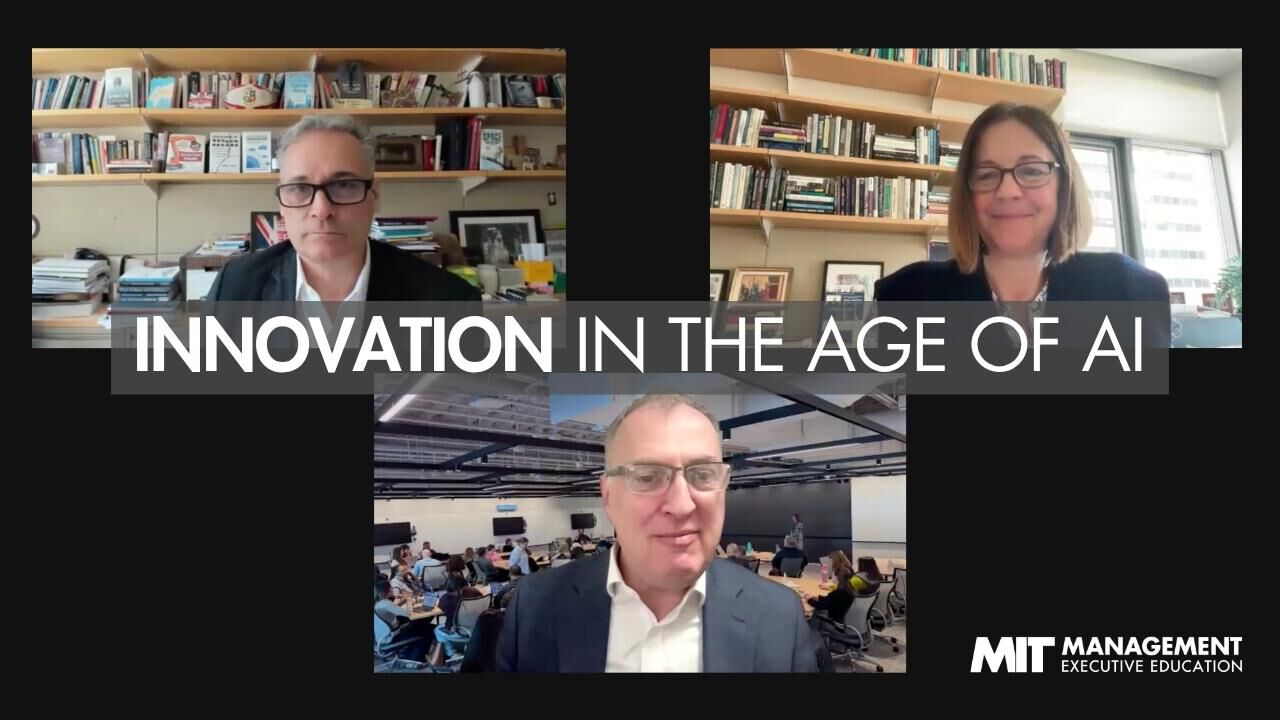




That was a key point my MIT Sloan colleague Steven Eppinger, Professor of Management Science and Innovation, made in a recent LinkedIn Live conversation. A longtime expert on systematic innovation, he made a compelling case for keeping the process at the center. As he put it, “AI is in our loop; AI is part of our process.”
Start with the work
Steve described how systematic innovation begins by breaking complex work into smaller, more manageable activities. You define the problem, understand customers, generate possibilities, evaluate them, test them, and decide what happens next.
AI fits this approach well because you can give it specific tasks and clear instructions at each stage. Steve offered a simple analogy: Imagine having several eager people ready to help. You would give them defined assignments, explain what you need, and supervise the results. Why should managing AI be entirely different?
This matters because organizations can easily mistake AI capability for process capability, Steve cautions. If the underlying workflow is poorly designed, adding AI may simply produce what he called a “faster mess.” Before automating the work, leaders need to understand how that work should happen. AI makes that responsibility more visible.
More ideas do not necessarily mean better ideas
Consider brainstorming. Generative AI has largely solved the quantity problem. Ask for ten ideas, and you can have them in seconds. Ask for a hundred, and you can have those too. But innovation was never really constrained by our inability to fill a whiteboard. Steve warns that AI can generate plausible responses quickly, but volume alone does not produce quality. A hundred mediocre ideas are not necessarily more valuable than ten.
This puts a premium on human expertise. Someone needs to recognize what deserves another look and direct the exploration toward territory that has not yet been considered. Someone also needs to look at an output and say: This is not what I meant. Try again, but go in this direction. Steve returned repeatedly to a deceptively simple, and often underestimated, idea: “We know what good looks like.”
Better AI will require better human judgment
One concern raised during the discussion was “cognitive surrender”: the temptation to accept an AI-generated answer simply because getting it was so easy. I suspect most of us have experienced this already. A result appears almost instantly. It seems reasonable. Perhaps it is not quite how we would have approached the problem ourselves or as good as we would like. But it is there, and the temptation is to call it good enough and move on.
The broader risk, Steve pointed out, is that we gradually invest less effort in exercising the judgment required to recognize weak work in the first place. That makes both domain expertise and AI literacy increasingly important. We need to understand the work well enough to define the task, assess the result, and recognize when further exploration is worthwhile.
Experiment before you automate
Steve also offered a practical way for leaders to approach AI without beginning with sophisticated systems. Start with a task. Try it in a chat interface. Change the instructions. Give the tool better data. See whether it can perform the work reliably. Learn where it helps and where it creates additional work. Only then consider turning the process into an automation or agent.
Once the work has been broken down into specific tasks, this kind of experimentation also becomes much easier. You can learn where AI genuinely improves the process before committing to a larger system. This replaces the pressure to make a sweeping technology decision with a series of smaller experiments. Some will show that AI can take on a task effectively. Others will reveal limitations. Both generate useful information.
The leadership task is changing
As AI becomes capable of handling more steps in a process, leaders may find themselves managing an increasingly mixed system of human and machine capabilities. The skills involved begin to look familiar: defining the work, setting standards, reviewing results, and deciding what to delegate. Steve reminded us that the tools are new, but many of the leadership questions are not.
What has changed is the scale and speed at which those decisions have to be made now. AI can generate possibilities faster than people can evaluate them and automate work before organizations fully understand its weaknesses. That makes judgment about where and how to use it increasingly important. As AI takes on more of the work, leadership becomes an allocation exercise: deciding where machines add value, where human expertise determines quality, and how the two should work together.
The organizations that develop that judgment will be much better positioned to turn AI’s expanding capabilities into better innovation. If you’re thinking about how to bring more discipline to innovation while making productive use of AI, Professor Eppinger and other MIT Sloan faculty explore these questions in the Systematic Innovation of Products, Processes, and Services course, offered November 9–13.