



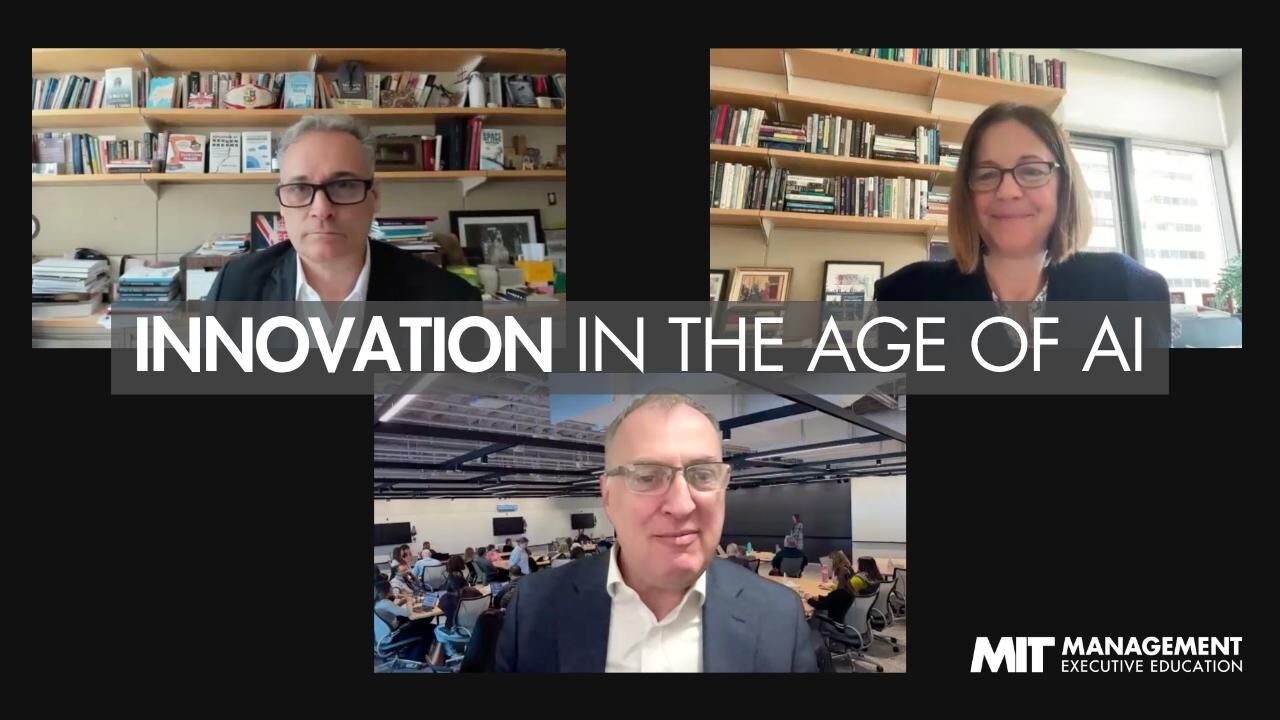




In a recent webinar, however, my colleague Pierre Azoulay, International Programs Professor of Management at MIT Sloan School of Management and a Research Associate at the National Bureau of Economic Research, offered a sharper perspective. He pointed out that the principles of platform strategy have not disappeared, but the level of difficulty in applying them effectively has changed. For leaders, that distinction is critical.
Most “platforms” aren’t actually platforms.
One of Pierre’s most important points is also one of the most overlooked: Many organizations that believe they are building platforms are not. As he noted during the session, the term has become so widely used that it often signals ambition rather than a precise strategic model.
Pierre is very deliberate in how he defines a platform. It is not about scale, technology, or even network effects. At its core, a platform enables interactions between distinct groups and reduces the friction that prevents them from occurring effectively. Misidentifying your business as a platform is not just a semantic error; it leads directly to flawed decisions on pricing, governance, and investment.
He offered a simple diagnostic that resonated with many webinar attendees: If you cannot clearly name the sides you are bringing together, you are unlikely to be operating a platform. It’s a deceptively simple test, but one that forces a level of clarity that is often missing.
AI doesn’t remove friction, only shifts it.
A common assumption is that AI will make markets frictionless. Pierre pushed back strongly against this idea. In his view, AI does not eliminate friction. It redistributes it.
Search becomes easier in one sense, as agents can surface dozens of options almost instantly. But as Pierre pointed out, abundance introduces a new problem: evaluation. When every option is optimized, polished, and algorithmically ranked, it becomes harder to distinguish signal from noise. The result is that while the cost of finding options decreases, the cost of choosing well often increases.
He extended this logic to transaction costs. While AI can simplify elements such as payments, verification, and coordination, it introduces new frictions around identity, trust, and interaction between autonomous agents. As Pierre framed it, the categories of friction are in motion and in both directions. The challenge for leaders is to understand how those shifts play out in their specific context.
Early platform decisions are hard to undo.
Pierre placed significant emphasis on what he calls “coring”: the foundational decisions that shape a platform before it ever reaches scale. These include choices about architecture, access, governance, and control, all of which are made before the first participant joins.
What makes coring so critical, in Pierre’s view, is its stickiness. Once expectations are set, they are difficult to change without consequences. He illustrated this with the example of Uber’s introduction of tipping. What seemed like a relatively small adjustment fundamentally altered the user experience and disrupted carefully constructed expectations.
As Pierre noted, large platforms with strong network effects can sometimes absorb these shocks. Smaller or emerging platforms rarely have that luxury. AI introduces an additional layer of complexity here, forcing leaders to make early decisions about agent participation, identity, and accountability—decisions that are similarly difficult to reverse.
Platforms require active governance
Another point Pierre repeatedly returned to is that platforms are not neutral. They are governed systems. There is often a tendency to view platforms as passive infrastructure, but Pierre challenged that notion directly. If you operate a platform, you are responsible for the market you create. That means managing imbalances, resolving disputes, and ensuring that incentives remain aligned across participants.
He pointed to real-world examples where the absence of governance led to significant consequences, reinforcing the idea that if a platform does not manage its ecosystem, others will, whether it’s regulators, competitors, or the users themselves.
In an AI-driven environment, this responsibility becomes even more pronounced. As Pierre highlighted, the introduction of agents and automated interactions increases both the complexity and the stakes of governance. Trust, once established through human interaction, must now be designed into the system itself.
Data alone is not a moat.
Pierre also challenged a widely held assumption about competitive advantage in the AI era: the idea that data alone creates a durable moat. In his view, most claims of data advantage are overstated. If data can be scraped or replicated, it is unlikely to provide lasting differentiation. Instead, Pierre identified more specific conditions under which data can still matter: real-time interaction data, data that is structurally difficult to access, or data that requires significant expertise to process and apply.
Even in these cases, the advantage is narrower and more fragile than many assume. As he noted, the conversation should shift from “Do we have data?” to “What kind of data advantage do we actually have, and how defensible is it?”
AI raises the bar for judgment.
If there is a single theme that runs through Pierre’s perspective, it is that AI increases the need for judgment rather than reducing it.
The frameworks of platform strategy remain intact, but the environment in which they are applied is more dynamic, more ambiguous, and less forgiving. As Pierre put it, this is not a moment to abandon first principles, but to apply them with greater rigor.
For organizations considering whether to adopt a platform model, his advice was equally clear. The goal is not to be “platform envious,” but to be “platform curious.” That distinction reflects a deeper point: Platform strategy is not a default path to growth, but a deliberate choice that requires careful consideration.
Ultimately, as Pierre’s webinar made clear, the competitive advantage in an AI-driven platform economy will not come from technology alone. It will come from the ability to make better decisions—earlier, and with greater clarity.
Pierre and another MIT Sloan faculty member, Associate Professor John Horton, explore these topics in even greater depth during our four-day live online course “Platform Strategy: Designing for Humans and AI Agents,” running Jun 15–18, 2026, so there is still time to enroll!