


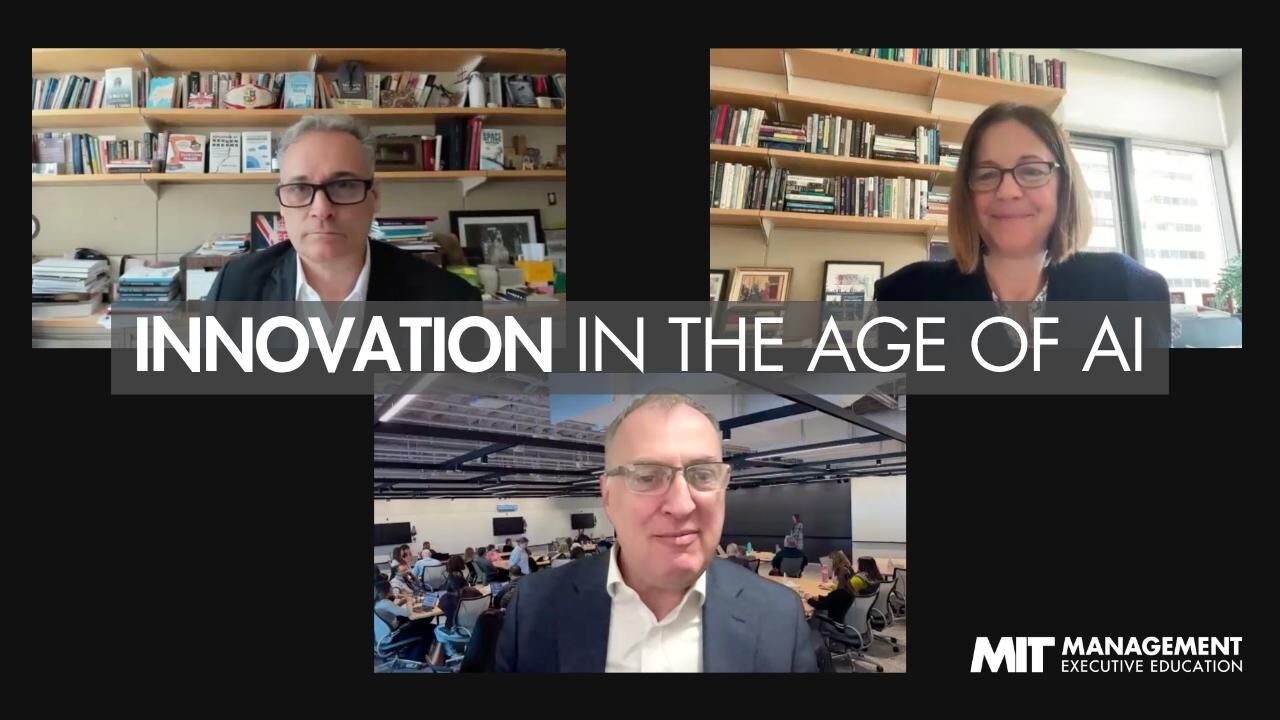




Key Takeaways from: Innovation in the Age of AI
To hear the full discussion, watch the full webinar recording here.
Innovation in the Age of AI
At MIT, innovation is defined as “the process of taking ideas from inception to impact.” This definition emphasizes that innovation is not a single breakthrough moment, but a structured journey, one that moves from identifying problems to delivering meaningful outcomes. It also reinforces that impact extends beyond products or profit, and that an idea is fundamentally a match between a problem and a solution
In this context, AI has rapidly shifted from an emerging capability to an embedded part of everyday business operations. As Fiona Murray asks, “what does it really mean to have AI as part of an innovation strategy?” The answer lies not in replacing the innovation process, but in enhancing it. AI can support organizations in exploring ideas, evaluating opportunities, and executing at scale, but it does not substitute for the discipline required to take ideas to impact.
From Experimentation to Impact
Innovation begins with exploration, but its value is only realized through execution. As Murray explains, it “starts from exploration and takes some ideas all the way through to scaling and really significant value creation.”
While AI has made it easier to generate and test ideas, many organizations struggle to move beyond early-stage experimentation. As Phil Budden noted, this is “often where exciting emerging technologies come unstuck and don’t deliver innovation that leads to impact.”
For leaders today, the challenge is not a lack of ideas; it is the ability to move them through to execution and scale consistently.
Managing Innovation at Scale
Both Budden and Murray emphasize the importance of portfolio thinking when managing innovation at scale. Innovation does not occur through a single initiative; it requires a coordinated set of efforts across an organization. A portfolio provides a clear view of how resources are allocated and serves as a practical expression of strategy.
As Murray explains, “your portfolio needs to reflect your strategic vision and your strategic goals.” In practice, however, many organizations face a disconnect between ambition and execution. Leaders may articulate a goal of transformation, yet the majority of resources are allocated to incremental projects.
This is why, as Murray noted, “the portfolio is, in a sense, the daily reality, it's the manifestation of their actual strategy.” For leaders, the implication is straightforward: innovation strategy is not what is stated, it is what is funded and actively managed.
Expanding the Innovation Landscape
AI is not just a tool to utilize; it is reshaping the landscape. It is expanding both the range of problems organizations can address and the solutions available to solve them.
As Murray explained, AI is part of a solution. At the same time, “it also shapes the problem space.” This dual role is critical. AI is not only embedded in new products and services, but it is also changing how organizations identify opportunities, understand customer needs, and define strategic priorities.
Across industries, this shift is creating new possibilities. AI can improve how organizations generate insights from data, enhance decision-making, and develop more effective solutions. But it also introduces new challenges, from managing data effectively to identifying which opportunities are worth pursuing.
For leaders, the key is to recognize that AI is expanding the innovation landscape in both directions. It increases the range of what is possible, while also increasing the complexity of deciding where to focus time.
Balancing Experimentation with Discipline
AI has significantly expanded the ability for organizations to experiment. It enables broader exploration, faster ideation, and new ways to generate and evaluate ideas. As Budden notes, these tools can help individuals become more creative and expand the problem, solution, and discipline to deliver on the ideas.
However, this increase in experimentation introduces a new challenge. As innovation becomes more distributed across an organization, leaders must balance openness with discipline. The democratization of innovation, often described as letting “a thousand flowers bloom,” can drive creativity, but also creates complexity in organizations.
To manage this effectively, organizations must implement clear stop-go decision processes. As Murray highlights, it is not enough to encourage experimentation; leaders must also be willing to “cultivate the garden reasonably aggressively at the right moment.” This means tracking initiatives, learning quickly, and making deliberate decisions about where to allocate resources.
Ultimately, the goal is not just to generate ideas but to scale the right ones, while stopping those that do not deliver value.
The Leadership Imperative
AI is a powerful tool, but it is not a replacement for leadership. While it can enhance decision-making and improve efficiency, it does not remove the need for human judgment, accountability, and strategic direction.
As Murray explains, these technologies should be viewed as “a sort of decision support,” not a substitute for decision-making itself. In fact, she cautions against over-reliance, noting “I’m not actually an advocate of us completely outsourcing decision making to a system that we don’t really fully understand.”
AI is both an opportunity and a toolkit for internal management and leadership. It can support how organizations prioritize projects, evaluate risks, and manage innovation processes, but leaders must remain actively involved.
Leading Innovation in an AI-Driven World.
As AI is reshaping how organizations approach innovation, it does not change the fundamentals of how innovation succeeds. AI explains what is possible, broadening both the problem space and the range of solutions, but the responsibility of delivering impact remains firmly with leaders.
For leaders looking to dive deeper into these concepts, consider joining Fioan Murray and Phil Budden's upcoming 8-day program, Innovation Executive Academy at MIT Sloan Executive Education. Where they dig into these issues in greater detail and highlight practical innovation tools and scenario-planning frameworks that can support leaders in assessing, managing, and responding to the waves of innovation in this age of AI.