




Shvedkyi arrived at MIT Sloan Executive Education’s Executive Program in General Management (EPGM) as a seasoned energy-sector executive whose leadership style was already well developed. But the environment around him had changed dramatically. Leading an energy business in Ukraine during wartime meant making consequential decisions every day, often without complete information and rarely with the luxury of certainty. In that context, leadership could not be theoretical. It had to be immediate, resilient, and clear-headed.
The moment that called for a different kind of leadership
What brought him to MIT was not a lack of experience but a desire to evolve his thinking. “I was looking for an environment where I could not just gain knowledge, but rethink my approach to leadership itself,” Shvedkyi says. “MIT became exactly that place where complexity is not simplified, but understood and navigated.”
That search for perspective led him to EPGM, MIT Sloan Executive Education’s hybrid, seven-month program for mid-career leaders preparing for the next phase of their professional journey. The program is designed to immerse participants in MIT Sloan’s approach to innovation, leadership, strategy, and decision-making while connecting them with a global cohort of experienced executives.
A program that fits the reality of leadership
For Shvedkyi, the structure of the program was important. A traditional full-time MBA was not realistic. He could not leave his company or his country for an extended period, and he was not looking for a long pause from work. What EPGM offered instead was a format that made rigorous learning possible alongside real-life responsibilities.
That combination of immersion and continuity became one of the defining strengths of the experience. The on-campus portions gave him something rare: room to reflect. Coming from the realities of wartime leadership, he found value in stepping back and seeing his work from another perspective. The online portions extended that reflection into practice. “That was where the real work happened,” he says. Back in Kyiv, he could test what he was learning in real time, using his own business challenges as a proving ground.
From tactical response to strategic architecture
The most important challenge Shvedkyi brought to the program was not technical. It was internal. He already knew how to run operations. What he wanted to understand was how to move beyond constant reaction mode and begin building something more scalable and enduring.
In times of political volatility, quick decisions are often unavoidable. But over time, Shvedki found himself asking a different kind of question: How do you translate repeated crisis response into a system that can support long-term growth? How do you build not only for today’s survival, but for tomorrow’s resilience? That became the deeper leadership challenge he wanted to solve.
“The program shifted my focus. I no longer think only like an operational manager. I think like a strategic architect who wants to build a system.”
Building a new vision for energy
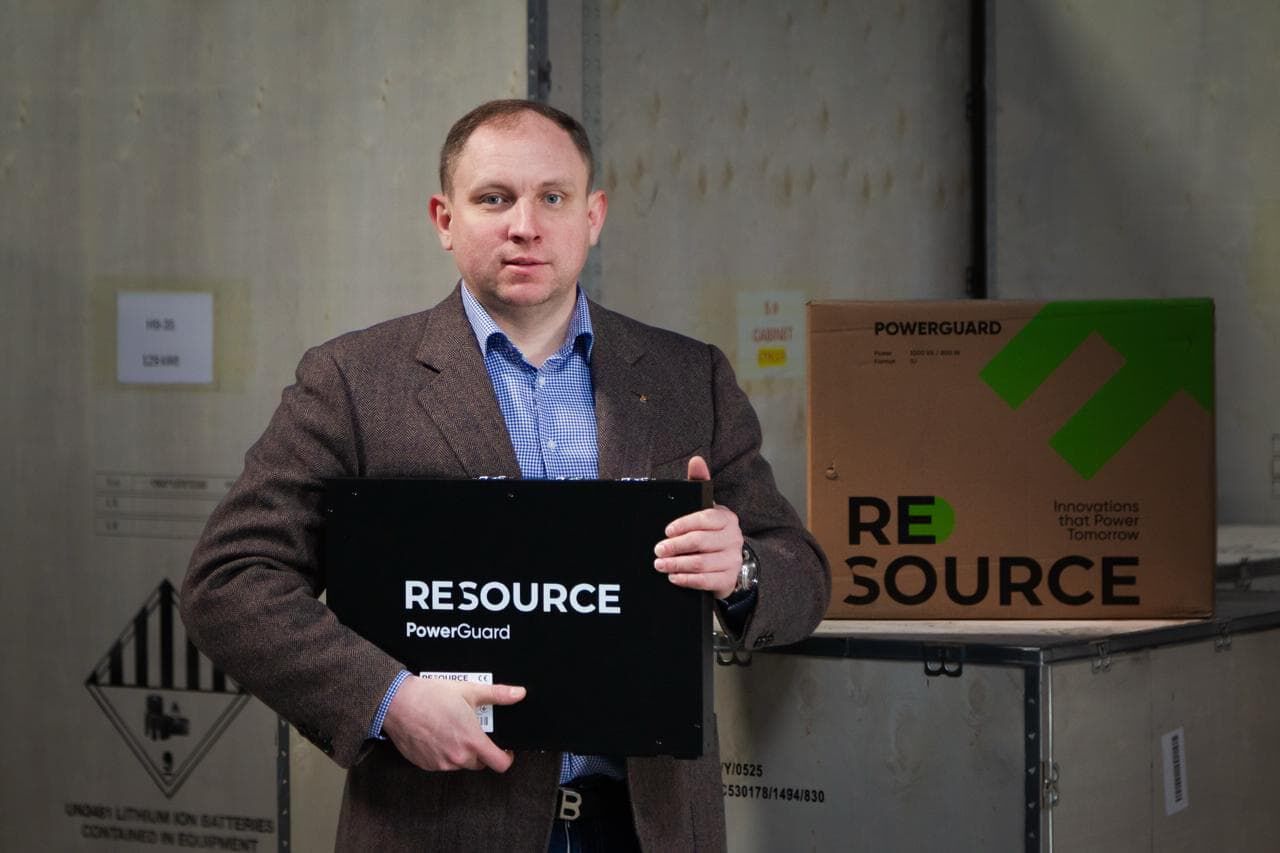
As he progressed through the program, Shvedkyi began developing a new direction in his work: a company focused on energy storage systems and a service-based model for a centralized energy system. Instead of thinking only in terms of supplying equipment or supporting infrastructure, he began exploring energy storage as a service—a model that would need to be technologically viable, economically sound, and scalable under highly uncertain conditions.
Multiple parts of the EPGM curriculum shaped that evolution in his thinking. He points to innovation, finance, and negotiation as especially useful, as well as conversations with peers that broadened his understanding of how new ventures are built. “I began to see energy not just as distribution or industry,” he says, “but as a complex ecosystem—technology, market, consumer behavior.”
That broader systems perspective gave him a new way to frame the work ahead. Rather than focusing only on immediate operational demands, he began to think in terms of platforms, business models, partnerships, and the long-term architecture required to support transformation in the energy sector.
Finding perspective in a global cohort
The cohort experience played a major role in that transformation. Shvedkyi describes the peer network as one of the most valuable parts of the program. Through conversations with fellow participants from different countries, industries, and organizations—including major global companies—he gained exposure to new ways of thinking. Those exchanges helped him sharpen his own ideas while also allowing him to see how leadership, scale, and innovation are approached in other contexts.
For someone leading through pressure and uncertainty, that kind of network carries real value. It offers not only perspective, but also community: a group of peers who understand the demands of leadership and can provide insight long after the formal program has ended.
Turning learning into action
That kind of transformation is closely aligned with EPGM’s broader purpose. Faculty Director David Robertson describes the program as helping executives move from functional decision-making to the broader, cross-functional thinking required of senior leaders. In his view, the program gives participants both a broader understanding of how companies operate and a trusted network they can rely on as they face increasingly complex leadership challenges.
Program Director Mollie Laffin-Rose Agbiboa saw something distinctive in Shvedkyi’s experience from the very beginning. She recalls noticing his application immediately because he was applying from Ukraine under exceptionally difficult conditions. What stood out was not only his commitment to an intensive program but the speed with which he translated learning into action. For her, his journey reflects what executive education can do at its best: support leaders facing real-world pressure as they apply new thinking directly to urgent business challenges.
What leadership means under uncertainty
For Shvedkyi, the most lasting insight from the program is not a single framework or classroom exercise. It is a redefinition of leadership itself. “Leadership is not about controlling every process,” he says. “It is about the ability to shape the future, even in the most uncertain conditions.”
Today, that belief continues to shape how he works. His focus in the energy sector is now more intentionally structured around scalable solutions and adaptive business models. The pressures of his environment remain real, but his response to them has changed. MIT Sloan did not remove the complexity of his world, but it helped him build a stronger way to lead within it.
If you are ready to take the next step in your career, the Executive Program in General Management can help you strengthen your leadership, expand your strategic perspective, and build a global network of peers.