







What strikes me most about this moment is not simply the speed of change, though that is remarkable; it is the need for leaders to hold two ideas at once. AI is creating genuinely new possibilities, and yet the fundamentals of innovation leadership remain surprisingly durable.
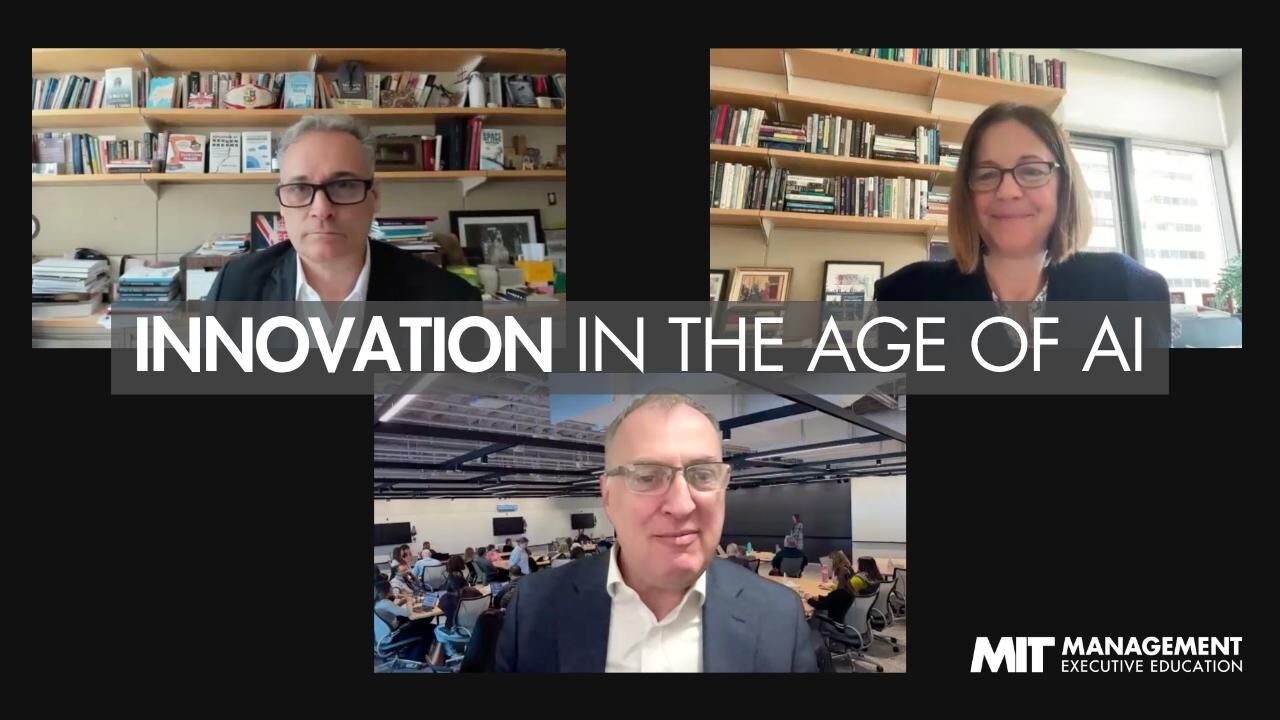
In a recent MIT Sloan Executive Education webinar, I had the opportunity to explore this tension with two MIT Sloan colleagues, Professor Dame Fiona Murray and Dr. Phil Budden. Fiona, an MIT Sloan professor and long-time advisor to public- and private-sector organizations, brings deep expertise in innovation strategy, frontier technologies, and ecosystems. Phil, a Senior Lecturer at MIT Sloan, has spent years helping organizations think clearly about innovation. What emerged from the conversation was not a reaction to AI hype, but a reminder that durable frameworks matter most when the environment is changing quickly.
Innovation is a process.
Early in the conversation, Phil explained MIT’s definition of innovation as “the process of taking ideas from inception to impact.” I find that framing especially important now, because AI can make innovation feel almost frictionless. New ideas can be generated quickly. Possibilities can be explored more broadly. Experiments can begin with fewer barriers than before.
But innovation is not simply the production of more ideas. It is the disciplined work of connecting a meaningful problem with a viable solution and carrying that connection through to impact. Phil’s point that an idea is really a match between a problem and a solution is a useful corrective to much of the current excitement. That is where the word “impact” matters. Impact may mean profit and growth, but it can also mean better public services, stronger healthcare outcomes, improved cybersecurity, or better decisions inside complex organizations. AI is powerful, but it does not decide which impacts matter. That remains a leadership responsibility.
AI expands the journey, but does not replace judgment.
Fiona built on this idea in a way that stayed with me. She described AI as a tool that can support the entire journey from inception to impact. It can help organizations explore wider idea spaces, generate options more creatively, triage possibilities, and support evaluation, scaling, and implementation.
That is exciting because it means AI can strengthen the innovation process, not merely accelerate isolated tasks. But it also raises an important caution. Faster is not always better. More ideas are not always more valuable. Greater efficiency is not the same thing as innovation.
Fiona’s distinction between efficiency and value creation is one that leaders should take seriously. There are real productivity gains to be had, and organizations should pursue them. But if AI is used only to speed up existing work, leaders may miss the larger opportunity. The more interesting question is whether AI helps an organization create more meaningful impact for customers, patients, citizens, employees, or other stakeholders.
Leaders need to think systemically.
Another takeaway from the discussion is that leaders must become more systematic in their approach to innovation. It is not enough to ask how AI can optimize an internal process. The better question is how an organization’s internal innovation system connects to the external ecosystems around it.
Within the organization, leaders need the processes, capabilities, governance, and decision-making mechanisms that enable innovation to occur repeatedly rather than accidentally. But as Fiona emphasized, much of the learning and opportunity also sits outside the walls of the firm: in startups, research institutions, investors, partners, and other parts of the innovation ecosystem.
This distinction between systems and ecosystems is one Phil and Fiona explore in much greater depth in the MIT Sloan Innovation Executive Academy. It is especially relevant now because AI is developing so quickly that no organization can afford to be entirely inward-looking. Competitive advantage will depend not only on what leaders build internally, but also on how well they read signals, form relationships, and learn from the wider environment.
Democratization takes discipline.
I was also struck by Fiona’s reflections on democratizing innovation. For years, leaders have wanted more people across the organization to participate in innovation. AI makes that ambition more realistic. These tools can lower barriers, help people experiment, and allow insights to emerge closer to where the work actually happens.
That is a very positive development. Some of the most valuable AI use cases may come not from a central team, but from people who understand the friction points in daily operations. They know where time is lost, where customers struggle, where processes fail, and where better decisions could make a difference.
But democratization is not the same as diffusion without direction. Fiona’s metaphor captured the leadership challenge well: “Let a thousand flowers bloom,” but then be ready to “cultivate the garden reasonably aggressively at the right moment.” Phil reinforced the point by reminding us that experimentation has costs in time, focus, and investment. Leaders need to create space for exploration, but they also need to make choices about what is worth scaling. That balance between openness and discipline may be one of the defining leadership capabilities of the AI era.
Innovation is now everyone’s leadership work.
Toward the end of the session, I asked Phil and Fiona who most needs this kind of innovation education. Their answers reinforced something we see every day in our executive education programs: Innovation can no longer be left only to people with innovation, R&D, or ecosystem roles in their titles.
Phil warned that if innovation sits only at the center, it risks becoming “innovation theater.” Fiona made a similar point from the perspective of people managing projects, products, services, and technology-enabled value creation. Many leaders may not describe themselves as managing an innovation portfolio, but if they are responsible for creating value through new tools, new processes, or new offerings, then that is precisely what they are doing.
That is especially true with AI. Because the technology touches so many parts of the organization, the responsibility for using it well is necessarily distributed. Business unit leaders, operating leaders, and functional leaders all need to understand how to connect technological possibility to real value creation.
The tools will change. The leadership task remains.
What I found most valuable in the conversation with Phil and Fiona was the combination of urgency and steadiness. AI is changing quickly, and leaders should not be complacent. But neither should they be swept away by each new wave of hype.
There is no shortage of places to encounter the latest claims about AI. What is rarer, and more useful, is a set of tested ideas that help leaders remain practical, applied, and impact-focused as the landscape shifts.
AI will continue to change the tools available to us. But the central leadership task remains strikingly consistent: Connect ideas to impact, build the systems that support innovation, engage the ecosystems that accelerate it, and make thoughtful choices about what is worth scaling.
If you would like to explore these ideas further, join Phil, Fiona and other MIT Sloan faculty at the upcoming Innovation Executive Academy, where you will dig deeper into these issues and practical innovation tools and frameworks.