



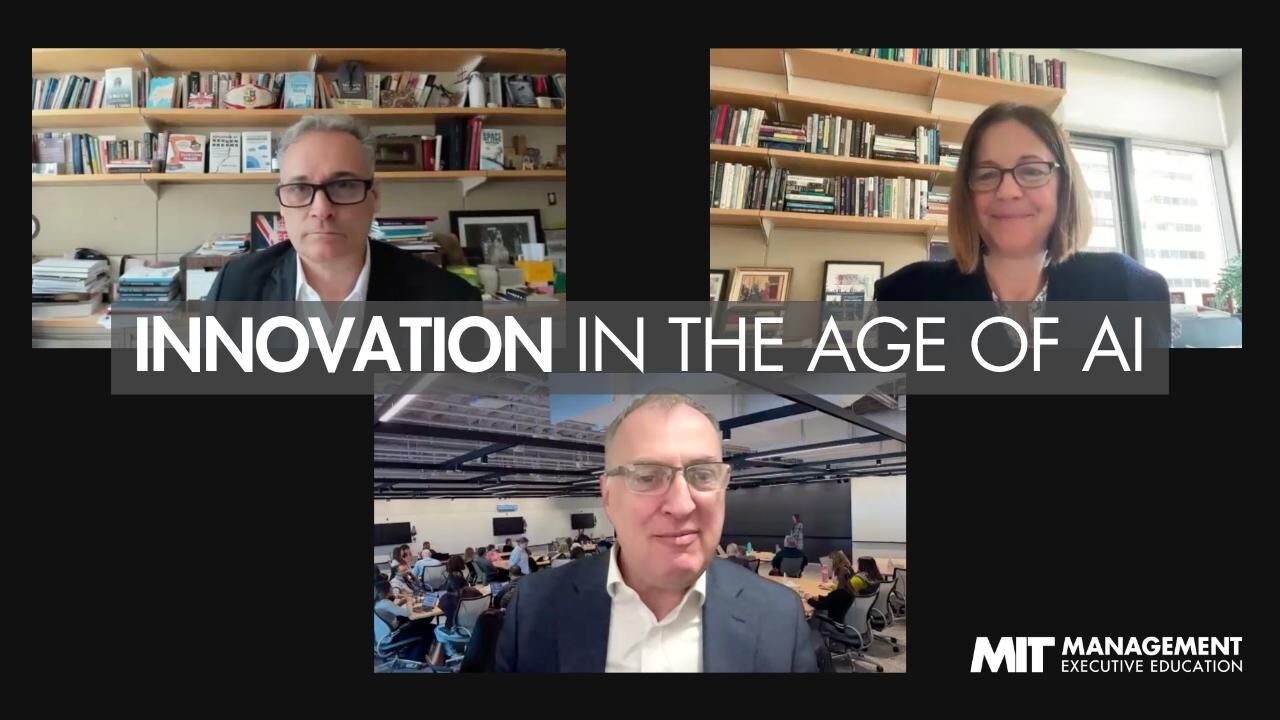




In a recent MIT Sloan Executive Education LinkedIn Live webinar, John Sterman, the J.W. Forrester Professor of Management, Professor of System Dynamics at MIT Sloan, and one of the leading voices in systems thinking, argues that this is not a failure of intelligence or effort. It is a failure of how we think. The challenge for leaders is not simply making better decisions, but understanding the systems in which those decisions occur.
The world runs on feedback, not plans.
Most organizations still operate on a linear decision-making model: Define the problem, analyze the options, choose a course of action, and execute. It’s clean, logical, and deeply misleading in complex environments.
In reality, decisions unfold through feedback loops. Every action changes the system, and those changes influence what happens next. Plans evolve, assumptions break down, and progress rarely follows a straight line. What appears to be poor execution is often the natural behavior of a system responding to intervention. Anyone who has ever led a project knows this. Leaders are not executing plans; they are continuously adjusting within systems that are in motion.
The most dangerous problems are mis-solved.
One of the most persistent leadership challenges is not failing to act; it is acting with confidence and still getting the wrong result. Sterman describes this as policy resistance: situations where solutions appear effective at first but ultimately undermine themselves over time. Expanding road capacity to reduce congestion often leads to more traffic. Efforts to control healthcare costs can increase total spending. Strategic mergers frequently fail to create value despite strong logic.
These outcomes are not the result of poor execution. They reflect decisions made with an incomplete view of the system. The problem is not that leaders are solving the wrong problem—it is that they are solving it in a way the system cannot sustain.
Decisions don’t have “side effects.”
When outcomes diverge from expectations, leaders often attribute the result to unintended consequences or external factors. In practice, this framing obscures what is really happening. Every decision produces multiple effects. Some are anticipated, and others are not. What we call a “side effect” is simply an outcome that falls outside the boundaries of our thinking.
This matters because it shifts accountability. If negative outcomes are treated as external, leaders miss the opportunity to refine their mental models. Strong leadership requires expanding the system boundary, recognizing that what lives outside our initial analysis is often what drives long-term performance.
What you don’t see drives what happens.
Leaders tend to focus on measurable, short-term outcomes, but the most important drivers of behavior often lie beneath the surface. Delays, indirect effects, and reinforcing feedback loops quietly determine how systems evolve. In healthcare, for example, efforts to reduce costs by tightening approval processes may lower unit costs in the short term. Still, they can delay care, worsen outcomes, and ultimately increase overall demand for services.
The visible system tells an incomplete story. The full system reveals why well-intentioned actions can produce counterintuitive results. Leadership in complex environments depends on the ability to see and act on both.
Experience alone can reinforce the wrong lessons.
Experience is often seen as the foundation of good judgment. Yet, in complex systems, it can be unreliable. When feedback is delayed or distorted, leaders receive positive signals from decisions that are quietly creating long-term problems. Early success reinforces flawed strategies, leading organizations to double down just as the system begins to push back.
Over time, this dynamic can entrench behaviors that are misaligned with desired outcomes. Without a systems perspective, experience does not necessarily lead to better decisions, and it can make poor ones more persistent.
This is why developing systems thinking requires more than analysis. It requires experience in a different form: through simulation, experimentation, and structured reflection that make system behavior visible over time.
Fewer decisions may actually work better.
The challenge of modern leadership is not complexity itself. It’s our tendency to oversimplify it. The leaders who will succeed are not those who move fastest or act most decisively in the moment. They are those who take the time to understand the systems they are shaping and who resist the allure of quick fixes. In the end, effective leadership in complex environments is not about making more decisions. It is about making fewer decisions that actually work.
For leaders looking to deepen this capability, upcoming programs like MIT Sloan Executive Education’s “Business Dynamics: MIT's Approach to Diagnosing and Solving Complex Business Problems” and “Understanding and Solving Complex Business Problems” offer a structured environment to test assumptions and explore real-world applications of systems thinking. If your organization is grappling with persistent challenges that resist conventional solutions, investing time in understanding the system itself may be the most valuable next step.