





When Antonio Melé came back to MIT this year for a reunion of the Advanced Management Program, he brought a demo. He put an AI agent on speaker, cast himself as the job candidate, and let it interview him in front of the room. It asked about his availability and his previous experience. When he cut in to say he was busy, it offered to call him back in ten minutes and booked the slot.
Three years earlier, in the same program, he had spent a weekend building a chatbot for his AMP cohort. He named it TIM, after MIT's mascot. His classmates started calling it BeaverAI.
A beaver with opinions
Melé's cohort arrived in the summer of 2023, which happened to be the summer everyone started paying attention to large language models. AI worked its way into the program — including a session led by MIT Sloan Senior Lecturer Rama Ramakrishnan — and into the conversations that ran alongside it.
Melé, who already had the technical background to build with the technology rather than just discuss it, spent a weekend doing exactly that.
BeaverAI was an internal tool, loaded with what the group was learning: lecture notes, frameworks, session materials. Ask how to work through the "Where will we play?" choice in Lafley and Martin's strategy cascade, and it answered from the actual course content.
He also gave it a personality, which is the part the cohort remembers. Asked what he did for a living, TIM explained that he worked in dam construction — a serious responsibility requiring careful planning — and that he applied the 4-CAP+ leadership model to it.
Classmates tested him through the rest of the program, threw prompts at him, and reported back what worked. The inside jokes accumulated inside the model alongside the frameworks.
It was a weekend experiment, built for 34 people and never meant to leave the cohort. But the shape of it stayed with him: a named agent, with specific context and knowledge, holding a conversation on its own.
"That was the first AI agent I built," he says. "It had the same essence as what we ended up building with OrbioAI."
Why he was there
Melé arrived at AMP after selling Nucoro, the fintech company he had co-founded and grown to 40 people, to the global banking platform Backbase. It was the end of a long and volatile run, and he was moving from running his own startup to being part of an organization with thousands of employees.
"We were in the middle of finalizing the transaction, and everything was changing a lot for me," he recalls. "I was thinking about what to do next and how to improve my leadership skills. It was the right timing, and it was a pivotal moment for me."
He had not come to MIT to learn to code. There had been computers in the house since he was a child, because of his father's work.
"When I was a kid, I was always studying and trying to build something," he says.
That led to an engineering degree and stayed with him through everything after. He is the author of Django by Example, now in its fifth edition and seven languages. The engineering was the part he already had.
"I had always been more in the startup world, building things and launching ventures," he says. "I knew how to build and scale a company. I came to MIT to get sharper about which company to build."
The frameworks that ended up inside BeaverAI are a fair index of what he was absorbing that summer: strategy models, leadership capabilities, and a different lens on the problems he already knew how to solve.
"I learnt frameworks and tools that allowed me to redefine the problems I was addressing and craft successful strategies," he said at the time.
What changed, by his account, was not only the toolkit but also the tempo. The founder's instinct is to attack the problem in front of you immediately; what the program gave him was the discipline to stop first and establish whether it was the right one. He credits MIT's mens et manus ethos — mind and hand — with making the habit stick.
Thirty-four people, twenty countries
Melé's cohort was 34 executives from 20 countries, across a wide range of functions and industries. What they had in common was timing.
"Everyone was at this pivotal moment where they were making some significant change in their lives," Melé says. Some were moving into C-suite roles. Others were leaving long careers to start companies, or working out what they wanted the next stage to look like.
"We built very strong connections," he says. "We have very good friendships, and we always ask each other for advice."
The range of the group is what makes the advice worth having. "You have people with very different backgrounds and in different industries," he explains. "One call with any of them can change how I'm seeing something. Either they bring a different perspective, or they have already been through a very similar situation."
A number of the cohort have launched companies since. Among them: Rosa Fernandez-Velilla, whose consultancy Prompt Couture works on AI transformation with fashion brands; Nicola Previati, who built Fractal Cloud, a platform to standardize and govern cloud infrastructure at scale; and Levan Kiladze, a serial entrepreneur whose SecondBoard is an AI advisory board for founders.
From TIM to Maria
Melé stayed at Backbase for nearly two years after the acquisition. In June 2025 he left to co-found OrbioAI with two other second-time founders, Nacho Travesí and Sergi Bastardas.
OrbioAI builds AI agents for HR, aimed at the frontline and deskless workers that conventional HR software was never designed around. The agents handle hiring, onboarding, engagement, and offboarding, reaching people by voice call, SMS, and WhatsApp.
The design constraint is a human one. Someone applying for a warehouse or restaurant job usually cannot take a recruiter's call at two in the afternoon.
"Candidates can apply for a job at night or whenever they have time," Melé explains. "The agent will contact them and do the interview at that time. Many of the conversations are being handled after hours."
That constraint is also a hard engineering problem. An agent that conducts one interview well in a demo is not the same as a fleet of them running unsupervised at midnight across three channels in several markets and languages.
"Many companies are building proofs of concept," he says. "But it's very difficult to actually get something out that you launch into production, and then monitor the agents at scale."
Just over a year after founding, OrbioAI has 30 employees and agents operating in 16 countries
— the United States, markets across Latin America and Europe, Australia, and Japan —processing more than three million candidates a year. Customers include YUM! Brands, Adecco, and AT&T. The company raised a $21 million Series A in June 2026, led by Dawn Capital.
OrbioAI's agents each have a name and a job. Maria runs the interviews, including the late-night ones and, for one afternoon at the reunion, the one with Melé on speaker. Daniel handles onboarding, and Clare covers engagement and exit interviews.
Melé built the first version of the product himself. As the company has grown, his job has moved toward the team, the strategy, and the organization — the side of the equation he came to AMP for.
"I can understand the strategy and how I can define a vision, but I can also execute it," he says. "AMP gave me a whole other set of skills I use every day."
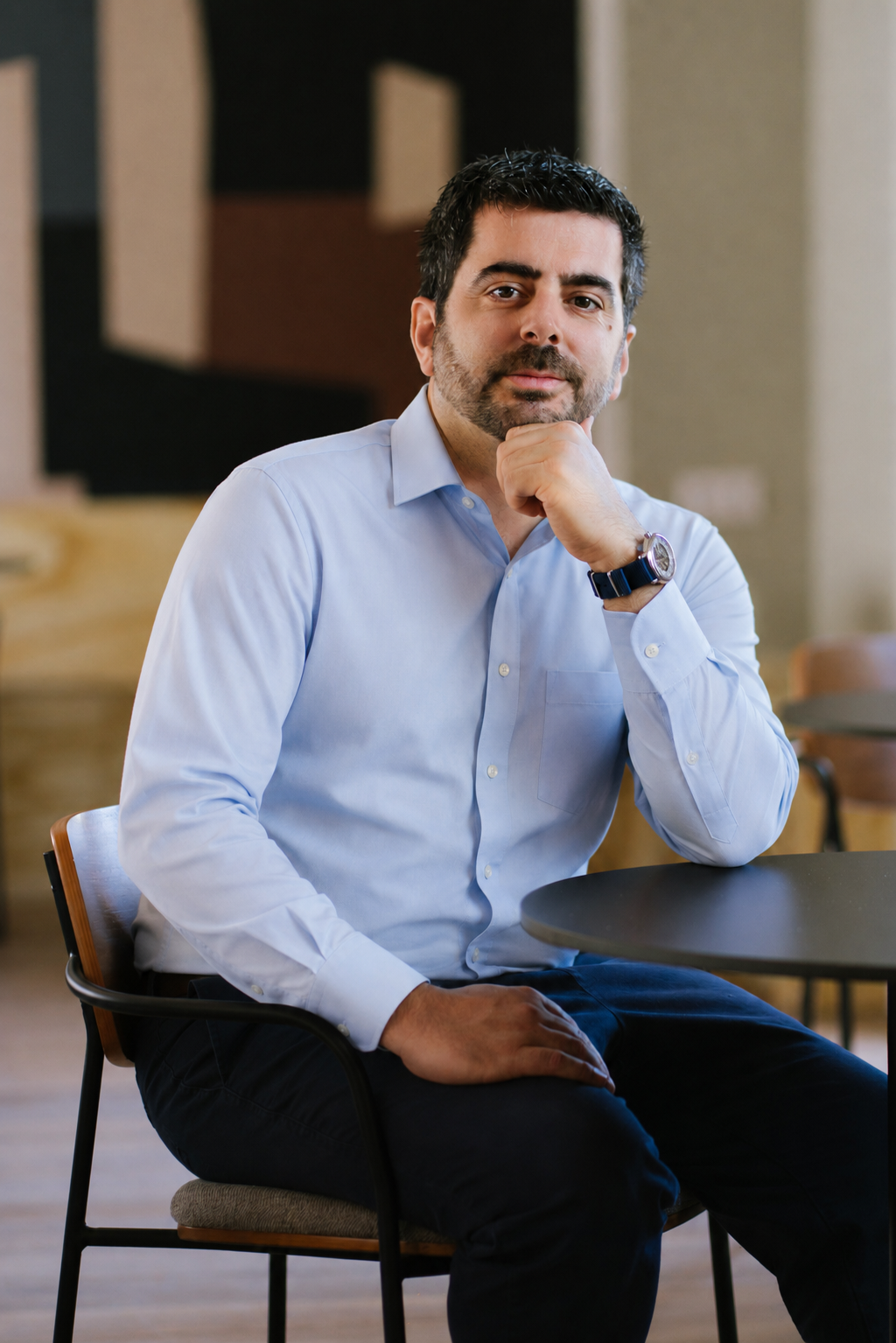
Three years earlier, on a weekend, he had built a chatbot that told jokes about dam construction. AMP itself produced something slower: a sharper sense of which problems were worth solving, and thirty-three people he can still call when he isn't sure.
"AMP was transformational, and I made true friendships with incredible people," he says. "I would totally do it again."