


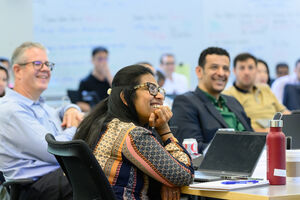


Artificial intelligence is forcing leaders across industries to rethink how their organizations operate. For many executives, the challenge is not simply adopting new tools; it’s understanding what the technology actually means for their businesses and how quickly change may arrive.
For Dr. Christian Oehner, that question became increasingly difficult to ignore. “I wanted to understand where the technology is heading and where the world is heading in terms of AI. And the Academy delivered big time on that one,” he said.
At the time, Oehner, a senior-level business consultant at a multinational firm, had already spent years working on AI-related initiatives. But he wanted a deeper understanding of the technology and its broader implications. That search led him to the MIT AI Executive Academy.
Among the participants in the program’s inaugural cohort was Dr. Vinicius Ferraz, a seasoned technologist who approached the program from the opposite direction: with a deeply technical background and a growing interest in better understanding the business side of AI. “I was looking for something with more of a technology flavor. Business content, but connected to the technical side of AI,” he recalled.
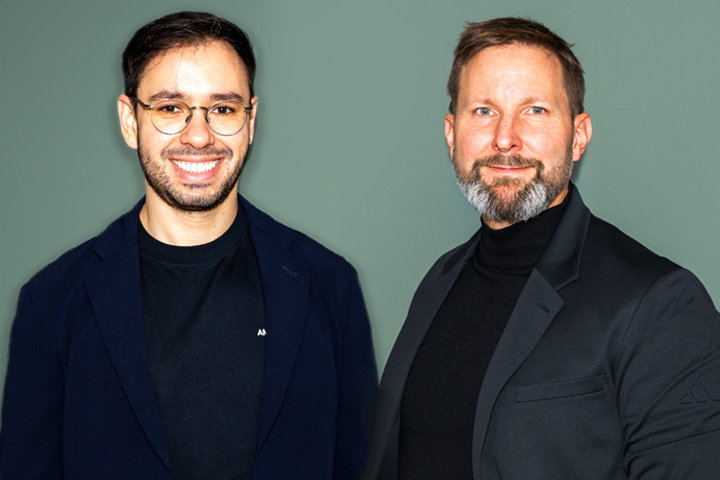
Vinicius Ferraz, Partner & Chief AI Officer; Dr. Christian Oehner, CEO & Founding Partner, Singularity.Inc.
The two may have come from different professional backgrounds, but their shared curiosity about AI and its business value would soon unite them outside the program.
Stepping back to see the bigger picture
The program’s two-week immersive format gives participants a rare opportunity to have the time and the mindspace to think more broadly about the future of their organizations. “It was a great experience stepping out of the day-to-day hustle and bustle and getting a strategic, helicopter view on things,” Oehner said.
The schedule is intentionally intensive, combining lectures, discussions, hands-on exercises, and group work designed to help participants translate AI concepts into real-world applications. Faculty sessions explore both the technical aspects of artificial intelligence and the managerial challenges it raises, from organizational change to leadership strategy. The program dives deep into a range of AI‑driven business applications—from finance, marketing, and supply chain to digital business transformation, workforce, and organizational design—helping leaders apply AI across core enterprise functions.
Sertac Karaman, Professor of Aeronautics and Astronautics at MIT, and faculty co-director of the program, encourages participants to approach the Academy with curiosity and a willingness to rethink familiar assumptions. “Come with an open mind and really try to up your game in AI personally, and then think about how to apply it to your business.”
Different backgrounds, shared questions
While faculty expertise is central to the experience, many participants say the learning extends far beyond the classroom. The cohorts typically come from a wide range of industries and regions, creating opportunities for conversations that continue long after formal sessions end. “It was very interesting to see what problems people from different industries were trying to solve,” Ferraz said. “Even across geographies, the challenges were surprisingly similar.” Those discussions often reveal that organizations in vastly different markets are grappling with many of the same questions about AI adoption and strategy.
Faculty members noted how the diversity of backgrounds within the cohort shapes the learning environment. In the inaugural cohort, both Oehner and Ferraz stood out in different ways. “Christian was very clearly a leader in the classroom, very vocal about identifying questions that were on other people’s minds,” said Eric So, Professor of Global Economics and Behavioral Science at MIT Sloan, and the program faculty co-director.
Participants with strong technical backgrounds played an important role in helping translate concepts for the broader group. For Ferraz, the experience allowed him to observe how executives outside the technology sector approach AI challenges and communicate about it. Those interactions often sparked conversations that continued well beyond the scheduled sessions.
A powerful peer network
According to Mollie Laffin-Rose Agbiboa, Director, Executive Programs at MIT Sloan, that dynamic is one of the Academy's defining aspects. She explained: “You bring together incredible talent from around the world, and the participants learn as much from each other as they do from the faculty.”
The relationships formed during the program often continue after it ends. “Even from that inaugural cohort, they’re still messaging each other every week, sharing research, articles, and updates about their journeys,” Mollie said.
From conversation to collaboration
The link formed during the program soon led to a deeper professional connection between Oehner and Ferraz. Both were exploring how artificial intelligence could reshape consulting and business services. The two recognized how their backgrounds complemented each other. “We realized there was a lot of synergy between what we wanted to build,” remembered Ferraz.
Oehner brought decades of experience advising organizations and navigating complex industries. Ferraz contributed deep expertise in AI systems and technical implementation. Together, they began developing the idea for a new venture focused on helping organizations integrate AI into their operations. Their partnership is one example of how connections formed during the program can evolve into collaborations beyond the classroom.
Why MIT?
Programs addressing artificial intelligence have emerged in many forms in recent years. The AI Executive Academy was designed to bridge a specific gap: helping leaders connect technical understanding with strategic decision-making. For many executives, that combination is essential. “To really understand AI, you need to understand the frontier. How these systems are evolving and how they’re affecting the economy and the world,” emphasized So.
The program structure is rooted in the collaboration between the MIT Sloan School of Management and the MIT Schwarzman College of Computing. “The fact that it’s MIT, with its engineering and computing culture and its investments in AI, really makes this program unique,” said Karaman. By bringing together expertise from both areas, the program exposes participants to AI from multiple perspectives. These range from the technology's foundations to the strategic and organizational questions leaders must address as AI reshapes industries.
“It should be a mandatory experience for leaders and decision makers today.”
The work ahead
Artificial intelligence continues to evolve at neck-breaking speed, and leaders across sectors are still working to understand how the technology will transform their organizations. For many participants, programs like the AI Executive Academy provide a starting point for that journey, offering frameworks, perspectives, and relationships that help leaders navigate an uncertain landscape. The program is continually refreshed to reflect state‑of‑the‑art technological developments and MIT’s thought leadership in AI innovation.