




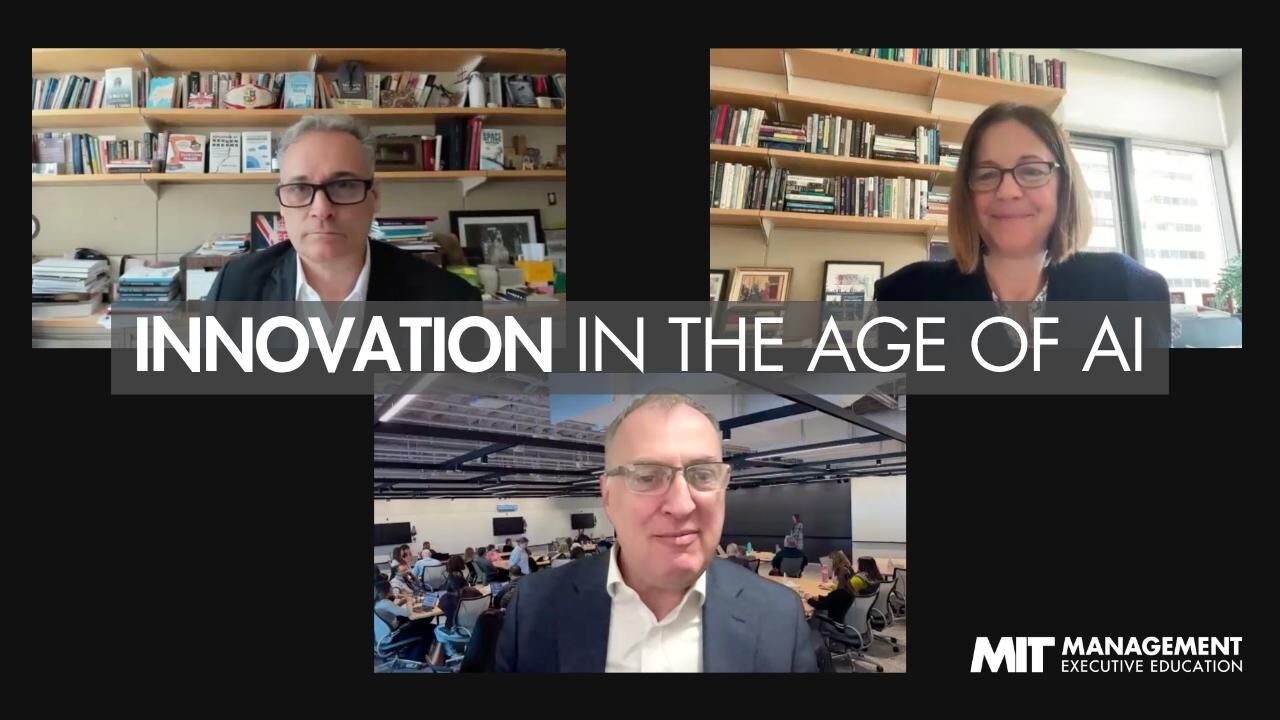




Artificial intelligence (AI) is transforming finance at a pace few could have imagined. From speeding up credit decisions to spotting fraudulent activity before it happens, these technologies are becoming integral to how banks, insurers, and investment firms operate. But adopting AI tools effectively demands insight into risk, ethics, and strategy.
Discover how senior leaders are applying AI technologies in financial services, and the governance frameworks that ensure AI drives both innovation and trust.
Core AI technologies used in finance
The AI toolkit across financial services is largely the same, even though leaders use these technologies in many different ways. While applications range from risk modeling to customer engagement, most organizations are building on a shared foundation — one that blends established machine learning techniques with newer generative AI capabilities.
Four core categories tend to anchor this foundation:
Predictive analytics
These algorithms analyze historical and real-time data to forecast outcomes such as:
- Credit risk
- Market movements
- Customer behavior
More than accuracy, predictive analytics help leaders make faster, more informed decisions at scale.
Security and fraud detection
AI-driven systems continuously learn from transaction patterns to identify anomalies and flag potential threats in near real time. As financial ecosystems grow more complex and interconnected, this capability is increasingly critical.
Chatbots and generative AI assistants
On the customer-facing side, AI is reshaping service delivery. These tools now extend beyond routine inquiries to support more personalized, context-aware interactions. At the same time, they introduce important considerations around oversight, transparency, and trust.
Back-office efficiency systems
AI is also streamlining operations behind the scenes. From automating document processing to accelerating compliance workflows, these systems reduce manual work and allow teams to focus on higher-value, judgment-driven tasks.
Taken together, these technologies form the operational backbone of AI in finance.
AI use cases in banking
If the technologies form the foundation, their impact becomes clearer in how executives apply them across banking and financial services. What began as targeted experimentation (often in retail banking) has evolved into more integrated, business-critical use cases.
Several examples illustrate this shift:
- AI-powered onboarding and compliance: Financial institutions are rethinking onboarding by using AI to accelerate identity verification and streamline compliance checks. This reduces time-to-account while maintaining regulatory rigor — an increasingly important balance as customer experience expectations rise.
- Customer service and financial guidance: Beyond basic support, virtual assistants can now guide users through decisions, from managing cash flow to identifying savings opportunities. In this context, AI improves efficiency while reshaping how institutions deliver advice at scale.
- Credit and risk evaluation: AI enables more dynamic approaches to assessing credit and risk, drawing on a broader set of financial and behavioral signals. This supports faster decision-making while prompting closer scrutiny around model governance and explainability.
- Personalization at scale: From tailored product recommendations to timely financial nudges, AI tools allow institutions to engage customers in more relevant ways. The emphasis is shifting from generic offerings to more adaptive, needs-based interactions.
AI applications in insurance
Insurance is uniquely positioned to benefit from AI’s analytical and operational capabilities, but realizing full value demands enterprise-wide integration. Insurers that embed AI deeply across underwriting, claims, and customer operations are achieving measurable competitive advantage.
Risk assessment and underwriting automation
AI technology can process vast and complex datasets, from claims histories to behavioral and geographic indicators, producing precise risk profiles with minimal manual effort. This allows underwriters to focus on nuanced cases while accelerating decision-making across the portfolio.
Dynamic pricing and product design
Advanced analytics enable more accurate and flexible premium-setting, reflecting emerging risks and individual behaviors. AI also informs the creation of innovative products, such as usage-based coverage or policies tailored for evolving markets like the gig economy.
Augmented claims management and fraud detection
Insurance professionals can use AI to:
- Streamline claims processing
- Evaluate documentation
- Identify anomalies that may signal fraud
By automating routine cases, insurers reduce operational costs and speed resolutions while freeing human expertise for more complex investigations.
Hyperpersonalized customer engagement
Generative and agentic AI support tailored interactions, from policy guidance to proactive financial advice. This helps teams meet rising customer expectations for immediacy, accuracy, and empathy.
For insurers willing to integrate AI strategically, these applications enable faster decisions, smarter risk insight, and more responsive, customer-centric operations.
AI in investment management and trading
AI in investment management is reshaping how professionals research, structure, and monitor portfolios. It’s not about replacing human judgment, but rather amplifying it. Sophisticated algorithms sift through vast data, from market trends to social sentiment, to surface insights that would take teams weeks to uncover manually.
Teams in investment management and trading can use AI technologies for:
- High-speed market analysis: Machine learning models process streams of market information in real time, identifying trends and predicting potential price movements. These insights support both institutional and retail strategies, helping managers adjust allocations quickly and efficiently.
- Portfolio optimization and risk monitoring: AI supports continuous evaluation of portfolio performance and risk exposure. By automating repetitive calculations and scenario testing, investment professionals can focus on strategy and judgment while AI handles large-scale data analysis.
- Consumer-facing advisory tools: Generative AI chatbots and virtual investment assistants can provide personalized guidance to clients, from simulating portfolio scenarios to offering tailored recommendations. However, experts like MIT Sloan’s Andrew Lo caution that large language models can give persuasive yet potentially risky financial advice, underscoring the need for human oversight and ethical safeguards.
- Algorithmic trading and execution: AI streamlines trade execution, optimizing order placement and timing. By integrating diverse data inputs, firms can improve execution quality, monitor market liquidity, and refine trading strategies — all while freeing human experts to focus on high-level decision-making.
Across investment management, AI technology is augmenting human expertise, speeding processes, and helping firms navigate increasingly complex markets.
AI in fraud detection and financial crime prevention
Real-time payments, mobile banking, and online platforms have expanded access, but they’ve also created new opportunities for bad actors. Fraud schemes now move quickly and operate across multiple channels, making traditional rule-based monitoring increasingly difficult to sustain in the financial sector.
AI is emerging as a critical tool in addressing this complexity.
Real-time transaction monitoring
AI models continuously analyze vast transaction streams to detect patterns associated with fraud. By combining payment data with signals such as device information, location, and transaction history, these systems can flag suspicious activity within seconds (often before a transaction is finalized).
Behavioral analysis across the customer journey
Machine learning tools build behavioral profiles that reflect how legitimate customers typically interact with financial platforms. Sudden changes in login behavior, device usage, or spending patterns can trigger alerts and initiate verification processes.
Financial crime network detection
AI also helps identify connections across accounts, entities, and transactions. These insights allow institutions to uncover coordinated schemes such as money laundering or identity fraud that might otherwise remain hidden.
As fraud tactics grow more complex, AI platforms help financial institutions move from reactive investigation toward proactive risk management.
Risk management and regulatory compliance
Financial services have always required a balance of innovation and oversight. Institutions oversee the movement of capital across global markets, which means new technologies must operate within strict regulatory, governance, and risk management frameworks.
As AI becomes more embedded in the financial services industry, these expectations are expanding to address how algorithms make decisions and how institutions maintain accountability.
Explainability and governance
Regulators increasingly expect organizations to demonstrate how AI-driven models arrive at specific outcomes, particularly in areas such as:
- Credit decisions
- Trading surveillance
- Compliance monitoring
Efforts like the U.S. Treasury’s Financial Services AI Risk Management Framework highlight the need for shared terminology, clear documentation, and structured oversight across the AI lifecycle. Plus, integrating insights from regulatory history and financial ethics, as Andrew Lo recommends, can help institutions train AI models to avoid harmful or unethical recommendations.
These guardrails help institutions move forward with AI adoption while maintaining transparency and operational resilience.
Bias and fairness oversight
Because AI models learn from historical financial data, they may unintentionally reflect existing disparities in lending, pricing, or risk scoring. And without ethical and regulatory guidance, they can produce biased or harmful advice, making human supervision essential.
Financial institutions must carefully evaluate training datasets and monitor model outputs to ensure algorithmic decisions remain fair, explainable, and aligned with consumer protection standards.
Data security and privacy protections
AI systems rely on large volumes of sensitive financial and customer data to train and operate effectively. Protecting that information requires robust cybersecurity safeguards, strong access controls, and clear data governance policies that dictate how data is collected, stored, and used.
Institutions must also prioritize compliance with privacy regulations while maintaining the data quality needed to support reliable AI models.
Learn more about AI as a financial industry tool
AI is moving quickly from experimentation to strategic infrastructure across financial services. For leaders responsible for guiding technology investments and managing risk, keeping pace with these developments requires more than surface-level familiarity.
Studying financial AI at MIT Sloan Executive Education offers a structured way to deepen that understanding. Programs focused on AI in financial services explore how machine learning, generative AI, and advanced analytics are reshaping areas from trading and compliance to customer experience and more.
Equally important, these courses examine the strategic questions surrounding AI adoption, including governance, regulatory considerations, and long-term competitive positioning. Executives navigating rapid change gain a clearer view of where this technology is headed, helping inform smarter investment decisions and more resilient organizational strategies.
Stay aware as financial AI evolves
The pace of AI innovation in finance is accelerating, and its impact is felt across risk management, trading, and customer engagement. Leaders must understand both what AI agents can do and how they can integrate these tools responsibly and strategically.
MIT Sloan Executive Education delivers practical insights, governance frameworks, and forward-looking guidance, empowering executives to stay ahead and make confident, ethical decisions. That way, they're equipped to turn AI-driven insights into lasting competitive advantage.
Enroll in Artificial Intelligence for Financial Services from MIT Sloan Executive Education to get started.