


The Client: Merck KGaA, Darmstadt, Germany
Merck KGaA, Darmstadt, Germany, is a global science and technology powerhouse with more than 60,000 employees working across life science, healthcare, and electronics materials to help improve human health and support digital living. As the firm advances its strategy, its leaders face the dual challenge of driving digital transformation with AI and ensuring that innovation remains impactful and sustainable.
With the rapid emergence of artificial intelligence and new data-driven opportunities, the company needed a way to scale innovation across its areas of expertise while maintaining alignment with its purpose and values. The MIT Sloan collaboration, an integral part of the company’s broader leadership development portfolio, was designed to give senior executives an immersive learning experience at MIT, combining world-class academic rigor with hands-on application.
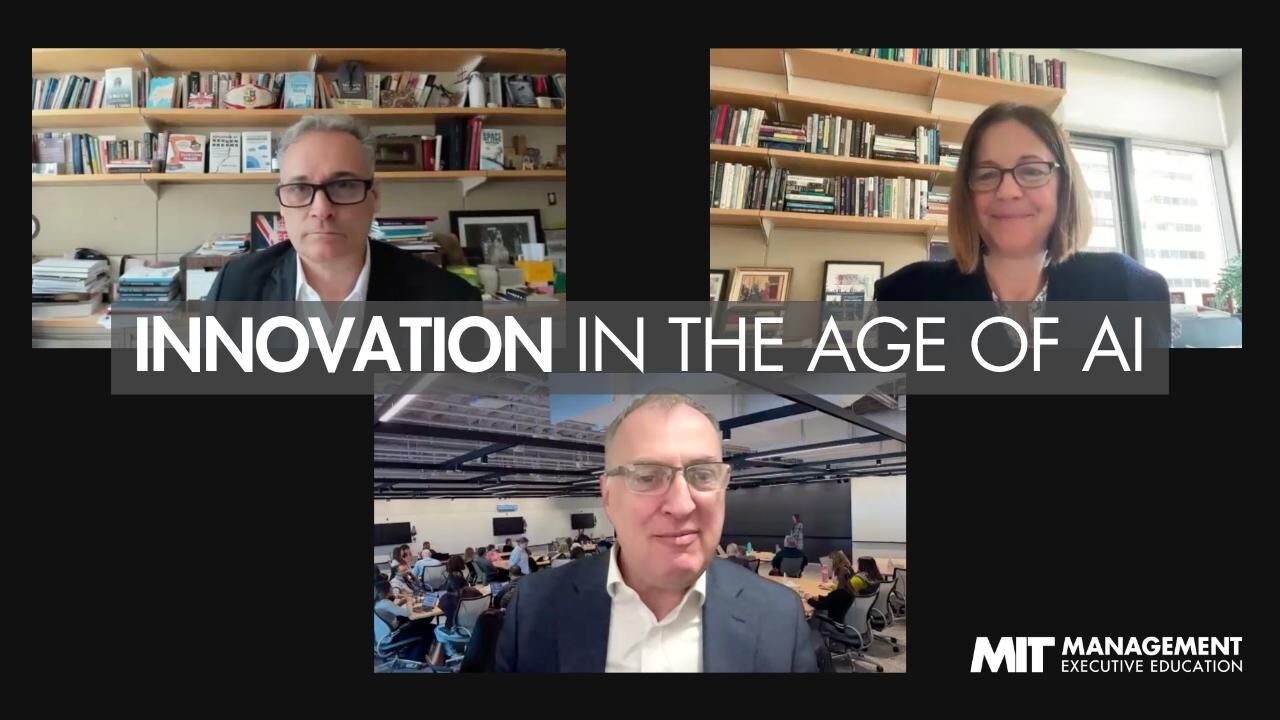
Led by Steven Eppinger, General Motors Leaders for Global Operations Professor of Management and Professor of Management Science and Innovation at MIT Sloan, the program bridges innovation strategy, design thinking, and AI leadership. Participants explore practical frameworks and cutting-edge techniques to enhance creativity, collaboration, and experimentation across their business areas. They also engage directly with MIT’s ecosystem—faculty experts, startup innovators, and applied researchers—connecting academic insight to the firm’s operational context. The first phase of the year-long M University experience, which also includes leadership development at INSEAD in Fontainebleau, France, and strategic sessions at the company’s global headquarters in Darmstadt, Germany, the MIT Sloan module anchors the journey by focusing on leading change through innovation and the integration of AI.
“We emphasized from the start that we didn’t want a standard program—we needed something customized to our maturity level and business context,” said Conny Bach, Head of Strategic Talent Programs and Director of M University. “MIT responded with an approach that blended academic depth with real-world application.”
Where insight meets implementation
According to Steven Eppinger, Faculty Director of the MIT module, the partnership succeeds because it balances theory and practice in the true spirit of MIT’s Mens et Manus (Mind and Hand) philosophy. “Each faculty member approaches the topic from a different angle, be it AI governance and data privacy or methods for creativity and innovation, so participants gain a multifaceted view that reflects both the opportunities and responsibilities of AI leadership.”
The week at MIT includes case studies, research insights, and presentations by C-suite executives from Merck KGaA, Darmstadt, Germany. Participants also collaborate on high-impact innovation projects that are later handed off to the company’s mid-level leadership program for further development, ensuring that ideas continue to evolve and scale across the organization.
“The company’s leaders are not just learning about innovation, they’re doing innovation,” explained Rob Dietel, Senior Director of Executive Programs at MIT Sloan Executive Education. “Their projects are real, their discussions are strategic, and their learning has lasting impact.”
Leadership alignment and organizational impact
The collaboration between Merck KGaA, Darmstadt, Germany and MIT Sloan reflects a shared philosophy: that the future of leadership lies in the intersection of technology, design, and purpose. As Conny Bach described it, “Leadership development at our organization isn’t just about building individual skills—it’s about creating networks, culture, and continuity. The MIT module gives our leaders the chance to explore AI and innovation in a context that’s both strategic and human.”
Participants echoed this sentiment. Rachel Hansard, Vice President and Head of US Rare Tumors, Marketing at EMD Serono, the U.S. and Canadian healthcare business of Merck KGaA, Darmstadt, Germany, noted that the program created “a shared space for collaboration and cross-functional dialogue about innovation and AI, applicable to everyone, regardless of sector or geography.”
Sebastian Arana, Executive Vice President and Global Head of Process Solutions at MilliporeSigma, the company's North American life science business, agreed: “It opened a completely new space for me, a space we weren’t exploring deeply enough before.”
Kerstin Weber, Head of Group Internal Auditing at Merck KGaA, Darmstadt, Germany, sums it up: “For me, it’s the combination of three things: the outstanding lectures from professors who bring cutting-edge insights in innovation and AI; the diversity of participants from across the organization; and the shared ambition to bring greater value to the company and to society. That triangle—knowledge, diversity, and purpose—creates transformative thinking. The exchange of ideas among such different leaders is truly unique.”
“Leaders leave the program with hands-on knowledge of AI tools and how to use them effectively with their teams. They come back with new ideas, confidence, and inspiration to apply what they’ve learned in their daily work.”
Driving responsible innovation at scale
The company’s legacy of scientific discovery continues to evolve through its commitment to sustainable innovation: combining advanced data capabilities, ethical AI, and human insight to improve lives and enable progress across industries. The Merck KGaA, Darmstadt, Germany-MIT collaboration continues to evolve to support this commitment, guided by ongoing feedback and shared ambition.
The focus now is on translating individual learning into enterprise transformation—turning insights into measurable progress across AI adoption, responsible governance, and innovation capability.
"What matters most is what happens between the sessions. A shared vocabulary for AI and design starts forming across sectors. Questions about value, risk, and ethics get sharper. And there's a growing willingness to run small, well-governed experiments where the business case and the ethical guardrail are designed together from day one. In regulated industries, that kind of collective sharpening is exactly what responsible scaling requires.”
Transforming learning into lasting impact
For the innovation leader, their M University program is more than a learning experience. It’s a catalyst for change. Through its partnership with MIT Sloan Executive Education, the 360-year-old firm is building a generation of leaders who are ready to navigate uncertainty, harness AI responsibly, and turn innovation into enduring business value. “The partnership between Merck KGaA, Darmstadt, Germany and MIT is a model for how science and technology companies can scale innovation responsibly, combining creativity with ethical leadership,” said Steven Eppinger.