



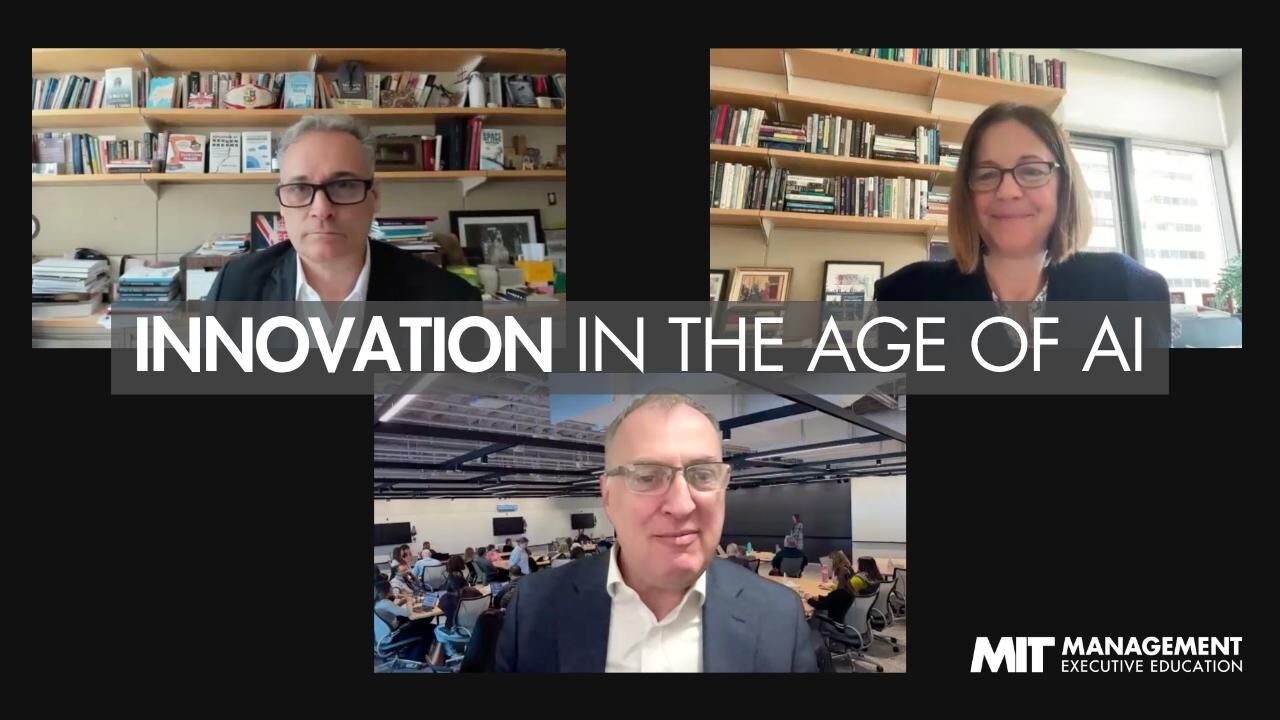




Recently, I had the pleasure of hosting my MIT Sloan School of Management colleague Hal Gregersen on a LinkedIn Live session with a global audience of business leaders, executives, and other curious individuals. The topic was seemingly simple: How can we strengthen our ability to ask better questions in an era increasingly shaped by artificial intelligence?
As organizations race to adopt AI technologies, leaders face a critical challenge of finding the right balance in embracing these tools without allowing them to crowd out key human capabilities. Hal’s work offers a compelling lens for addressing this challenge.
Questions as a leadership capability
Hal has spent decades studying innovation and leadership, and one theme runs consistently through his research: Breakthrough ideas rarely start with answers. Instead, they start with better questions!
As Hal reminded us during the discussion, Clayton Christensen, the late American economist who developed the concept of “disruptive innovation,” once described questions as “keys that unlock new doors of insight and impact.” That idea is particularly relevant today. In environments defined by uncertainty, leaders cannot simply rely on existing answers. Instead, they must develop the ability to frame the right questions.
To facilitate this type of thinking, Hal demonstrated a technique he calls the “Question Burst.” The method is simple but powerful. For a few minutes, individuals or teams focus exclusively on generating questions about a challenge. No answers, no explanations, just questions.
Over many years of using this approach with thousands of leaders, Hal has found that something remarkable happens. About 85% of the time, participants end up reframing the problem or identifying new ways forward. Just as importantly, the process often increases psychological safety between people working together. In other words, asking better questions does more than generate insights—it strengthens collaboration.
AI should amplify inquiry, not replace it
So how can AI tools support this questioning process? Again, we start with the human. If we rely entirely on AI to generate questions, we risk losing the very skill we most need to cultivate. Instead, the process begins with human participants identifying a challenge and generating their own questions. Only then does AI enter the conversation, expanding the field of inquiry and offering new perspectives.
What struck me during the exercise was how quickly the conversation expanded. My original challenge was fairly specific: How do organizations ensure that the rush to develop AI capabilities does not crowd out investment in foundational human skills?
Within minutes, the questions generated by Hal, the AI tool, and our audience broadened the lens considerably, and, suddenly, we were exploring issues of organizational responsibility, ethics, culture, and leadership identity.
What leaders told us matters most
At one point in the session, we asked our audience a simple question: What human capability will become more valuable—not less—in the age of AI? The responses flew in rapidly from around the world. Some emphasized critical thinking and strategic judgment. Others highlighted ethical reasoning, negotiation, and the ability to deal with unexpected situations. Many pointed to more relational capabilities: human connection, empathy, vulnerability, and the ability to create purpose. One response that stood out to me was common sense, a reminder that even as technologies advance, the ability to interpret context and make practical judgments remains uniquely human.
Collectively, these responses reinforced a powerful idea: the future of leadership will not be defined by choosing between AI and human capability. Instead, it will depend on how effectively leaders cultivate both.
Finding the right balance
Another insight from the session was the importance of framing these conversations at the right level. Before the exercise, I realized that many in our audience may have already begun to think about the AI challenge in somewhat tactical terms. The questioning process helped shift the conversation back to a broader strategic perspective.
Rather than asking only how organizations should invest in AI, we began asking:
- What human capabilities will matter most as AI becomes more powerful?
- How should organizations develop those capabilities?
- And how can leaders ensure that technology enhances rather than diminishes human creativity and agency?
These are not questions that AI can answer for us. These are for humans to grapple with.
A surprising leadership skill worth strengthening
One of the most striking outcomes of the session was how energized the conversation became once we focused on inquiry rather than solutions! In many leadership contexts, there is pressure to arrive quickly at answers. Yet the reality is that the most complex challenges rarely yield to immediate solutions.
What they require instead is a disciplined commitment to curiosity. In the age of AI, that commitment may become one of the most important leadership capabilities of all.
If you would like to integrate these methods into the work of your team or organization, Hal’s courses offer plenty of opportunities to learn and practice.