






Most senior leaders don’t go back to school because they lack knowledge. They do it because the barriers they’re facing no longer yield to what has worked before.
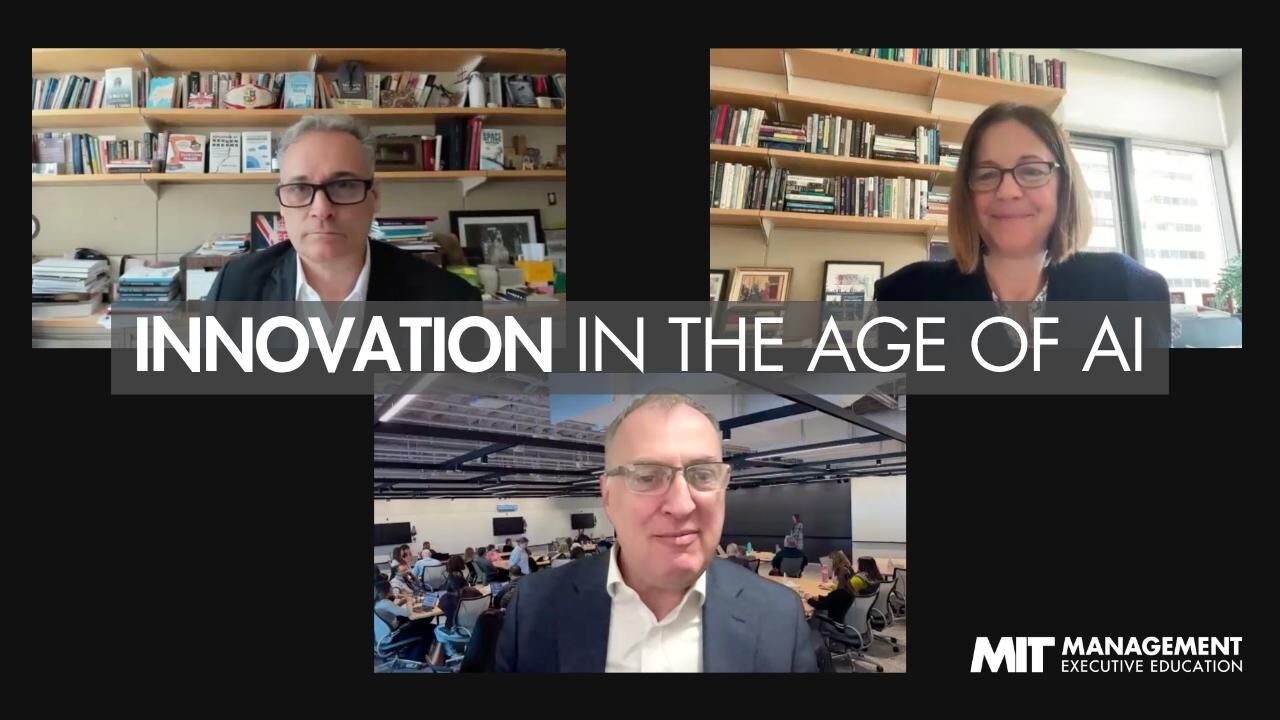
That was the key takeaway from a recent information session on MIT Sloan’s Advanced Management Program (AMP), featuring Court Chilton, Faculty Director of AMP, alongside Molly Schneider, Associate Director, and Rob Dietel, Senior Director, Executive Programs, who facilitated the discussion. This program is designed for a particular moment in a leader’s journey when responsibility has outgrown playbooks and complexity has outpaced experience.
Integration over topics
Unlike many namesake programs that assemble a set of “advanced” subjects, AMP is built around integration. Leadership, strategy, innovation, and execution are not treated as separate disciplines, but rather as interconnected components of a unified system.
The five-week structure mirrors how strategy is applied in organizations: setting direction, building capability, executing under constraints, and adapting continuously as conditions change. This matters because senior leaders rarely struggle with understanding individual concepts, but can have trouble aligning them under pressure, with incomplete information, and real consequences. In that sense, AMP feels less like a curriculum and more like a practice space for enterprise leadership.
A program that meets the moment
AMP is never the same from year to year. The curriculum shifts—by design—based on what leaders are actually facing. Topics like AI, for example, are not treated as trends to chase, but as forces reshaping strategy, operating models, and decision-making.
What matters here is not the specific topic, but the mindset: leadership development as a living system, not a static body of knowledge. The AMP curriculum is less focused on teaching leaders what to think and more on strengthening their capacity to keep thinking as the environment changes.
The cohort as the core asset
Another theme that stands out is how seriously AMP treats peer learning. The diversity of industries, geographies, and functions is essential. Senior leadership can be a lonely experience, and many executives lack a safe space to pressure-test ideas or admit to uncertainty. AMP intentionally creates that space. As Molly described, participants often leave with something like a personal advisory board, a trusted group of peers they continue to consult long after the program ends. The fact that alumni engagement remains so active suggests these relationships are not superficial. They endure because they’re useful.
The MIT ecosystem as a learning partner
Another key element is how intentionally AMP leverages MIT’s ecosystem as part of the learning experience. Kendall Square isn’t treated as an attraction or a backdrop; it functions as an extension of the classroom. Participants don’t just talk about innovation, they encounter it directly, through engagement with researchers, startups, global companies, and ongoing experiments happening within walking distance of the MIT Sloan campus.
What matters is not simply exposure to innovation, but learning how it actually moves from lab to market, from idea to organization. AMP also helps participants understand how to engage MIT itself: how to collaborate with researchers, how to ask the right questions, and how to translate cutting-edge work into practical impact. For many participants, those relationships continue well beyond the five weeks, shaping strategic choices long after they return home.
“Mens et Manus” in practice
MIT’s motto, Mens et Manus (Mind and Hand), imbues every aspect of the program’s design and delivery. There are no traditional case studies. Participants don’t debate decisions made by other companies years ago. Instead, they work on their own live challenges, in real time, with peers who bring diverse perspectives and no political stake in the outcome.
Even the classroom design reinforces this philosophy. Flat rooms, whiteboards everywhere, constant movement and interaction. Authority is not centralized at the front of the room. Faculty facilitate rather than “edutain.”
Space to think, not just to absorb
The rhythm of the program—structured days, limited evenings, open weekends—recognizes an essential component of learning: insight requires margin. Similarly, strategic leadership is not just about speed. Sometimes it’s about stopping long enough to see clearly.
The program is deliberate in offering opportunities for reflection. One-on-one leadership coaching, confidential and independent, signals that inner work is not optional at senior levels. This is foundational.
A temporary system for lasting change
All in all, AMP feels less like a course and more like a staging environment, one that immerses senior executives in a different way of learning, thinking, and engaging with complexity. The program doesn’t promise a magical transformation. What it offers instead are the conditions under which transformation becomes possible if leaders are willing to do the work. For many, that is exactly what they need.
If you are a leader at an inflection point (and who isn’t right now?), the Advanced Management Program may be just what you need this year! To learn more, email the team at execedamp@mit.edu or join us at the next AMP online info session.