



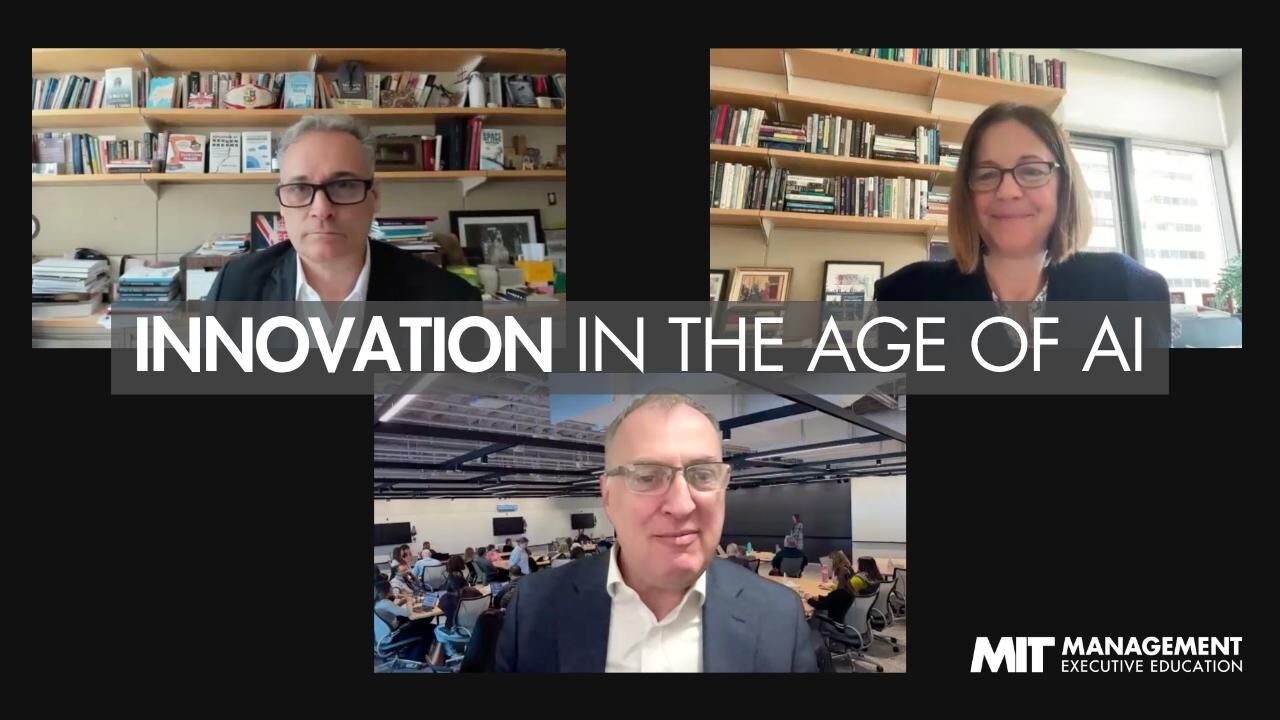




Gregersen emphasized that in 2026 and beyond, leaders are operating in an environment defined by uncertainty. From rapid technological change to complex organizational challenges, many problems leaders face today do not have clear answers. In these moments, Gregersen argues that questions themselves become the most powerful tool for navigating the unknown. As he explains, when we are working on the edge of uncertainty, questions are often the answers.
Why Questions Unlock Innovation
Questions are one of the most powerful tools humans have for both inquiry and discovery. As organizations increasingly integrate AI into everyday work, Gregersen poses an important challenge:
“How can we hold tightly to our uniquely human ability to ask great questions?”
For Gregersen, the concern is not that AI will replace human thinking, but that leaders may gradually lose the habit of questioning if they rely too heavily on machines to generate answers
Gregersen shared a moment from his past work with leadership teams that illustrated the power of questions firsthand. During a particularly difficult initiative, the energy in the room began to drop, and the group appeared stuck. Gregersen proposed something simple: stop and spend a few minutes asking nothing but questions about the challenge.
The shift was immediate. Energy returned to the room as leaders began exploring the problem from new angles and discovering new ways to view the challenge at hand. In many cases, the answers they were seeking were already embedded in the questions, helping the group reframe the problem and move forward.
Over the past two decades, thousands of leaders have used Gregersen’s “Question Burst” method. The exercise is simple: spend three to four minutes generating only questions about a challenge, no answers, explanations, or solutions.
Through years of research and observation, Gregersen has found remarkable patterns. In 85% of cases, the challenge becomes reframed, the emotional tone improves, and new ideas begin to emerge that move the work forward. When the exercise is done with a colleague or team member, psychological safety improves 89% of the time, helping teams feel more comfortable tackling difficult problems together.
These findings reinforce a powerful idea: sometimes the fastest path begins not with answers, but with better questions. Participants who take Gregersen’s course at MIT Sloan Executive Education, Questions Are the Answer: A Creative Approach to AI-Enhanced Inquiry, Insight, and Impact, experience this exercise live, led by Gregersen.
Using AI to Strengthen Human Inquiry
During the session, Gregersen demonstrated how AI can support, rather than replace, human inquiry. He created a custom ChatGPT model designed to guide users through the Question Burst process.
The model walks participants through several stages:
- Defining a meaningful challenge
- Generating questions about the challenge
- Identifying insights from those questions
- Developing potential next steps
Gregersen emphasized that the success of the exercise begins with selecting a challenge that truly matters.
Stage 1: Choose the challenge
The process begins by entering a challenge into the model. The AI responds by asking clarifying questions to ensure it fully understands the issue and then generates a concise version of the challenge.
Stage 2: Brainstorm questions
Next comes the core of the exercise: generating questions. Importantly, Gregersen emphasizes that this step should be human-first. The goal is not for AI to generate all the questions, but for people to actively engage in the questioning process.
To guide the brainstorming, the model provides several rules:
- Ask questions only
- No explanations before the question
- No answers after the question
- Focus on short, challenging questions that test assumptions
During the live session, Gregersen and Hirst invited the audience to contribute their own questions about the challenge, reinforcing the importance of human curiosity in the process.
Gregersen then demonstrated a creative feature of the model: the ability to generate questions from different AI personas. These personas can challenge assumptions, draw on experiences from different industries or disciplines, and introduce new ways of thinking about a problem.
This approach encourages leaders to explore perspectives they may not naturally consider. However, Gregersen stresses that these tools should expand human thinking—not replace it.
As he noted during the session, if we rely on machines to generate all of our questions, we risk losing one of the most valuable leadership capabilities we possess.
Readers who want to see the process in action can watch Gregersen and Hirst’s live demonstration from the session, where they walk through the full Question Burst method using Gregersen’s AI model.
The Leadership Skill That Matters Most in the AI Era
As the conversation continued, Gregersen and Hirst explored a broader leadership question: which human capabilities will become more important as AI becomes more integrated into work?
As AI is now able to accelerate analysis and automate many tasks, Gregersen argues that it also introduces a new responsibility for leaders to protect and strengthen essential human skills.
One of those skills is inquiry. The ability to ask thoughtful, challenging questions helps leaders navigate ambiguity, uncover hidden assumptions, and open new paths for innovation.
Participants in the session also highlighted several human capabilities that may become even more valuable in an AI-enabled workplace, including critical thinking, judgment, empathy, and common sense. These skills help leaders interpret information, evaluate decisions, and guide teams through complex challenges.
Rather than competing with AI, the goal for leaders is to strengthen the distinctly human capabilities that technology cannot easily replicate.
Designing the Future of Leadership
Gregersen suggests the challenge is not simply adopting new technologies, but deciding how those technologies influence the way we think, learn, and lead.
If leaders rely on AI without reflection, important human capabilities such as curiosity and inquiry may gradually weaken. But when used intentionally, AI can help expand how leaders explore problems and generate new ideas.
Gregersen leaves leaders with a critical question: Are our capabilities changing by design, or by default?
For organizations navigating the future of work, the answer may shape not only how they adopt AI, but how they continue to innovate, learn, and lead.
Ready to learn more about the power of asking better questions?
Explore the Questions Are the Answer: A Creative Approach to AI-Enhanced Inquiry, Insight, and Impact from MIT Sloan Executive Education.