



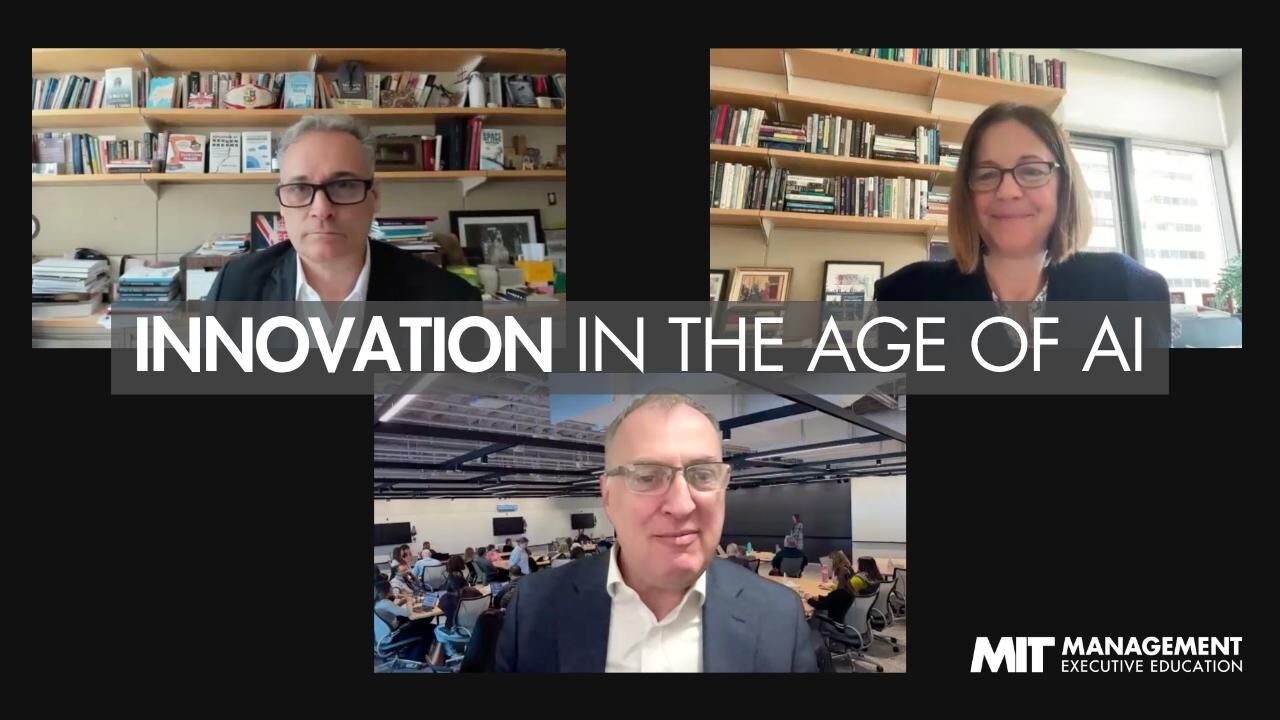



What is changing today is not the influence of geopolitics in business, but the extent to which it brings uncertainty into nearly every strategic decision. That was the thread running through a recent MIT Sloan Executive Education webinar I moderated with Professor Dame Fiona Murray and Senior Lecturer Phil Budden. Their backgrounds are different but highly complementary. Fiona brings deep expertise in innovation, entrepreneurship, and security. And Phil draws on decades of experience in diplomacy, public service, and global affairs. Both emphasized that uncertainty itself is a constant leadership condition. Executives don’t need to be foreign policy experts, but they do need better ways to understand how geopolitical shifts may affect their organizations and how to make decisions when the trajectory is unclear.
Uncertainty vs. risk
With risk, leaders may know the possible outcomes even if they do not know the probability of each one. With uncertainty, they may not yet be able to imagine all the possible outcomes. That distinction matters because many traditional planning processes are built around known variables. Leaders identify scenarios, assign probabilities, and optimize accordingly. Geopolitical change does not always unfold neatly.
Leading through uncertainty requires a willingness to think several steps ahead and to consider possibilities that may initially appear unlikely. It also requires a culture of inquiry: a space where people can raise difficult scenarios, test assumptions, and explore what might happen without being dismissed too quickly.
The world is not flat
One of the more unexpected ideas in the conversation was Phil’s challenge to the notion that globalization had made geography less important. Innovation still happens in particular places, within ecosystems of talent, capital, infrastructure, government, and industry. Production, data centers, critical minerals, and regulation are also rooted in specific locations. Globalization did not erase those realities; it made them easier to overlook.
Geopolitical pressure is now exposing those dependencies. A technology may seem globally available until export controls restrict access. A supply chain may appear efficient until a border closes or a critical input becomes scarce. The lesson here is not that globalization is over. It is that geography must return to strategic thinking. Leaders need to understand what they rely on, where it sits, who controls it, and how political decisions could change access.
Looking beyond efficiency
For much of the past several decades, organizations built their businesses around global efficiency. Manufacturing was often organized around just-in-time delivery, and anything beyond the minimum required capacity could be treated as unnecessary. That approach created enormous value. It also created deep dependencies.
A decision based entirely on performance or cost may overlook a much larger strategic question. Will an organization continue to have access to a technology on the terms it expects? Will it comply with the requirements of the jurisdictions in which the company operates? Could export controls, tariffs, capital controls, or other forms of economic statecraft affect its availability? This is why resilience matters. Of course, resilience is not a new idea, as Fiona pointed out, citing several examples from recent history. What has changed is the range and complexity of the pressures against which organizations now need to be resilient. Leaders may need to accept some loss of efficiency in exchange for greater flexibility, security, or continuity.
What business can learn from war games
Using war-game simulations in executive education may sound unusual, but business has long borrowed from military thinking. Strategy, campaigns, frontline teams, and command centers are now part of corporate language. Sun Tzu’s The Art of War remains popular among executives because it emphasizes understanding the environment, anticipating others’ actions, and adapting before circumstances force your hand. Corporate war games have been putting those ideas into practice for years.
That is especially relevant when military conflict and geopolitical rivalry are directly affecting business. The goal is not to turn executives into military strategists. It is to make uncertainty tangible and expose assumptions, reactions, and second-order consequences before leaders confront the real event. Crises often arrive as shocks, but they should not always come as complete surprises.
A global perspective through a business lens
Thinking about geopolitics will not remove uncertainty, but it can help leaders approach uncertainty more systematically. Organizations can strengthen their ability to sense change across markets and functions. They can create space to consider less familiar scenarios. They can examine where efficiency has created dependency. They can assess geopolitical headwinds and tailwinds together. They can use scenario planning and war-gaming techniques to explore how systems and actors may respond to shocks.
For leaders interested in exploring these topics further, the two-day MIT Sloan Executive Education course Geopolitics for Executives: From Global Risk to Strategic Advantage, led by Phil Budden and Fiona Murray, offers an opportunity to practice applying these techniques to the strategic questions they are already facing.