


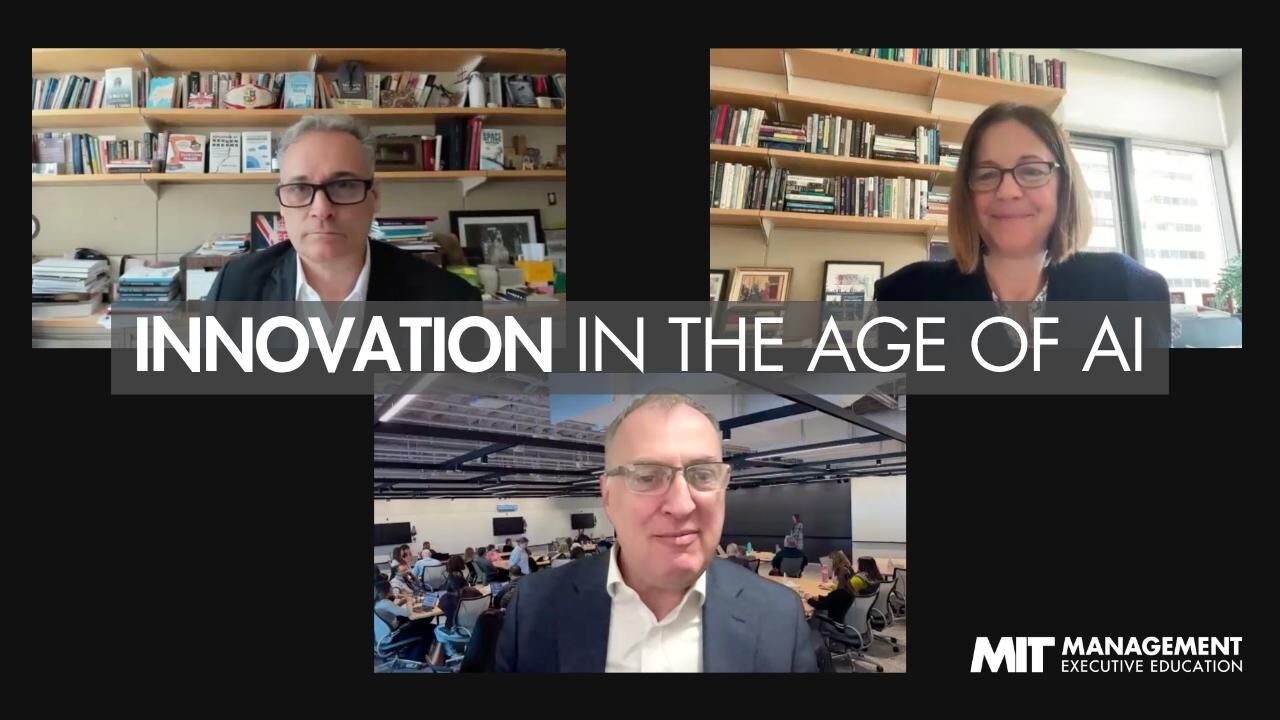



For the past few years, leaders have understandably focused on adoption: pilots, platforms, proofs of concept, licenses, and integrations. Those efforts mattered, and still do, but as Paul McDonagh-Smith, Senior Visiting Lecturer at MIT Sloan, and I discussed in a recent LinkedIn Live, what business leaders should also pay attention to is AI adaptation and how organizations are changing in response to AI. I will even add that the neck-breaking speed of AI advances is dictating a new paradigm: to stay competitive, businesses must be aware, ready to adopt, and able to adapt to AI technologies—simultaneously. It’s a lot, to say the least, which made our conversation with Paul all the richer. In our far-ranging discussion, Paul highlighted the following key ideas:
Moving from tools to organizational change
One of Paul’s key insights is that AI’s impact does not come solely from implementation. It comes from how organizations rethink work, skills, structures, and decision-making as the technology matures.
That shift reframes the conversation. It becomes less about selecting the right tools and more about leadership choices—about behavior, mindset, and organizational design. To make sense of what’s changing, Paul framed AI’s impact from three perspectives: work, workforce, and workplace.
Reevaluating work: Start with tasks, not titles
Whenever we talk about work, we tend to default to job titles. But roles are not fixed units. Most jobs are made up of a collection of distinct tasks, often 15–25 of them. AI compels leaders to look more closely at those tasks and ask different questions. Which elements of the work can be automated? Where can AI augment human effort? And where might agentic systems, for example, support people in entirely new ways? This kind of task-level clarity isn’t about replacing roles wholesale. It’s about redesigning work so it remains effective as capabilities continue to change. Organizations that understand work at this level are far better positioned to adapt as AI evolves.
Rethinking the workforce: Capabilities that scale
As tasks shift, skill requirements shift with them. Technical fluency remains important, but it is no longer sufficient on its own; it must be complemented by other skills. What increasingly differentiates high-performing teams are human capabilities that complement AI rather than compete with it. Judgment, creativity, curiosity, critical thinking, and empathy allow people to interpret outputs, challenge assumptions, and navigate ambiguity. In practice, these capabilities enable better decisions and more thoughtful use of technology.
Paul emphasized that rather than diminishing the role of people, AI raises expectations for how humans contribute to value creation.
Reimagining the workplace: Structure shapes outcomes
History often offers a useful parallel. Paul reminded us that when electricity was first introduced into factories, productivity gains were limited. Real progress occurred only when organizations redesigned workflows, layouts, and business models to take advantage of electrification.
AI seems to be following a similar trajectory. Simply layering new tools onto existing structures constrains their impact, Paul cautioned. Leaders need to think more deliberately about how humans and machines collaborate, how decisions flow through the organization, and how learning becomes part of everyday work rather than a separate activity.
Recognizing organizational natural selection
As Paul noted during our conversation, this moment feels less like incremental change and more like a form of organizational natural selection. Organizations win—or lose—based on their ability to evolve. This is not just a metaphor; it describes a real mechanism at work. Adaptive organizations tend to experiment broadly, using many small initiatives to explore what’s possible. They rely on data to determine what should scale, and they make deliberate choices about what to embed into standard practice so that successful innovations endure. This is what Paul described as AI organizational fitness: the capacity to reshape the organization in response to new technological possibilities.
The question leaders should be asking isn’t whether AI will disrupt their industry. It’s whether their organization can change fast enough to remain effective as the environment shifts.
Measuring what actually matters
Paul pointed out that measurement is where many organizations struggle. Traditional KPIs often capture activity—how frequently a tool is used or how widely it is deployed—but fail to capture impact.
Looking ahead, leaders will need to pay closer attention to what AI is changing inside the organization. That includes how quickly decisions are made, whether their quality improves, whether people feel more capable and empowered, how innovation cycles evolve, and how effectively learning feeds back into the system. A simple framing helps cut through the complexity: what work are we asking AI to do, and how do we know whether it’s doing that work well?
Shaping what comes next
The bottom line is that organizations are always changing, whether leaders are consciously guiding that process or not, Paul emphasized. Those that perform best in the years ahead will not necessarily be the ones with the most advanced tools. They will be the ones who continually rethink how work gets done, how people contribute, and how the organization learns.
To learn more, watch the LinkedIn Live recording or catch Paul online or in person in one of the many AI-focused courses he teaches at MIT Sloan Executive Education.