




The Client: a Global Technology Company
A global technology enterprise operating across multiple business lines, spanning connectivity, digital services, and IT, approached MIT Sloan Executive Education with a mandate to help its senior executives develop a shared perspective on AI, global strategic forces, and leadership at scale, in a period of accelerated transformation.
The organization faced a convergence of technological and organizational pressures. AI advancements were reshaping customer expectations and competitive dynamics, while geopolitical and economic shifts were influencing growth plans across markets. The company’s expanding portfolio and recent acquisitions also created an urgent need for leadership cohesion.
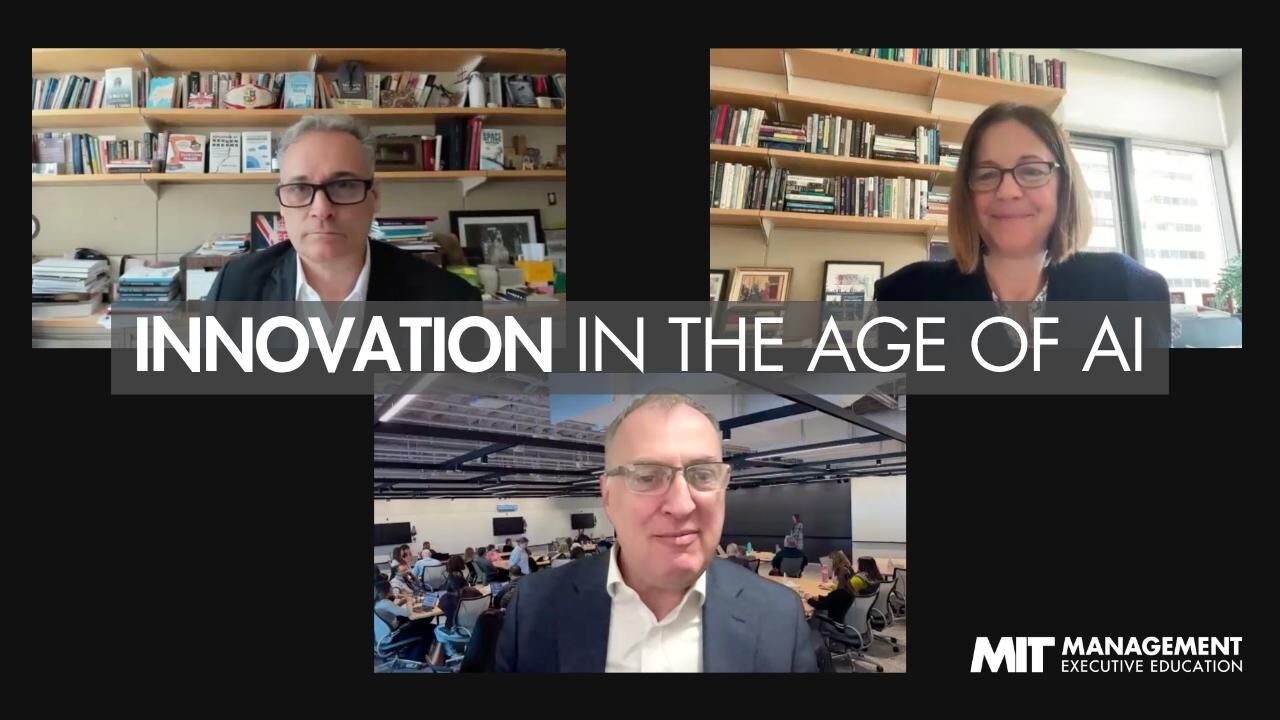
Unlike many organizations exploring AI for the first time, this company was already a sophisticated producer of enterprise-grade AI solutions. As Faculty Director Jonathan Ruane noted, the challenge was designing sessions “not about just spinning up or discussing proof of concepts” but about extracting value from AI “at a strategic level” and preparing leaders for what comes next.
To shape a learning experience that met the client’s immediate needs, the MIT Sloan Executive Education program team conducted extensive interviews with C-suite executives. Ruane described the discovery process as a “gold standard,” providing clarity on business challenges and leadership needs across the enterprise. Participants arrived with equally high expectations: senior leaders who were, in Ruane’s words, “there to learn something that they could bring back to really drive their business.”
Two in-person cohorts of senior leaders, each comprising roughly 80 participants, visited MIT three weeks apart. The five-day residential program wove together frontier AI research, global economic context, leadership frameworks, and innovation practices. Faculty from across MIT contributed insights and expertise: Andrew McAfee on organizational disruption and high-growth mindsets; Antonio Torralba on the future of AI; David Autor on the evolving relationship between human knowledge and intelligent systems; Charlie Fine on geopolitical and economic forces; Kate Isaacs on nimble global leadership; Jason Jay on sustainability and systems thinking; and Steven Eppinger on AI-enabled innovation for products and services. Ruane linked these elements through sessions on strategic AI adoption and technology transformation.
“When you serve leaders something they can genuinely use, they respond generously and enthusiastically—and that’s when a program becomes truly impactful.”
The client’s own leadership team played a central role, including a CEO-led session and executive panels that reinforced strategic priorities and strengthened alignment across business units. The CEO’s participation in both cohorts underscored the program’s strategic importance and the expectation that learning would translate directly into business impact.
By the end of the program, senior leaders had developed a shared strategic language for AI, strategy, leadership, sustainability, and innovation. They gained clarity on the forces shaping their industry, frameworks to accelerate decision-making and innovation, and a renewed sense of cohesion across business lines.
The result was a leadership team better prepared to navigate accelerating technological change and lead with confidence across a complex, global enterprise. As Ruane reflected: “We can only teach well when people want to capture it. And with this group, once both sides were fully engaged, it all just clicked.” Several participants later engaged with MIT research events, including a quantum computing conference. A shorter program is planned for next year for 700 next-level leaders in the firm’s home country. It will feature a distilled selection of content from the MIT Sloan program to cascade the learnings throughout the organization, extending the program’s impact beyond the classroom.