



When it comes to artificial intelligence, many organizations master the models but struggle with adoption. At Merck KGaA, Darmstadt, Germany, a global science and technology leader, the question isn’t whether AI will reshape work, but how to make that transformation happen responsibly, at scale, and with measurable impact.
Through our partnership, I’ve seen the company build something rare: a leadership culture that treats AI not as a technology project, but as an organizational capability. The company’s executives come to MIT Sloan Executive Education as part of a broader leadership development portfolio called M University, designed to give senior executives an immersive learning experience at MIT that combines world-class academic rigor with hands-on application.
1. Start with leadership fluency
Laura Matz, Chief Technology Officer at Merck KGaA, Darmstadt, Germany, explains the challenge clearly: “With the rapid acceleration of AI, automated labs, and digital transformation, everything is moving faster than ever. Our leaders need to be agile to identify emerging trends quickly and respond effectively so we can continue enabling our customers.” She adds: “After our time at MIT, our leaders walk away with real working knowledge of AI tools—how to use them with their teams and in their day-to-day roles … the creativity and inspiration to take it back to their teams.”
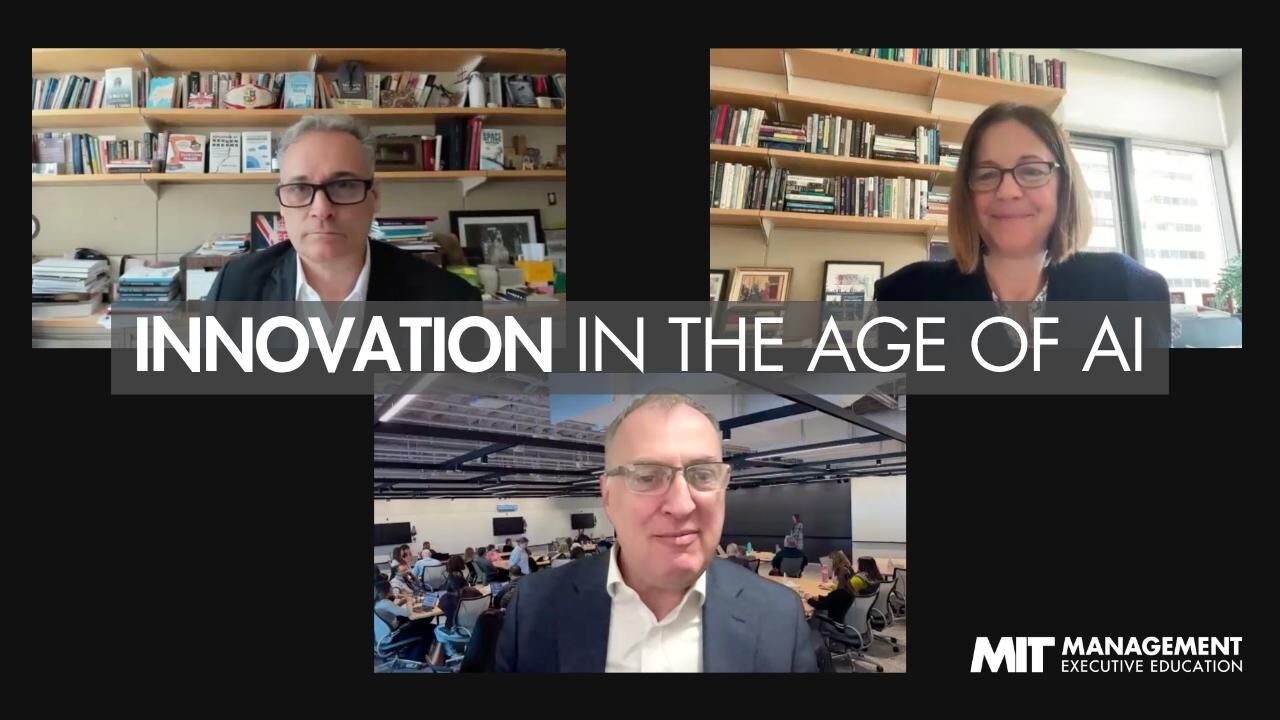
That combination of agility and applied fluency turns AI from an abstract concept into practical, day-to-day leadership behavior. My colleague George Westerman, Principal Research Scientist, Senior Lecturer at MIT Sloan and one of the key faculty members in the company’s M University MIT module, notes that the company takes this program seriously. They worked with us to design a program that covered the topics they wanted in a flexible format, bringing people to Boston for a week, but also augmenting it with virtual sessions before the campus visit. The experience continues after participants leave campus, as the company regularly conducts events that bring their alumni together for further discussions.” In the coming weeks, George will co-present to more than 100 M University alumni, connecting his research on AI-enabling capabilities with insights from the company’s head of AI on how Merck is building them in practice.
2. Design for the “last mile” of adoption
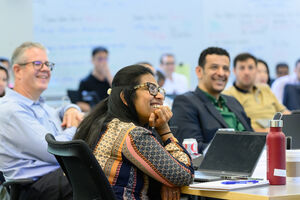
At MIT, we emphasize bridging the gap between ideas and implementation. Participants experiment with frameworks, case studies, and live challenges to connect learning directly to the business of Merck KGaA, Darmstadt, Germany.
Another colleague, Paul McDonagh-Smith, Senior Visiting Lecturer at MIT Sloan, often reminds us that the real test of AI isn’t accuracy, it’s adoption. Paul calls this “engineering the last mile”: moving from models to mindset to metrics, and tracking AI’s impact through augmentation, autonomy, and velocity.
He advises leaders to “ship small, learn fast, and scale,” applying decision-first targeting, human-centered co-design, and trust-by-design governance.
Those principles are now deeply embedded in the company’s approach. Every project connects value, people, and governance from the outset.
3. Build a culture of responsible experimentation
Walid Mehanna, Chief Data & AI Officer at Merck KGaA, Darmstadt, Germany describes what happens when learning translates into behavior: “We see a shared vocabulary emerging for AI and design, sharper questions about value, risk, and ethics, more cross-sector dialogue on how to scale responsibly, and a higher willingness to run small, well-governed experiments that link business outcomes, data quality, and compliance.”
He also frames the broader landscape: “Every large organization is operating amid geopolitical uncertainty, intense tech disruption, and rising sustainability expectations. Value creation often depends on innovating with data and AI while keeping ethics and competitiveness in balance.”

[The Innovation Center in Darmstadt, Germany]
That philosophy—innovation with integrity—is what keeps experimentation productive and trusted across the company’s business.
4. Adopt behaviors that encourage adoption
From our joint experience, the teams at Merck KGaA, Darmstadt, Germany, that are making the fastest progress, share five consistent habits:
- Define the decision first: Focus on where AI can improve decisions, not just efficiency.
- Co-design early: Bring business, tech, and risk voices together.
- Measure what changes: Use AI-native metrics alongside traditional KPIs.
- Ship small, learn fast: Treat pilots as prototypes for scale.
- Build trust by design: Make transparency and human oversight explicit.
Each reflects Paul’s practical formula for scaling AI responsibly, and they’re the same behaviors we see among M University participants.
5. A model for AI leadership at scale
The Merck KGaA, Darmstadt, Germany, experience offers a blueprint for others:
- Start with leaders. Ensure executives can use and coach AI, not just endorse it.
- Anchor innovation in governance. Ethics and data quality are force multipliers, not constraints.
- Design the last mile. Adoption happens when leadership, process, and technology advance together.
At MIT Sloan Executive Education, we see firsthand how the leaders of the company leave with confidence, a common language, and a mindset of continuous experimentation. They return to their teams ready to connect AI to strategy and to the trust that sustains responsible growth.
That’s what enterprise-wide adoption looks like when technology, culture, and leadership move in sync. Learn more about the M University participant experience and program outcomes.