






Originally published on LinkedIn on October 31, 2025 by Andrea Donatucci
Earlier this week, I had the privilege of attending Hal Gregersen’s Questions Are the Answer at MIT—a class that challenged my assumptions about leadership, learning, and the art of asking questions. The experience was transformative, and I am excited to share the key insights and practical takeaways that I believe can inspire anyone to rethink how they approach challenges, conversations, and growth.
Why Better Questions Lead to Better Answers
At the heart of the class was a simple but profound idea: the quality of our questions determines the quality of our outcomes. Whether you are leading a team, navigating uncertainty, or seeking personal growth, asking the right questions opens doors to deeper insight, stronger relationships, and innovative solutions.
Core Values for Inquiry
We began the class experience by exploring the values and behaviors that create the conditions for meaningful inquiry. Below is the list that we co-created as a class:
- Empathy & Positive Intent: Approach every conversation with understanding and optimism.
- Energy & Patience: Stay engaged but allow space for reflection.
- Listening & Collaboration: True inquiry is a team sport.
- Mindfulness & Purpose: Be present and intentional.
- Kindness & Non-Judgment: Create psychological safety for honest dialogue.
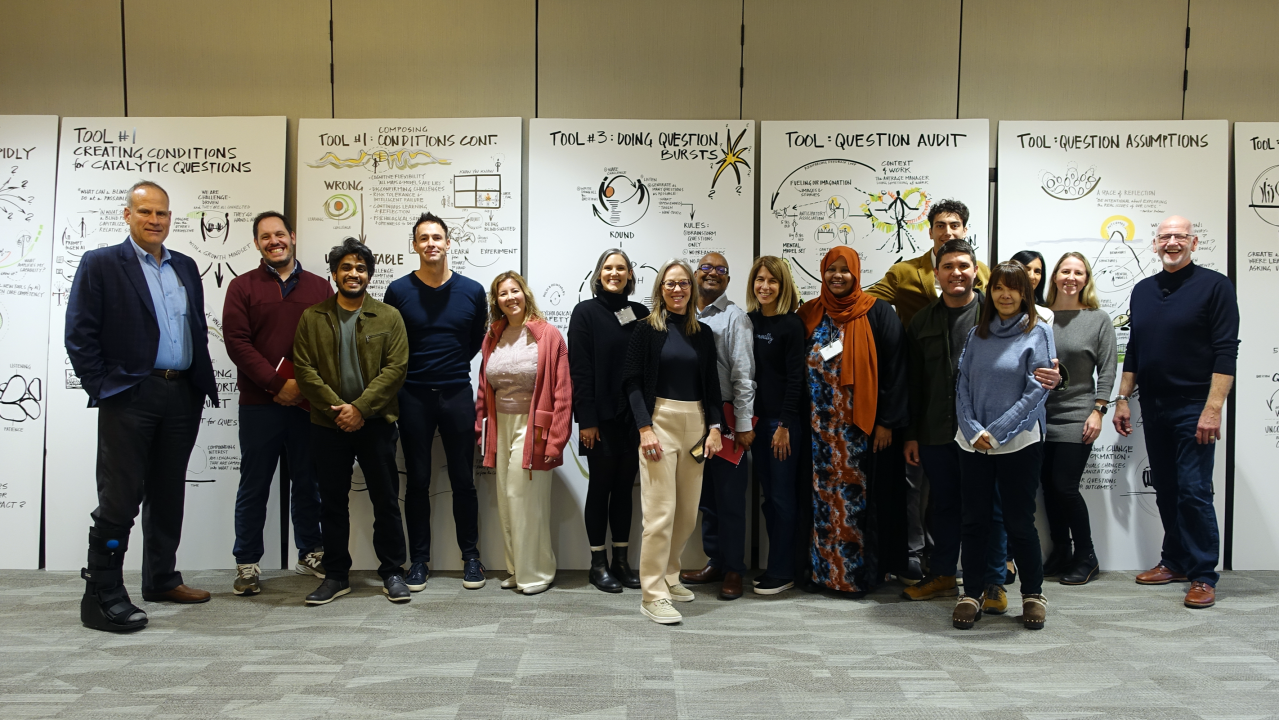 (Group Photo from MIT's Questions Are the Answer)
The Leader’s Role: Asking with Purpose
Great leaders do not just provide answers, they ask catalytic questions that build trust and uncover what matters most. One example that Hal shared with the from the class: Nicky Sparshott, former CEO of Unilever NZ/Australia, began her role by asking her team not just about business goals, but about their personal stories and motivations. This approach fostered connection and clarity before diving into strategy.
Transparency, clarity, and a growth mindset are essential. Progress, however small, is a key ingredient for a good day at work. When we are on the edge of uncertainty, questions help us move forward.
Changing Your Questions, Changing Your Outcomes
A recurring theme: “If we change our questions, we change our outcomes.” Every day, ask yourself: “Why are we even doing this?” Composing the right conditions and waiting for catalytic questions can lead to breakthrough insights. To drive this point Hal shared used a photography metaphor – explaining and showing situations where he saw all the conditions for a great shot and then waited for “something interesting to happen. He then gave us all a homework assignment to try it out for ourselves – as a way of building this muscle to “Compose and wait.”
Below was my favorite (captured by a classmate on his ride home on the T)

The Question Burst Exercise
One of the most practical tools we learned was the “Question Burst.” It went a little like this:
Hal divided the class into groups of two and asked us to complete the following steps:
- Share a challenge with a trusted partner.
- Generate as many short, open-ended, tough (but non-toxic) questions as possible. Resist the urge to answer the questions... the point is to generate questions and write them down verbatim.
- Engage with a custom agent in ChatGPT to expand the list. (We were encouraged to ask ChatGPT to take on personas of our choosing (I had ChatGPT take on the voice Steve Jobs, Oprah Winfrey, and Satya Nadella – one at a time)
- Organize questions into categories and select one to explore deeply.
This exercise increased the pace, variety, and uniqueness of our questions, helping us see challenges from multiple angles and reinforcing the importance of perspective-taking.
Leveraging AI and Diverse Perspectives
The Question Burst activity encouraged us to use AI as a sparring partner—to spot blind spots, categorize questions, and reveal patterns we might miss. This exercise reinforced the power of “human + AI” that our pre-read for the class explained “AI can take really obscure variables and make connections. When these hidden connections come together, it causes you to reframe your question and deliver disruptive innovation.” In other words, AI’s novel connections can spark your novel question, which in turn can lead you to investigate solutions others have not dreamed of yet.”
This exercise stressed the importance of perspective-taking as we ideate and solve business challenges. As we asked ChatGPT to take on different personas, it helped us see the challenge from both familiar and unfamiliar viewpoints. This broadened our lens and helped us see the situation from new angles.
Embracing Discomfort and Curiosity
The class also illustrated the point that growth happens outside our comfort zones, so that we can:
- Welcome tough feedback and act on surprises.
- Embrace uncertainty, even when answers are not clear.
- Reflect on “intelligent failures” as valuable learning opportunities.
Strategic Listening and Self-Reflection
This is the second class that I have taken at MIT that stressed the need to set aside quiet time for deep, strategic thinking. We often overschedule ourselves – not creating enough space to stop and sit with the bigger challenges we are trying to solve.
And if you are feeling “stuck” a great question to ask others, “If you were in my role, what would you do differently?”—then listen.
We also discussed the importance of self-awareness. Hal challenged us to track our question-to-answer ratio in interactions with managers, peers, direct reports, clients, and family. We should be observing the amount of space we are creating for others to ask questions – and adjusting as needed.
And when you do create that “quiet” - Pay attention to the questions others ask; they often reveal new approaches or missing perspectives.
How our life story impacts our approach to discovery
The class highlighted how family and educational experiences—like daily reflection on mistakes or group questioning—can build or constrain a lifelong “questioning muscle.”
Hal shared examples of leaders whose upbringing shaped their approach – but his story of Sarah Blakely (founder of Spanx) stayed with me. Sarah’s parents made a habit of asking daily “What mistakes did you make today?” This line of questioning was not from a place of shame or negativity – instead, it was building the foundations for a growth mindset – Embracing failure as an opportunity to learn.
Inspirational Quotes
Throughout the class Hal shared thoughtful quotes including:
- “In the word question, there is a beautiful word – quest.” ~Elie Wiesel
- “Getting the right question is key to getting the right answer.” ~Jeff Bezos
- “If we change our questions, we change our outcomes.”
- “Be intentional about exploring the real issues of our lives.” ~Parker Palmer
Final Thoughts: Your Invitation to Explore
This class was a powerful reminder that inquiry is not just a skill, it is a mindset. By asking better questions, embracing discomfort, and leveraging diverse perspectives (including AI), we can unlock new possibilities for ourselves and our organizations.
I have compiled a few links below to help you explore and learn more:
AI can help you ask better questions – and solve bigger problems (Gifted link to HBR article)
Questions are the Answer: A Breakthrough approach to Solving your Most Vexing Problems at Work and in Life – a book by Hal Gregersen
Questions Are the Answer – Register now to secure your seat. Let’s keep asking, keep learning, and keep growing.