



Courses for Individuals
MIT Sloan Executive Education courses provide hands-on learning experiences, faculty research, and proven frameworks that have immediate applicability to careers and organizations.


Hands-on, highly engaging courses on campus
Live OnlineReal-time, interactive courses delivered on Zoom
Self-Paced OnlineAsynchronous, collaborative learning within set dates
On-Demand OnlineLearning that fits your schedule—start at any time
Executive AcademiesTwo-week, intensive on-campus courses
HybridA mix of learning formats
Hands-on, highly engaging courses on campus
Live OnlineReal-time, interactive courses delivered on Zoom
Self-Paced OnlineAsynchronous, collaborative learning within set dates
On-Demand OnlineLearning that fits your schedule—start at any time
Executive AcademiesTwo-week, intensive on-campus courses
HybridA mix of learning formats


Artificial Intelligence is such a large topic these days, and there are many professors who teach aspects of it within both Open Enrollment and Custom programs. In this strip of hieroglyphs, the plane is part of a diagram on model-driven machine learning. The lounging figure with a book over its face is how Antonio Torralba conveys that, like a lazy intern, “AI will solve the problem with as little effort as possible”. The drawing with the person at the center highlights the necessary feedback loops between humans and machines to build systems that are more flexible and useful. The drawing on the far right shows how current models hallucinate facts, requiring users to discern real information from imagined content.

A section of the hieroglyph.
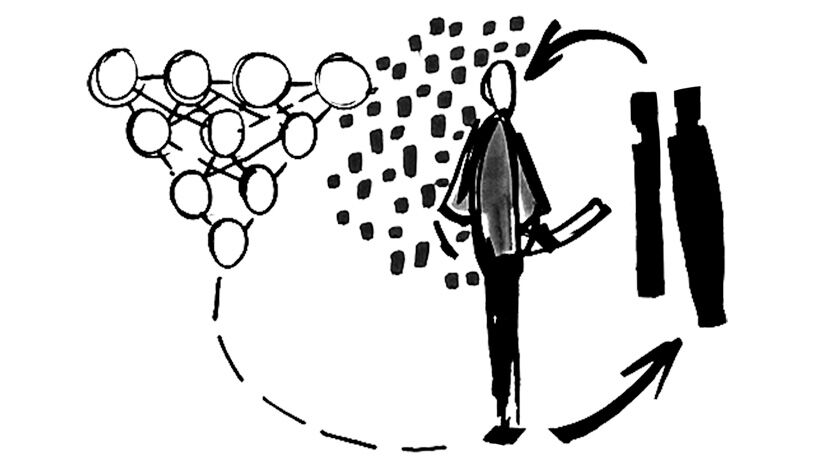
Enlarged portion of a the Human-Machine feedback loop.
The custom program that included a session on AI also featured Digital Solutions, Quantum Computing, Innovation in Business Process and Customer Experience, Competing in the Marketplace of Time, and Cybersecurity. Due to extensive use of the dry-erase walls for real-time teamwork, the scribing was done on large 4x8’ sustainable boards that moved around the space for display and provided a physical artifact the client ended up shipping back to headquarters!
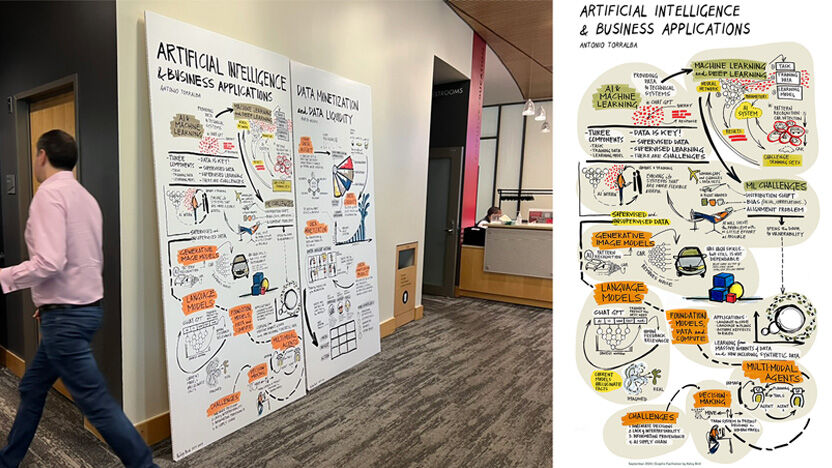
"AI & Business Applications" - Scribing created by Kelvy Bird
Scribing—visually representing ideas while people talk—is a distinct social art form that facilitates group learning and cultural memory. Scribed images enhance the learning experience by mapping ideas as they emerge, aiding both decision-making and information retention. Scribes listen on multiple levels—factually, with empathy, and for emerging possibility—to simplify complex concepts and make them accessible. By providing a visual representation of the program's content, participants can revisit and reflect on key insights, ensuring that knowledge gained becomes both memorable and actionable.
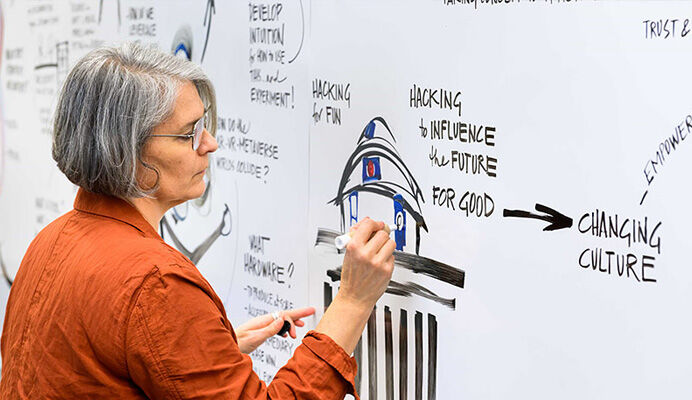
Kelvy Bird scribing in the classroom
At MIT, scribing takes on additional depth through the deliberate integration of systems thinking and conceptual frameworks. Scribed drawings function as layered narratives, representing both specific stories and examples while simultaneously mapping interconnected ideas across domains. In the physical classrooms and in online digital experiences, participants can scan the visuals to discern key themes from faculty presentations alongside the related threads through an entire program. This transforms scribing from simple recording into a tool for systemic understanding and collective sense-making.
The sequence of hieroglyphs that are on display around the E66 Suite each represent a theme within Custom and Open Enrollment Program designs. While just a sampling of the overall range of topics, the images on display represent:
We encourage you to find the other themes throughout the space.


Featured Courses
Expand your capabilities with MIT Sloan Executive Education courses. Learn breakthrough strategies, sharpen your decision-making, and apply cutting-edge research to solve your organization's toughest challenges.